|

Kamala Harris vs Donald Trump: betting odds put Trump ahead

United States citizens are deciding who will rule the destiny of the world’s largest economy today. Either Vice President Kamala Harris or former President Donald Trump will become the 47th President of the United States.

Over the weekend, one of the major betting platforms, PredictIt, showed that Harris became the slight favorite to win the US presidential election, surpassing Trump for the first time since early October. This lead, however, remained short-lived as Trump moved to the top again on the platform, albeit with a small margin.

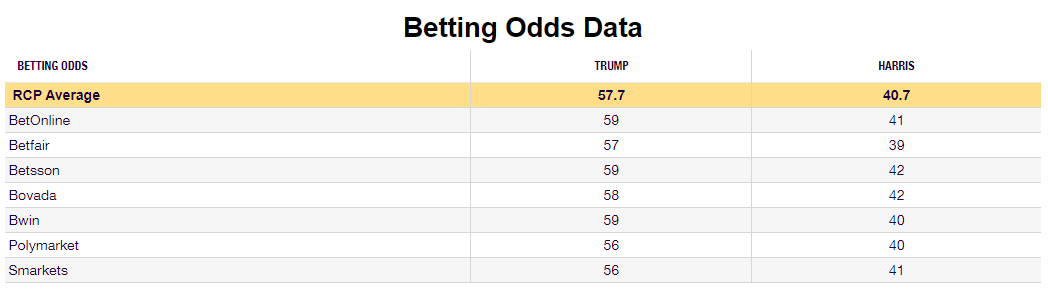
Although US presidential election betting odds should not be taken as a representative view of US voters, they might still trigger a reaction in financial markets. Unlike PredictIt, RealCelarPolling's average for betting odds currently has Trump with at a comfortable lead against Harris, 57.7 vs 40.7.

According to Reuters, betting site PredictIT showed Harris at 54 to Trump on 53, compared to 42 to 61 just a week ago.
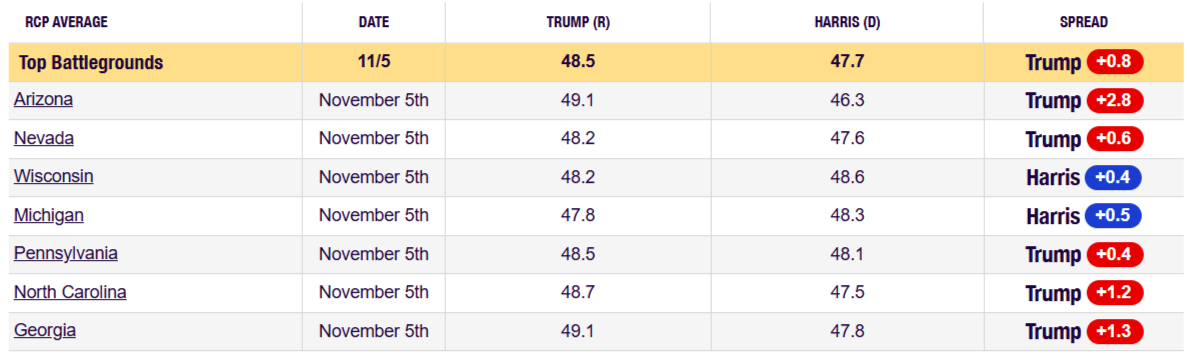
Nevertheless, polls show the race remains tight. Neither Harris nor Trump has a clear lead, with polls showing a modest 1 to 2-point lead favoring one or other candidate.  The election will likely be defined by the so-called seven swing states, that is, states without a clear winner at sight, as opposed to most US states, which clearly lean towards either Republicans or Democrats

“Polls will start closing at 19:00 EST or 00:00 GMT, and the excitement on exit polls will likely move markets, although the final result could take a couple of days. The focus will be on the key seven swing states, with Georgia, North Carolina and Pennsylvania among the first to report,” notes Valeria Bednarik, FXStreet.com Chief Analyst.

Follow our live coverage of the market reaction to the US presidential election as counting results start hitting the wires.

Top Battlegrounds: Trump vs. Harris

According to www.realclearpolling.com

Author

More from FXStreet Team
Share:

Markets move fast. We move first.

Orange Juice Newsletter brings you expert driven insights - not headlines. Every day on your inbox.

By subscribing you agree to our Terms and conditions.

Editor's Picks

EUR/USD eases to near 1.1650, eyes US PCE for fresh impetus

EUR/USD turns south to test 1.1650 in European trading on Friday, facing rejection once again near seven-week highs. The pair, however, continues to draw support from persistent US Dollar selling bias, despite a cautious market mood. Traders now await the US September PCE inflation and UoM Consumer Sentiment data. 

GBP/USD holds gains near 1.3350 ahead of US data

GBP/USD sticks to a positive bias near 1.3350 in the European session on Friday. Traders prefer to wait on the sidelines ahead of the key US inflation and sentiment data due later in the day. In the meantime, broad-based US Dollar weakness helps the pair stay afloat. 

Gold remains below $4,250 barrier as traders await US PCE data for directional impetus

Gold gains some positive traction on Friday, though it remains confined in the weekly range. Dovish Fed expectations continue to undermine the USD and lend support to the commodity. Bulls, however, might opt to wait for the US PCE Price Index before placing aggressive bets.

UoM Consumer Sentiment Index expected to post a mild recovery in December

December’s preliminary Michigan Consumer Sentiment Index is forecast to have picked up to 52 from a three-year low of 51.0 in November. A stalled labour market and higher price pressures are likely to weigh on consumers’ confidence.

Canada Unemployment Rate expected to edge higher in November ahead of BoC rate decision

Statistics Canada will release its Labour Force Survey on Friday, and markets are bracing for a weak print. The Unemployment Rate is expected to tick higher to 7% in November, while the Employment Change is forecast to come in flat after a nice gain in October.

Pi Network Price Forecast: Bearish streak nears critical support trendline

Pi Network (PI) edges lower on Friday for the third consecutive day, approaching a local support trendline. The on-chain data suggests an increase in supply pressure as Centralized Exchanges (CEXs) experience a surge in inflows.