Dow Jones Industrial Average reclaims 400 points in election day runup
- The Dow Jones pushed back into the high end of near-term consolidation on Tuesday.
- Equity markets are bracing for the results of the US election showdown that kicks off this week.
- Indexes have been rangebound heading into the election window.

The Dow Jones Industrial Average (DJIA) gained ground on Tuesday, climbing around 400 points to add nearly a full percent to its top-line. The major equity index is bumping into the ceiling of a near-term consolidation range as investors brace for the outcome of the US election as US voters head to the polls.
Another Federal Reserve (Fed) rate call looms ahead this week. Fed Chair Jerome Powell is widely expected to deliver another quarter-point cut to interest rates on Thursday, bringing the Fed Funds Rate down 25 bps to 4.75%. The Fed Funds Rate peaked at 5.5% in July of 2023, and investors have been clamoring for a return to a low interest rate environment that has become familiar territory since US interest rates clattered to an all-time low near 0% in early 2009.
US election odds have both candidates neck-and-neck in a dead-heat race for the Presidency, with former President Donald Trump and current Vice President Kamala Harris polling within 5% of each other, depending on which poll results you reference. Equity investors, tech sector addicts specifically, appear to broadly believe former President Trump to be the preferred stock-friendly candidate, an odd choice considering the Republican candidate has strongly voiced support of a return to the Smoot-Hawley tariff era of US history. Trump has regularly suggested stiff tariffs across the board on all imported goods into the US, an incredibly inflationary economic policy proposal.
The University of Michigan’s (UoM) Consumer Sentiment Index is waiting in the wings and slated for release on Friday. Investors expect November’s UoM sentiment indicator to climb to a six-month high of 71.0 from the previous month’s 70.5.
Dow Jones news
Most of the Dow Jones equity board is firmly in the green on Tuesday, with less than ten of the index’s listed securities down by half of a percent or more. Losses are being led by Boeing (BA), which backslid nine-tenths of a percent and falling below $154 per share. Boeing briefly rallied early Tuesday after announcing that the aerospace company finally negotiated an end to their workers’ strike, but markets remain concerned about the airplane manufacturers profitability looking forward and sent the ticker back into the low end.
Intel (INTC) rose over 4% on Tuesday, climbing into $23.50 per share despite an announcement that the Dow Jones Industrial Average would be dropping the chipmaker in favor of long-running AI rally darling Nvidia. Nvidia will be included in the Dow Jones equity roll beginning on Friday, November 8.
Dow Jones price forecast
The Dow Jones has seen some near-term chop as the major index grinds out chart paper around the 42,000 major handle. Price action has been pinned to the 50-day Exponential Moving Average (EMA) since dipping into its current range at the end of October.
Despite recent consolidation, the Dow Jones remains pinned deep into bull country. The index has outpaced its 200-day EMA for over a year straight and has closed higher for all but two of the last 11 straight calendar months.
Dow Jones daily chart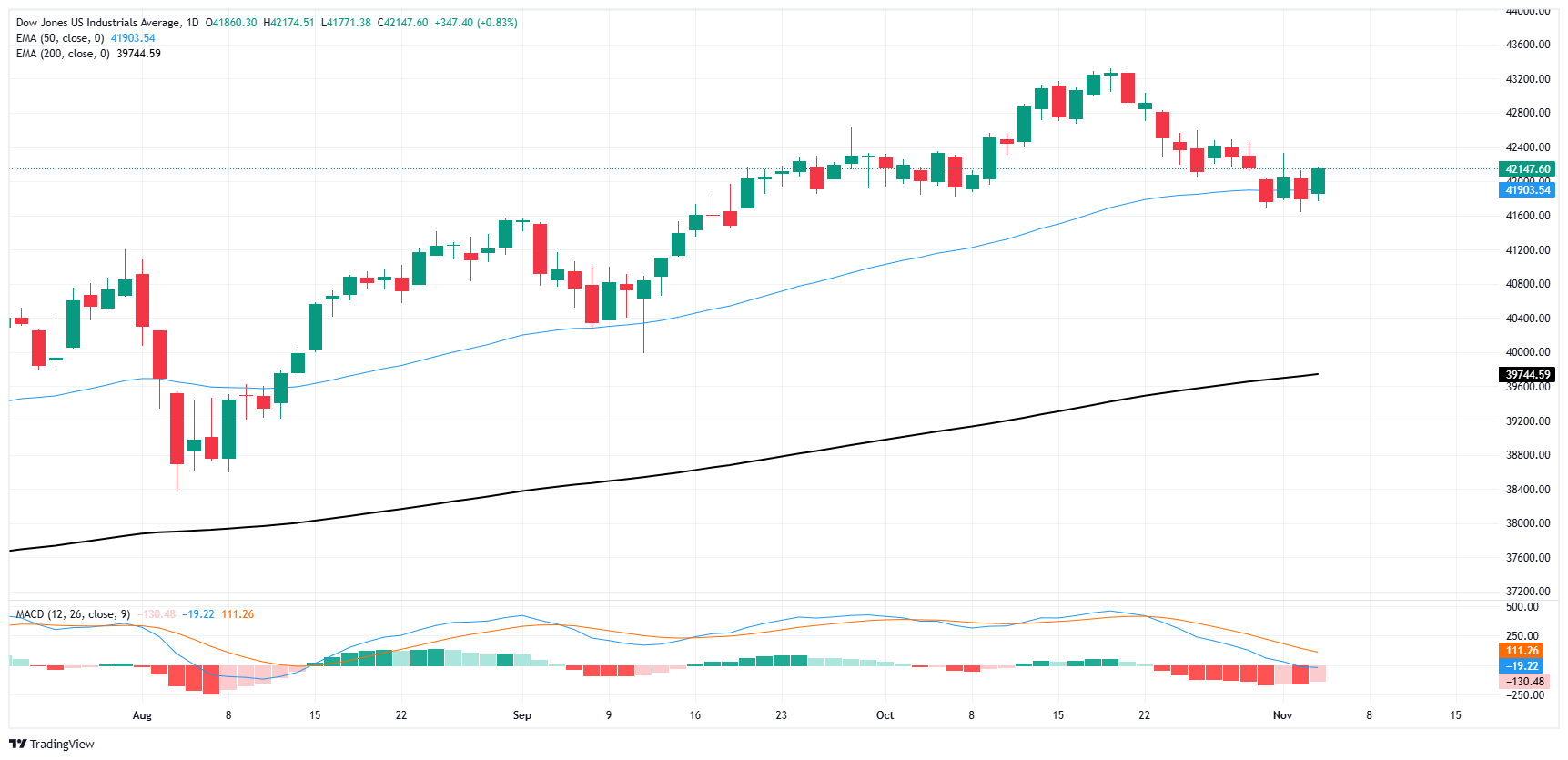
Nvidia FAQs
Nvidia is the leading fabless designer of graphics processing units or GPUs. These sophisticated devices allow computers to better process graphics for display interfaces by accelerating computer memory and RAM. This is especially true in the world of video games, where Nvidia graphics cards became a mainstay of the industry. Additionally, Nvidia is well-known as the creator of its CUDA API that allows developers to create software for a number of industries using its parallel computing platform. Nvidia chips are leading products in the data center, supercomputing and artificial intelligence industries. The company is also viewed as one of the inventors of the system-on-a-chip design.
Current CEO Jensen Huang founded Nvidia with Chris Malachowsky and Curtis Priem in 1993. All three founders were semiconductor engineers, who had previously worked at AMD, Sun Microsystems, IBM and Hewlett-Packard. The team set out to build more proficient GPUs than currently existed in the market and largely succeeded by late 1990s. The company was founded with $40,000 but secured $20 million in funding from Sequoia Capital venture fund early on. Nvidia went public in 1999 under the ticker NVDA. Nvidia became a leading designer of chips to the data center, PC, automotive and mobile markets through its close relationship with Taiwan Semiconductor.
In 2022, Nvidia released its ninth-generation data center GPU called the H100. This GPU is specifically designed with the needs of artificial intelligence applications in mind. For instance, OpenAI’s ChatGPT and GPT-4 large language models (LLMs) rely on the H100’s high efficiency in parallel processing to execute a high number of commands quickly. The chip is said to speed up networks by six times Nvidia’s previous A100 chip and is based on the new Hopper architecture. The H100 chip contains 80 billion transistors. Nvidia’s market cap reached $1 trillion in May 2023 largely on the promise of its H100 chip becoming the “picks and shovels” of the coming AI revolution. In June 2024, Nvidia's market capitalization crossed the $3 trillion mark.
Long-time CEO Jense Huang has a cult following in Silicon Valley and on Wall Street due to his strict loyalty and determination to build Nvidia into one of the world’s leading companies. Nvidia neary fell apart on several occasions, but each time Huang bet everything on a new technology that turned out to be the ticket to the company’s success. Huang is seen as a visionary in Silicon Valley, and his company is at the forefront of most major breakthroughs in computer processing. Huang is known for his enthusiastic keynote addresses at annual Nvidia GTC conferences, as well as his love of black leather jackets and Denny’s, the fast food chain where the company was founded.
Author

Joshua Gibson
FXStreet
Joshua joins the FXStreet team as an Economics and Finance double major from Vancouver Island University with twelve years' experience as an independent trader focusing on technical analysis.

















