GBP/USD Forecast: Sterling set to suffer after deadlocked dinner, ahead of Brexit deadline
- GBP/USD is on the back foot after the Brussels' Brexit dinner failed to yield a breakthrough.
- Ongoing talks, now set to extend through Sunday overshadow US fiscal stimulus and virus developments.
- Thursday's four-hour chart is showing bears are gaining ground.

"Deadlock at dinner" screams Thursday's headline of the Daily Mail, summarizing Wednesday's long meeting between UK Prime Minister Boris Johnson and European Commission President Ursula von der Leyen.
The two leaders and their negotiating teams failed to reach a much desired Brexit breakthrough over a three-course dinner which included fish – one of the three topics of contention. Another one is governance and the third is a level-playing-field, which German Chancellor Angela Merkel highlighted earlier in the day. After concluding that they remain "far apart", the EU and the UK agreed to extend talks until the end of the weekend.
What does this summit mean for sterling? Failing to reach a deal three weeks before the transition expires is an adverse development for the pound. Contingency plans for a no-deal exit are likely to grab the headlines, further weighing on sentiment.
While the weekend deadline may not be the final one – many dates have come and gone – the fact that investors will be unable to react to a Sunday statement may cause some to take bets off the table. Fear of another deadlock could prompt a run against the pound.
As talks continue in Brussels, fresh headlines will likely move sterling, even if significant news is unlikely on Thursday. EU leaders convene for a two-day-summit, but they seem determined to keep Brexit at the margins of their debate, which focuses on approving the budget.
Those impatient to hear from the talks will likely react to another set of negotiations – US fiscal stimulus talks. Republicans and Democrats seem to coalesce around the framework – $900 billion – but not about the details. Nevertheless, there seems to be more optimism in Washington than in Brussels.
The US Food and Drugs Administration is on course to greenlight the Pfizer/BioNTech vaccine for use on Thursday, following the UK, which is already administering the shots. An FDA approval, even if expected, may give a shot in the arm to markets after Wednesday's down day.
US Consumer Price Index is forecast to show a minor increase in November, while jobless claims for the week ending December 4 are estimated to edge higher after dropping beforehand. The pace of America's recovery has slowed amid the winter coronavirus – the daily death toll surpassed 3,000 for the first time on Wednesday.
See
- US Initial Jobless Claims: Less indicative than emotional
- US CPI November Preview: A long time ago in an economy far far away
UK Gross Domestic Product rose by 0.4% in October, within expectations while Manufacturing Production jumped by 1.7%, beating estimates. The economy likely struggled in November amid the nationwide lockdown.
Overall, Brexit talks continue dominating pound/dollar trading, with more chances of further downside after the recent deadlock at dinner.
GBP/USD Technical Analysis
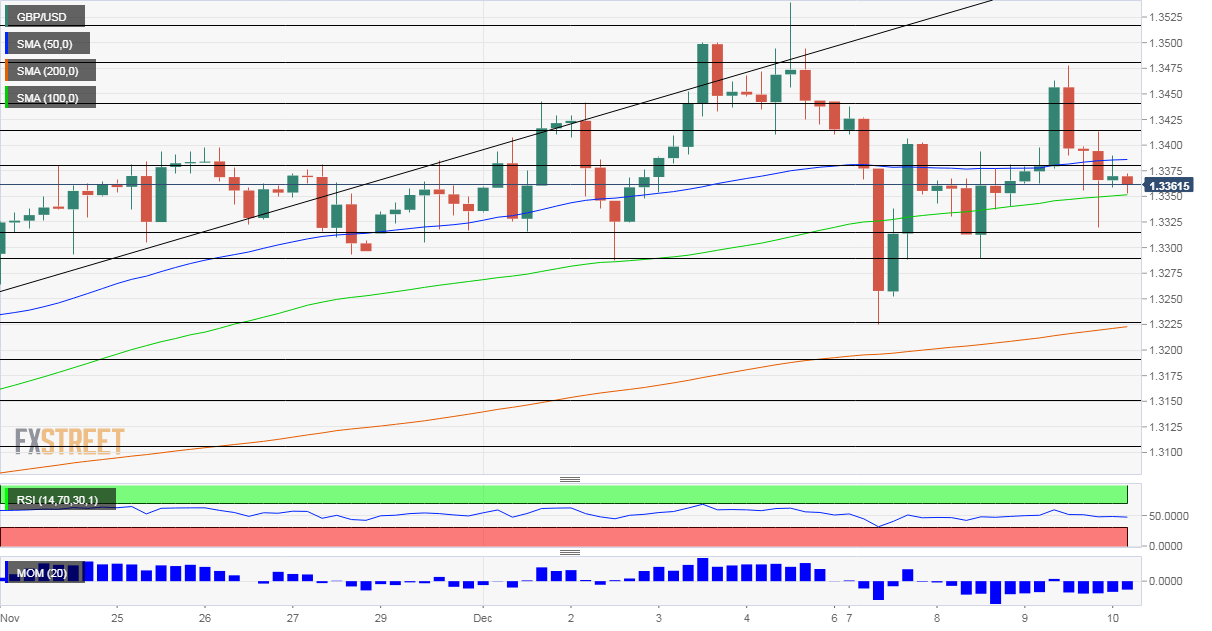
Cable has recaptured the 100 Simple Moving Average on the four-hour chart but trades under the 50 SMA. Momentum is to the downside while the Relative Strength Index is stable. All in all, bears are gaining ground but are not in full control.
Some support awaits at 1.3320, which was a swing low on Wednesday. It is followed by 1.3290, a stepping stone on the way up earlier in the week, and then by 1.3225, the weekly low.
Some resistance is at 1.3385, where the 50 SMA hits the price, followed by 1.3410, the daily high. Further above, 1.3445 and 1.3480 await GBP/USD.
Author

Yohay Elam
FXStreet
Yohay is in Forex since 2008 when he founded Forex Crunch, a blog crafted in his free time that turned into a fully-fledged currency website later sold to Finixio.
















