Fed likely to hold rates steady and warn of the risk of delay to cuts

Elevated inflation and strong activity and jobs numbers have pushed market expectations for the timing of the first interest rate cut to December. We still see an opportunity for a September rate cut. Nonetheless, the Federal Reserve will remain wary and signal that if inflation stays high, so will interest rates.
Robust data forces the Fed to sound less dovish
At the March FOMC meeting, the Fed stuck with the view that the most likely path forward involved three 25bp interest rate cuts in 2024 with a further three in 2025. While they won’t be updating these forecasts again until June, the fact that inflation continues to run too hot for comfort and that the economy is still growing strongly suggests a more cautious take on prospects for policy easing at next Wednesday’s FOMC press conference.
Core CPI has come in at 0.4% month-on-month for three consecutive months, more than double the rate we need to see to bring inflation down to 2% year-on-year over time. Meanwhile, the consumer continues to spend aggressively and the economy added 829,000 jobs in the first three months of the year. This led Fed Chair Jerome Powell to state on 16 April that “recent data have clearly not given us greater confidence” that inflation is coming under control and “instead indicate that it’s likely to take longer than expected to achieve that confidence.” He additionally warned that “if higher inflation does persist we can maintain the current level of restriction for as long as needed.”
Fed funds ceiling rate with time period between last rate hike and first rate cut (%)
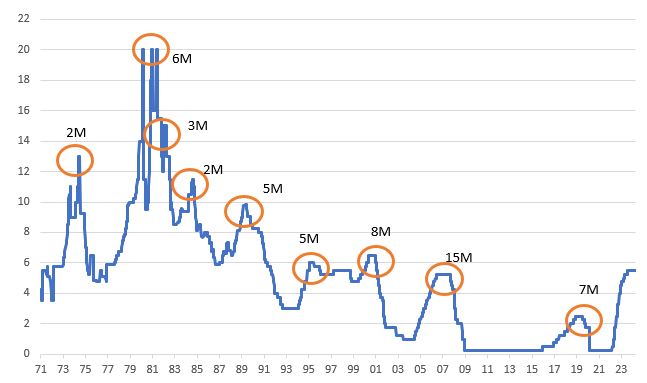
Source: Macrobond, ING
Surveys still suggest a case can be made for a September rate cut
Consequently, markets are now pricing next to no chance of any action on 1 May with only 3bp of cuts priced by June, 20bp by September and 36bp by December. This is a remarkable swing given it was only three months ago that the market was fully discounting 150bp of rate cuts this year starting at the March FOMC meeting.
We are forecasting the first move coming at the September FOMC meeting with two further cuts in November and December. Business surveys suggest more and more caution on the outlook for the economy with employment components pointing to a pronounced slowing in hiring in coming months. We also expect inflation to gradually converge on 2% as cooler economic activity and subdued labour cost growth help dampen price pressures, which in turn is compounded by softening pricing power. Nonetheless, there is little sign of this happening just yet and the risk remains that the Fed ends up bringing interest rates to a more neutral level more slowly and over a longer period than we are currently forecasting.
Treasuries remain under pressure on soft policy versus the implied inflation threat
With the Federal Reserve a tad slavish to inflation data, the focal point of the curve is the 10-year rather than a stable funds-rate-bullied front end. That makes the curve quite directional, meaning that the shape of the curve is coming from longer tenors. Without a new impulse from the Fed, and with inflation continuing to tick firmer than comfortable, the 10-year Treasury yield is liable to continue to trek towards the 5% area, steepening the curve from the back end. That said, should the Fed surprise us and get ahead of this with some hawkish commentary, and even go as far as threatening a hike, then we could see the 10-year yield come off its highs on the theory of more Fed inflation protection.
The FOMC will likely continue its discussion on balance sheet roll-off, too. Policymakers have already intimated an intention to cut the pace of roll-off in half, with particular reference to the pace of the Treasury bond roll-off. The Mortgage-Backed Security roll-off remains behind schedule in any case, on account of a lower pre-payments profile. In fact, the slower MBS roll-off results in the aggregate roll-off pace being around $75bn per month, rather than the $95bn per month originally planned. Meanwhile, liquidity conditions remain ample, with bank reserves still elevated in the US$3.3tn area, and cash going back to the Fed on the reverse repo facility still in the US$440bn area. We think there is a comfortable US$0.75tn liquidity excess in those numbers.
Data, not the Fed, in the driving seat for FX
The dollar has ended the day lower on the last three consecutive Fed meetings. In effect, the market had bought into the Fed’s communication from those meetings that the disinflation trend was visible and the Fed wanted to cut. However, the dollar has rallied 2%+ since the Fed’s last meeting in March - confirming data supremacy in FX market pricing. And with both activity and price data heading in the wrong direction for the Fed over the last six weeks, it is hard to see Chair Jerome Powell on 1 May offering much resistance to a market that is minded to buy dollars.
If the dollar is to go lower later this year, it will then have to be the data which drives it. We have recently seen the dollar selling off on the soft April US PMIs and we think there would be a good reaction lower should real sector activity finally slow or some new, reassuring signs of disinflation trends emerge. Until then, wide rate differentials, geopolitical risk and the uncertainty around the US November presidential election suggest the dollar can hold recent gains.
Read the original analysis: Fed likely to hold rates steady and warn of the risk of delay to cuts
Author

ING Global Economics Team
ING Economic and Financial Analysis
From Trump to trade, FX to Brexit, ING’s global economists have it covered. Go to ING.com/THINK to stay a step ahead.

















