GBP/USD Analysis: Break below 200-DMA paves the way for further near-term weakness
- The sterling got a lift on Tuesday after BoE Governor downplayed speculations of negative rates.
- Persistent Brexit uncertainties and new restrictions in the UK kept a lid on any meaningful gains.
- concerns about rising COVID-19 cases benefitted the safe-haven USD and exerted some pressure.


The GBP/USD pair had some good two-way price moves on Tuesday and was influenced by a combination of diverging forces. Following an early slide to the 1.2700 neighbourhood, the pair caught some intraday traction and rallied over 150 pips after the BoE Governor Andrew Bailey downplayed expectations that the central bank could soon cut interest rates below zero. At an online talk hosted by the British Chambers of Commerce, Bailey said that the mention of negative rates doesn't imply anything about the possibility of using it. He also noted that the experience of negative rates elsewhere was mixed, and the effectiveness depends on the structure of the banking system and the timing of the move.
The British pound got an additional from positive Brexit-related headlines. EU source reportedly said that Brexit talks have been going a bit better than expected and that there is a 'window of opportunity'. The UK PM spokesman confirmed the EU Chief Brexit Negotiator Michel Barnier's visit tomorrow for informal talks. The spokesman further stressed that the UK will continue to work hard on securing a Brexit deal. The optimism turned out to be short-lived after Ireland's foreign minister, Simon Coveney was noted saying that there is a growing sense that perhaps Britain doesn't want a Brexit deal and the UK government tactic is making complex talks even more difficult.
In the latest developments surrounding the coronavirus saga, the UK Prime Minister Boris Johnson announced a slew of coronavirus restrictions for England. These new measures to contain a fresh spike in the number of COVID-19 infections may last for six months. Adding to this, Johnson warned to introduce greater restrictions if there is no improvement in the pandemic situation. This, in turn, took its toll on the British pound. This coupled with a strong pickup in demand for the US dollar prompted some fresh selling at higher levels. The pair finally settled near the lower end of its daily trading range and extended the slide during the Asian session on Wednesday.
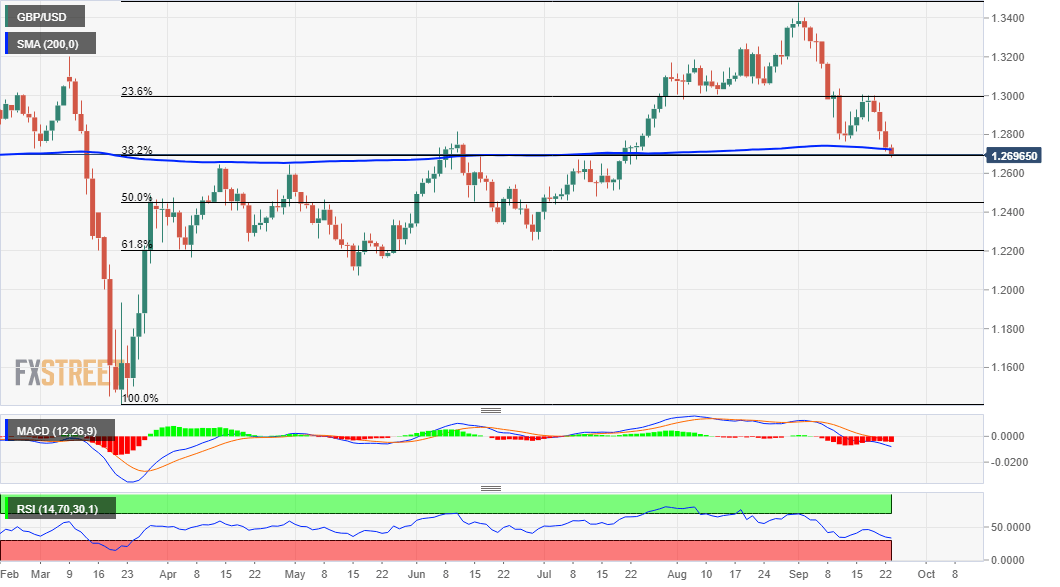
The greenback remained well supported by growing market concerns that the second wave of coronavirus infections could hinder the current economic recovery. The USD uptick got an additional boost after Chicago Fed President Charles Evans struck a hawkish tone on Tuesday and said that further quantitative easing may not provide additional lift to the US economy. Evans further added that it is possible for the Fed to raise interest rates before inflation starts to average 2%. The bid tone surrounding the buck pushed the pair below the very important 200-day SMA, or two-month lows during the Asian session on Wednesday.
In the absence of any major market-moving economic releases from the UK, the incoming Brexit-related headlines will play a key role in driving the British pound. Later during the early North American session, traders will take cues from the release of the flash version of the US PMI prints for September. Apart from this, the Fed Chair Jerome Powell's second day of the congressional testimony will influence the USD price dynamics and the broader market risk sentiment will influence the USD price dynamics, which, in turn, might further contribute to produce some meaningful trading opportunities.
Short-term technical outlook
From a technical perspective, the pair was last seen hovering near the 38.2% Fibonacci level of the 1.1412-1.3482 positive move. Some follow-through selling will confirm a near-term bearish breakdown and accelerate the slide further towards the 1.2625-20 horizontal support. Subsequent weakness below the 1.2600 mark will set the stage for a fall towards mid-1.2500s en-route the key 1.2500 psychological mark and 50% Fibo. level support near the 1.2445 region.
On the flip side, any attempted recovery back above the 1.2700 mark now seems to confront a stiff resistance and remain capped near the previous multi-week swing lows, around the 1.2760-65 region. That said, some follow-through strength might prompt some short-covering move and lift the pair back above the 1.2800 mark. This is followed by resistance near the overnight swing high, around the 1.2865 region, which if cleared might negate any near-term bearish bias. The pair might then aim back towards conquering the key 1.3000 psychological mark in the near-term.
Premium
You have reached your limit of 3 free articles for this month.
Start your subscription and get access to all our original articles.
Author
Haresh Menghani
FXStreet
Haresh Menghani is a detail-oriented professional with 10+ years of extensive experience in analysing the global financial markets.