Dow sinks 3% as market slides on triple witching day after steep Thursday run-up
- Dow is one of the worst-performing Dow Jones stocks on Friday.
- The market is somewhat volatile on the year's third triple witching day.
- Large volumes of stocks are traded on triple witching days when options expire.
- Dow receives $100 million from the Department of Energy to build chemical plant for batteries.

Dow (DOW), the holding company of Dow Chemical Company, was one of the worst-performing stocks in the Dow Jones Industrial Average (DJIA) on Friday. Shares sank 3% in the morning session before attempting a weak recovery by lunchtime.
The DJIA is the only major index making gains, but it is up just 0.1% at the time of writing. The S&P 500 and NASDAQ are both slightly lower. This follows Thursday's new all-time high for the Dow Jones.
Friday happens to be a triple witching day, the third of the year, which usually involves plenty of volatility. This happens when three sets of derivatives all expire on the same day. In this case, the expiration of $5.1 trillion in stock options, stock index futures and stock options tied to stock index futures will see many institutions rolling over their old options into new positions, which will involve heavy volumes of buying and selling.
Dow stock news
It’s too bad for Dow that it’s getting short shrift on triple witching day. The market is focused on another Dow Jones compatriot — Apple (AAPL). Since Berkshire Hathaway’s Warren Buffett has been selling large stakes in Apple over the past year, this allows the managers of the Dow index, as well as other indices, to give Apple a larger weighting.
Buffet’s Apple shares have been locked up since 2016, so they subtracted from the float available to index makers. Free in the larger market, Apple stock will now see lots of buying volume on Friday as index funds and others trying to mirror the major indices give it a heavier weighting in their portfolios.
For its own sake, news on the Dow front is actually quite good. The US Department of Energy approved $100 million for Dow as part of a $3 billion allotment for US battery production. The US government is vying with China for a larger share of the global battery market as it grows in prominence.
Dow is set to receive the funding in order to help it produce battery-grade carbonate solvents for lithium-ion battery electrolytes. Dow will build a new plant on the Gulf Coast in order to use waste carbon dioxide to fabricate the carbonate solvents that help to improve battery performance.
Dow’s grant was one of the larger grants in size but well below fellow Dow Jones constituent Honeywell’s (HON) $127 million to build a Louisiana plant that will refine an important electrolyte salt used in lithium batteries.
Dow stock forecast
Dow stock has been consolidating within a large rectangle pattern since at least October 2023. This rectangle has support at $48 and resistance at $60.
Dow stock is clearly in a downtrend as it trades beneath its 50-day Simple Moving Average (SMA). Additionally, the 50-day SMA trends below the 100-day SMA, which is likewise below the 200-day SMA. Overtaking the 50-day SMA at $52.73 is the first step toward getting back on its feet. But the $48 support level beckons and looks likely to be retested soon.
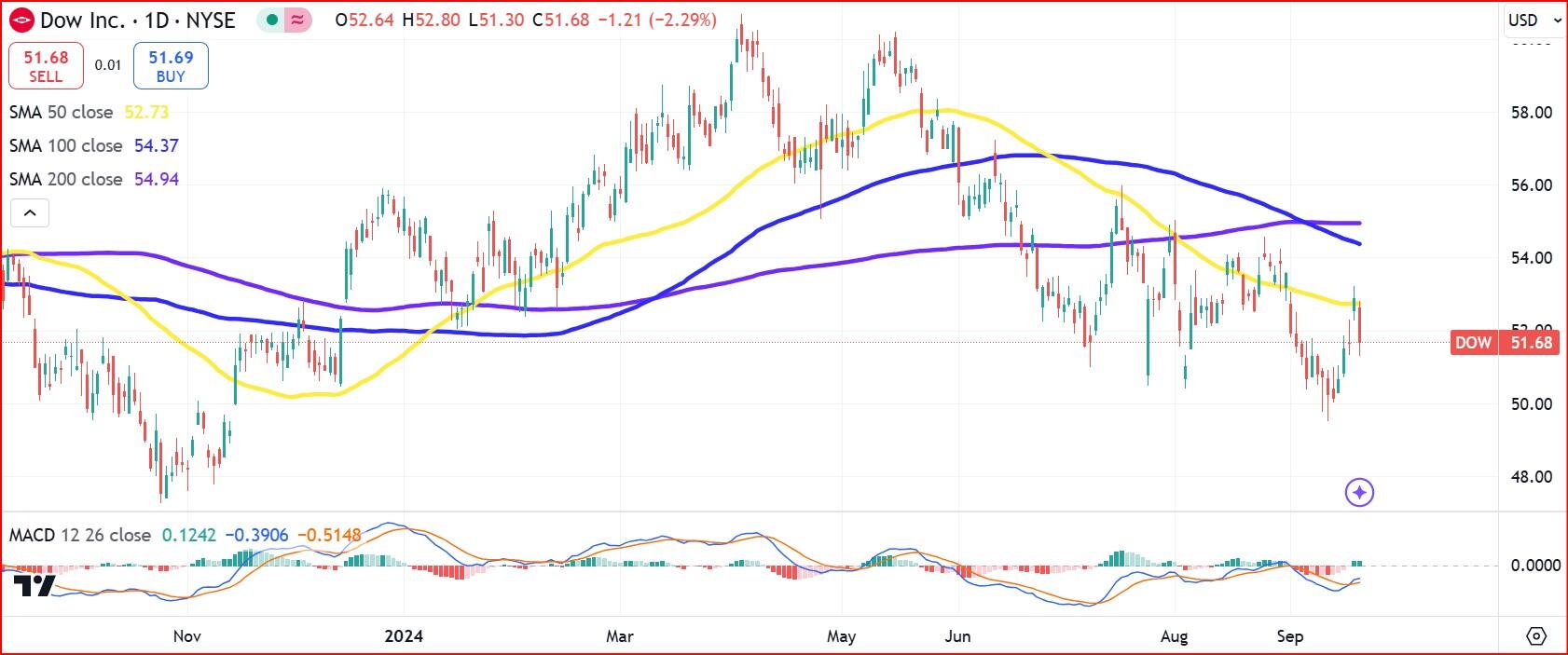
DOW daily stock chart
Author

Clay Webster
FXStreet
Clay Webster grew up in the US outside Buffalo, New York and Lancaster, Pennsylvania. He began investing after college following the 2008 financial crisis.

















