EUR/USD Weekly Forecast: ECB decision, United States inflation come up next
- Federal Reserve Chairman Jerome Powell maintains the door open for additional hikes.
- The European Central Bank will announce its monetary policy decision next week.
- EUR/USD consolidates below 1.0600 ahead of the next directional catalyst.

The EUR/USD pair recovered some ground this week, ending at around 1.0590. The US Dollar slid despite a risk-averse environment as geopolitical woes in the Middle East continued to escalate. The war between Israel and Palestinian Hamas has kept investors on their toes, with Iran getting more involved in the conflict. Iranian Foreign Minister Hossein Amirabdollahian called for an Oil embargo and other sanctions on Israel, pushing Crude Oil prices higher, which, in turn, fueled concerns about global stagflation. At the same time, the armed group Hezbollah attacked Israel from the north, while the latest appears to be preparing a ground operation on the Gaza Strip.
The situation capped the Euro as demand for high-yielding assets remained subdued. This week's winner was gold, with XAU/USD reaching a fresh three-month high of $1,985.86 a troy ounce.
Chairman Jerome Powell pours some cold water
The USD was also unable to take advantage of soaring government bond yields. Demand for bonds kept yields down throughout the first half of the week, but Treasury yields surged ahead of Federal Reserve (Fed) Chairman Jerome Powell’s appearance at the Economic Club of New York, reaching fresh multi-year highs. The 2-year note offered as much as 5.25%, while the 10-year note briefly stood above the 5% threshold. The rally in government bond yields could partially be explained by resurgent concerns about the United States (US) fiscal deficit and growing auction sizes to fund the country.
Higher yields tend to boost the Greenback. However, since the Fed noted that higher yields could offset the need for rate hikes to slow the economy, the USD's and yields' correlation has broken.
Powell discussed the economic outlook and repeated that inflation remains “too high,” highlighting that September figures were “less encouraging.” He noted that the effects of past interest-rate increases are arriving and need time to work. Finally, to cool down speculative interest, Powell said that “there may still be meaningful tightening in the pipeline.” Odds for additional rate hikes decreased with government bond yields retreating, but Wall Street also eased amid mixed earning reports.
Over the prior weekend, European Central Bank (ECB) President Christine Lagarde spoke at the International Monetary Fund (IMF) annual meetings in Marrakech, Morocco. Lagarde brought nothing new to the table, reiterating that underlying inflation in the eurozone is still strong while wage growth stands at “historical highs.”
European Central Bank decision, US inflation in the docket
Macroeconomic data over the week was generally encouraging. US Retail Sales rose by 0.7% in September, much better than the 0.3% expected. Across the pond, Germany released the October ZEW survey on Economic Sentiment, which improved in the country to -1.1 and to 2.3 for the Eurozone, beating expectations. Additionally, the assessment of the current situation resulted better than anticipated, printing at -79.9. The EU confirmed the September Harmonized Index of Consumer Prices (HICP) at 4.5% YoY in September, while the German Producer Price Index fell by 14.7% in the same period.
The upcoming week will be busier on the data front. S&P Global will publish the preliminary estimates of the October PMIs for all major economies, while the US will release the first estimate of the Q3 Gross Domestic Product (GDP) and the September Core Personal Consumption Expenditures (PCE) Price Index, the Fed’s favorite inflation measure. Finally, the ECB will announce its decision on monetary policy, with markets widely anticipating that rates will be kept on hold.

EUR/USD technical outlook
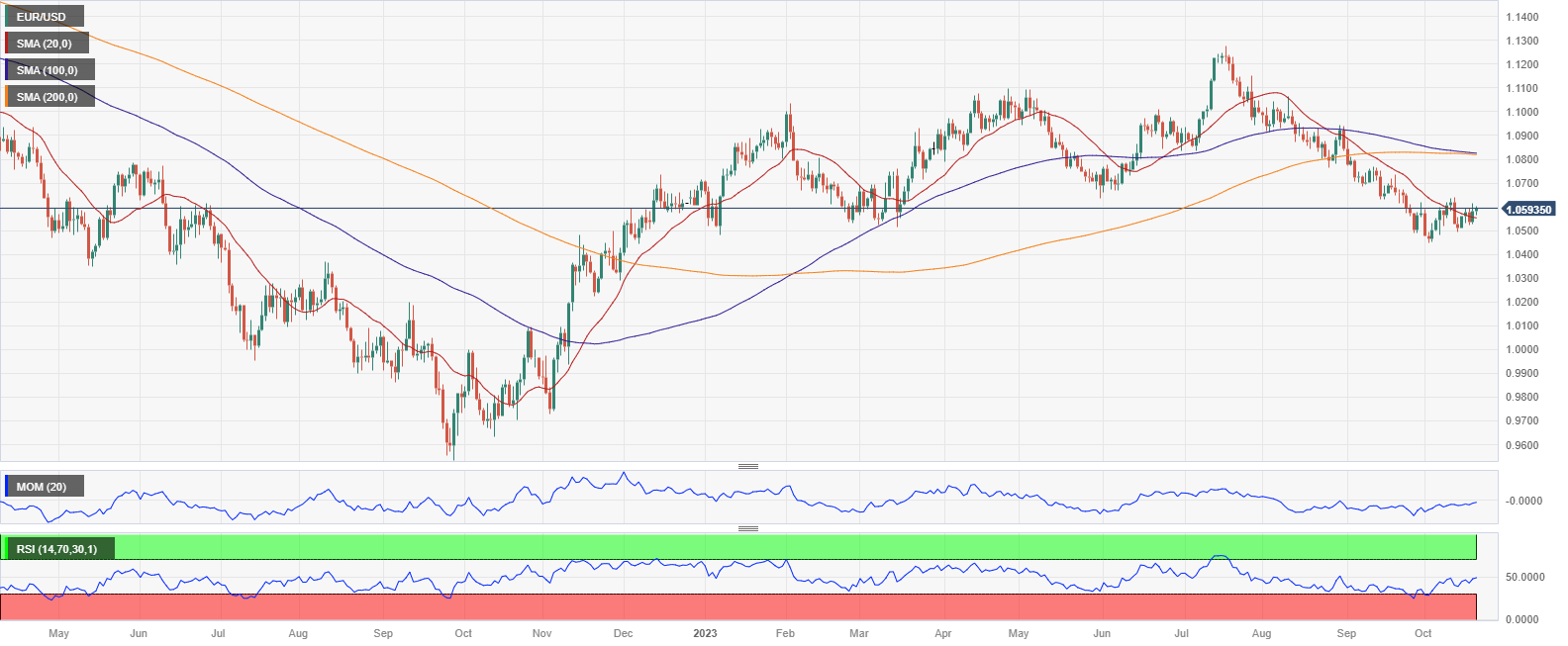
From a technical perspective, however, EUR/USD can not confirm an interim bottom. The pair has steadily met sellers around the 1.0600 threshold, with bears unwilling to give up. The weekly chart shows that the pair traded within the previous week’s range, holding below bearish moving averages. The 100-week Simple Moving Average (SMA) is the closest one, providing dynamic resistance around 1.0695. At the same time, the Momentum indicator maintains its firmly bearish slope well below its 100 level, while the Relative Strength Index (RSI) indicator barely bounced from oversold territory, reflecting the current recovery instead of suggesting more gains ahead.
The daily chart offers a neutral-to-bullish stance. The pair struggled to overcome a mildly bearish 20-day SMA for most of the week, developing above it on Friday. Still, the longer moving averages stand in the 1.0820 price zone, slowly grinding lower. The Momentum indicator aims higher well above its midline, but the RSI consolidates at around 47, failing to support additional gains.
The pair peaked at 1.0639 on October 12, the level to beat to attract buyers. Once above it, the 1.0700 threshold comes as the immediate resistance en route to the 1.0760 price zone. A weekly close around the latter would be the first step towards confirming an interim bottom. The 1.0500 mark is the immediate support level, followed by the monthly low at 1.0447. A break through the latter exposes the 1.0320-1.0340 price zone.
EUR/USD sentiment poll
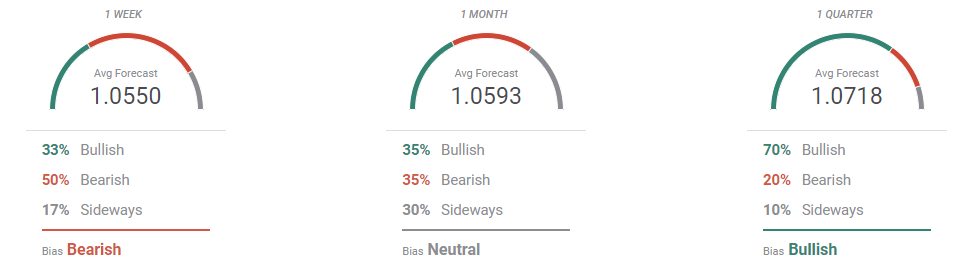
According to the FXStreet Forecast Poll, EUR/USD will remain under selling pressure. Bears lead the weekly perspective, with the pair seen averaging 1.0550. It turns neutral in the monthly view, although the pair is still seen developing below the 1.0600 level. Finally, bulls take over in the quarterly perspective, up to 70% of the polled experts. Still, on average, EUR/USD is seen at 1.0718, suggesting buyers may not be convinced.
The Overview chart shows the risk skews to the downside. The three moving averages turned lower, with uneven but clear bearish strength. The spread of potential targets in the wider perspective goes from 1.0300 to 1.1200, but most targets accumulate in the 1.0700/1.0900 range.
Author

Valeria Bednarik
FXStreet
Valeria Bednarik was born and lives in Buenos Aires, Argentina. Her passion for math and numbers pushed her into studying economics in her younger years.