EUR/USD Forecast: Correction time? China's payback, US data, overbought conditions may push it down
- EUR/USD has been taking a pause from its surge just under 1.16.
- Sino-American relations, jobless claims, and coronavirus figures counter optimism about the EU fund.
- Thursday's four-hour chart is pointing to mildly overbought conditions.

Five days and 200 pips of rises – with hardly any stop – is a rare sight for EUR/USD and a much-needed downside correction could be cooking. Apart from profit-taking, EUR/USD has reasons to correct downward – mostly based on safe-haven flows to the dollar.
China is set to retaliate in response to the US closing of its consulate in Houston. Washington officially accused Beijing of Intellectual Property violations in Texas' largest city, and some have suggested it served as a "spying center." This exacerbates already tense relations.
The world's largest economies have been clashing over coronavirus, Huawei suspicious technology, China's tightening of its grip on Hong Kong, and other topics. Investors have been focusing on the trade deal – which both China and Washington vowed to uphold.
Will investors continue ignoring this decoupling? When the US slapped tariffs on China in 2018 and 2019, stocks dropped – at least in the short-term when China responded with counter-levies. Will it happen again? The safe-haven dollar has room to rise if stocks turn south.
Hu Xijin, the editor-in-chief of the Global Times – an English-language outlet considered a mouthpiece of Beijing – tweeted that the reaction would be "painful."
Another painful development is in the increase in US coronavirus deaths – surpassing 1,100 per day. Figures released for workdays tend to exceed those published for the weekend. New figures due out on Thursday – potentially putting sending the number of cases above four million – may continue painting a gloomy picture and could weigh on sentiment.
The economic calendar is relatively light this week, but US existing home sales bounced to 4.72 million annualized, within expectations, and showing the strength of the sector. However, weekly jobless claims may already reflect that increase in COIVD-19 cases. Initial claims are for the week ending July 17 – when Non-Farm Payrolls surveys are held – and are set to remain stubbornly high at 1.3 million.
See Jobless Claims Preview: Improvement stalls and worry returns
One positive development is that Republicans and Democrats seem to be making progress – or at least not raising their rhetoric – on the next fiscal package. The GOP seems to have backed down on President Donald Trump's desire for a payroll tax cut, and the opposition seems willing to accept a decrease in federal unemployment benefits. Talks continue as the clock is ticking ahead of the July 31 for extending some of the measures.
In the old continent, the euro continues benefiting from the EU agreement on the €750 billion recovery fund – the common currency's main driver. Italy, the hardest-hit country, is seeing demand for its debt and rise to announce new spending programs. Germany's benchmark bunds are also holding up despite upcoming competition from the mutual EU bonds.
Overall, EUR/USD has room to extend its broad uptrend, but a much-needed correction seems somewhat overdue and could come shortly.
EUR/USD Technical Analysis
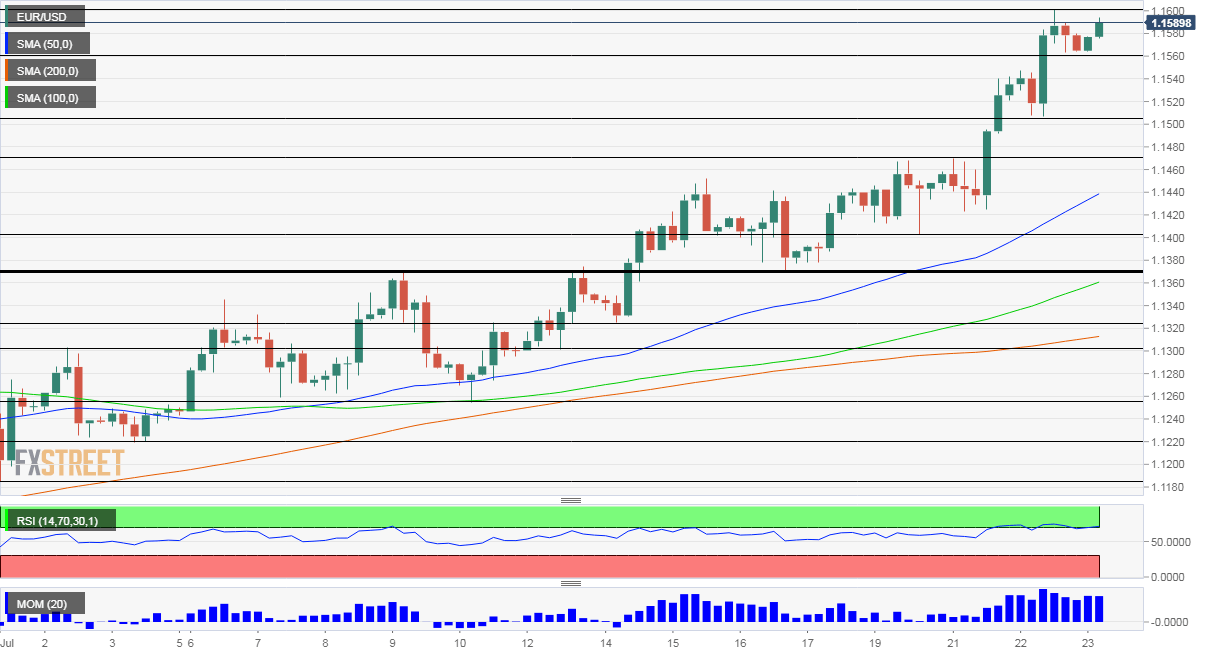
The Relative Strength Index on the four-hour chart is above 70 – pointing to overbought conditions and to a decline. Euro/dollar is enjoying upside momentum and trades above the 50, 100, and 200 Simple Moving Averages.
Technicals also point to a short-term correction.
Resistance awaits at 1.16, the fresh high, and a psychologically significant level. It is followed by 1.1620, a cap from late 2018, and then by 1.17 – EUR/USD launch price.
Support is at the daily low of 1.1560, followed by 1.1505, a temporary low. Next, 1.1470 and 1.14 await EUR/USD.
Author

Yohay Elam
FXStreet
Yohay is in Forex since 2008 when he founded Forex Crunch, a blog crafted in his free time that turned into a fully-fledged currency website later sold to Finixio.
















