EUR/TRY: Good news, bad news


Turkstat data on Monday showed a sharp decrease in headline inflation to 61.8% in July from 71.6% the previous month. This marks the second consecutive fall in consumer prices. Nonetheless, while the annual inflation rate eased in July, it rose by 3.23% on a monthly basis compared to June, when it had increased by 1.64%. The biggest price increases were seen in education, housing, health, and hotels and restaurants. This increase was actually anticipated by Turkish policymakers, expected temporarily due to one-off factors such as adjustments in administered prices and taxes.
However these good news were overshadowed by turmoil in international markets, where fear and uncertainty reign due to a convergence of factors. Poor economic indicators in the US have raised concerns about the health of the US economy and the Federal Reserve's policy. Unclear developments on the Middle East front could turn dramatic. Yet the main trigger of the financial turbulence appears to be a change in Japanese monetary policy that caused the Yen to recover quickly, affecting market participants involved in carry trades (where an investor borrows in a currency with low interest rates, such as the Yen, and reinvests the proceeds in a currency with a higher rate of return).
Carry trades have also been prevalent in the Turkish financial market lately, where high interest rates and relative stability of the Lira attracted foreign investors, spurring an inflow of foreign currencies (primarily USD) greatly needed by Turkish Central Bank reserves.
Within this scenario, EUR/TRY boosted over the 36.30 resistance on Monday and is trading around 36.72 at the moment of writing (on FXCM brokerage platform). This is an interesting level, representing the projection of half the previous trading channel height. The pair seems headed towards the 37 psychological resistance (where it is also set the first Fibonacci projection target) and 2 or 3 candle closures above the 36.30 level should confirm the uptrend.
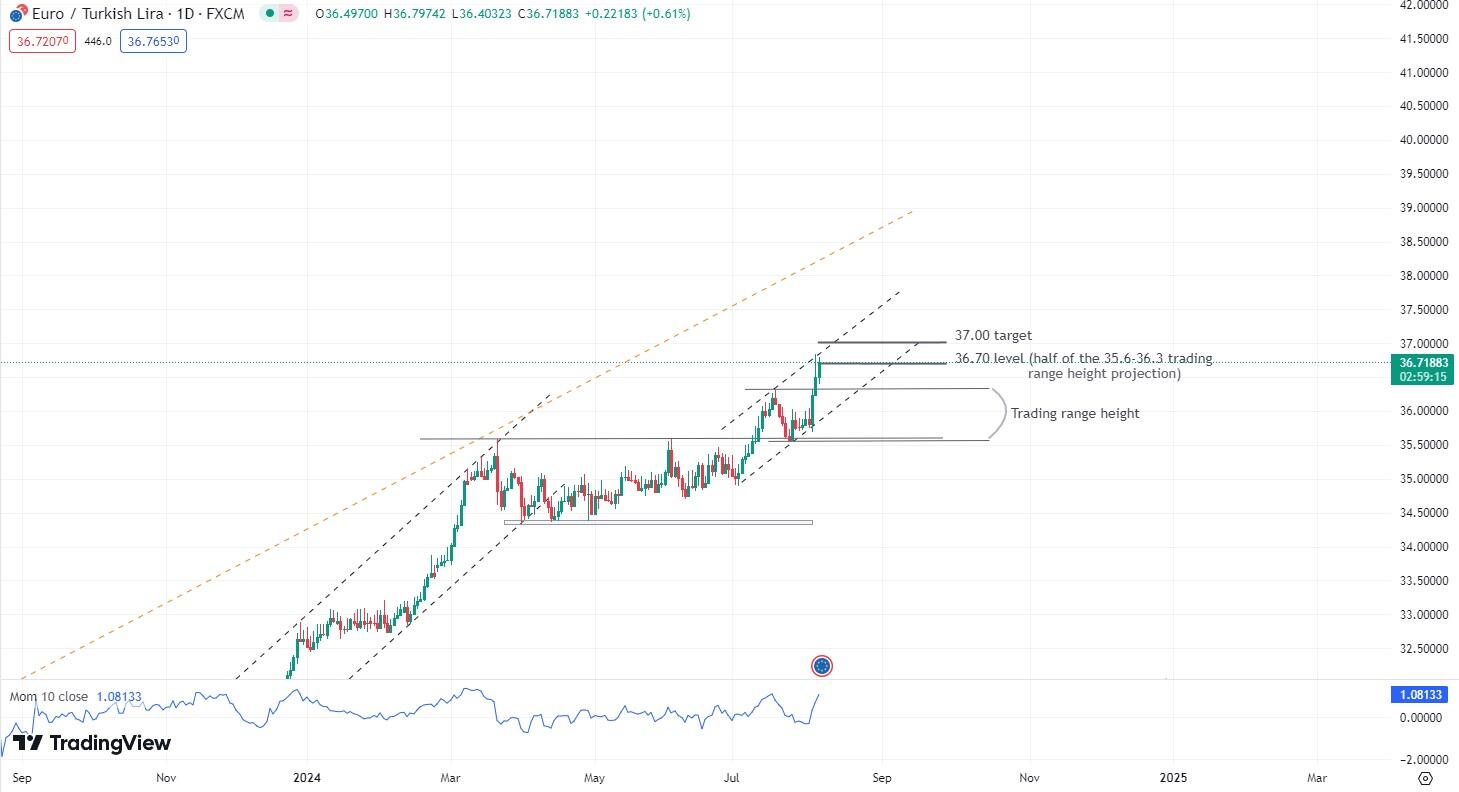
Let’s see what the developments in international market pressures will be, and how the international picture will evolve. An easing of tensions in the markets and a pullback in EUR/USD could reduce the extent of the EUR/TRY pair's recent surge. Within this view, it is also worth remembering the Turkish central bank's interest in keeping the exchange rate stable and its possible intervention in the markets.
Author
Giuseppe Bocci, CTA
Independent Analyst
Giuseppe Bocci is an independent trader primarily active in the U.S. stock market, international bonds, commodities, and forex. He has been trading full-time for about ten years, turning a passion into a profession.

















