Energy price inflation in the Eurozone: Government responses and impact on household purchasing power

The increase in energy prices is the main driving force behind the surge in eurozone inflation, despite significant differences between member states.
Energy made the biggest contribution to the increase in consumer prices in the Eurozone. In March 2022, the energy component of the harmonised index of consumer prices (HICP) increased 44.4% year-on-year (y/y) (see chart 2). Since this component accounts for an average of 11% of household expenditures, energy contributed nearly two thirds (65.6%) of the increase in headline inflation in March 2022. Yet this overall figure masks important disparities between the main Eurozone economies (see chart 3). In Italy and Spain, where energy prices jumped by 50% y/y, the contribution was more than 70% (73.6% and 72.3%, respectively). The increase in energy prices in Germany and France was nearly two times lower than for their southern European counterparts, the contribution was smaller at 59.7% and 60.3%, respectively. In April 2022, the energy component rose at a slightly slower pace (+38% y/y vs. 44% in March), but still contributed more than half of headline inflation (55.3%).
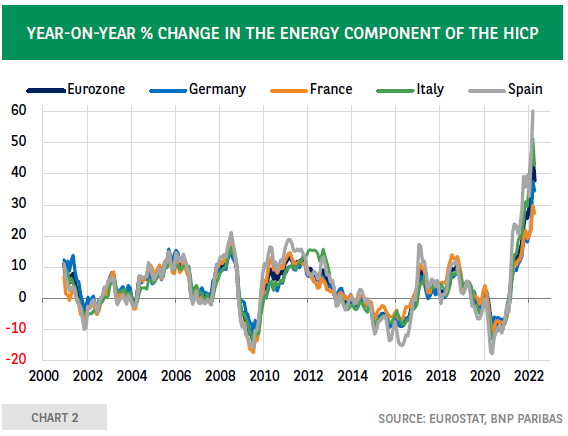

Assuming there is not another surge in international energy prices, the relative importance of this component should gradually decline due to second-round effects and a stronger upturn in non-energy inflation.
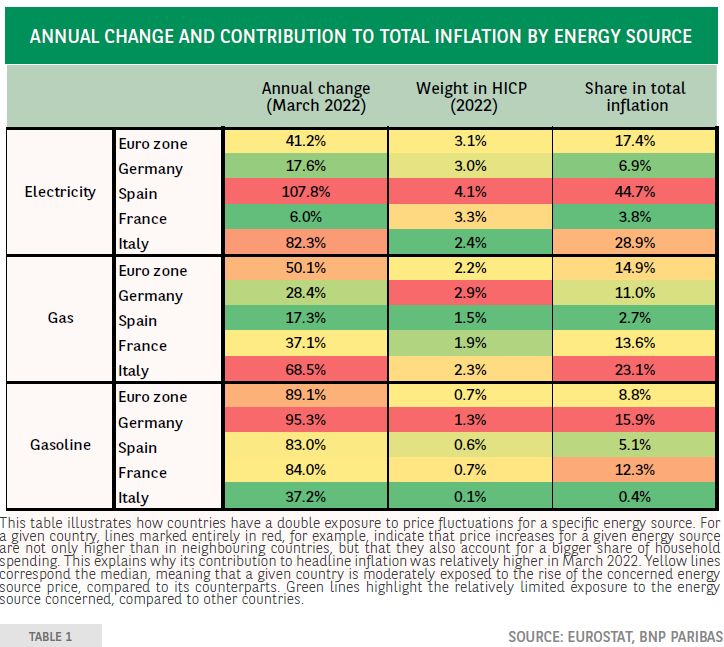
Energy’s contribution to inflation differs between countries due (i) to the various dynamics of the sub-components of energy, and (ii) to the weighting of these different energy sources in household consumption. In the Eurozone, electricity stands out as one of the key factors behind the increase in the price index (see table 1). It had a double impact on households due to a price effect and to the higher weighting of electricity as a share of household spending. Even so, major differences exist between countries. In Spain, electricity was the biggest contributor to price increases in March 2022, while natural gas and fuel, respectively, stood out in Italy and Germany. France stands apart from its European neighbours due to the mild increase in regulated electricity prices.
Author
BNP Paribas Team
BNP Paribas
BNP Paribas Economic Research Department is a worldwide function, part of Corporate and Investment Banking, at the service of both the Bank and its customers.