Dollar Index approaching a triple top, a warning for equities?


As the implied probability of US interest rate hike is entering in the 70% territory, the US Dollar is showing impressive strength, making new intermediate-term tops against major currencies. As correlations change over time, intermarket relationships also change, giving investors the task to interpret trends and potential snapbacks.
As most traders know, the Dollar Index is not a perfect tracker of the US Dollar performance against main global currencies. Indeed, it is a weighted geometric mean of the dollar's value relative to some currencies, in detail:
-
Euro (EUR), 57.6%
-
Japanese yen (JPY) 13.6%
-
Pound sterling (GBP), 11.9%
-
Canadian dollar (CAD), 9.1%
-
Swedish krona (SEK), 4.2%
-
Swiss franc (CHF) 3.6%
As we may observe, the Index is based, for almost two thirds of its weight, on the EUR/USD pair, and, since its bottom at 71.33 during the 2008 crisis, we saw a positive correlation between the Dollar Index and the S&P 500.
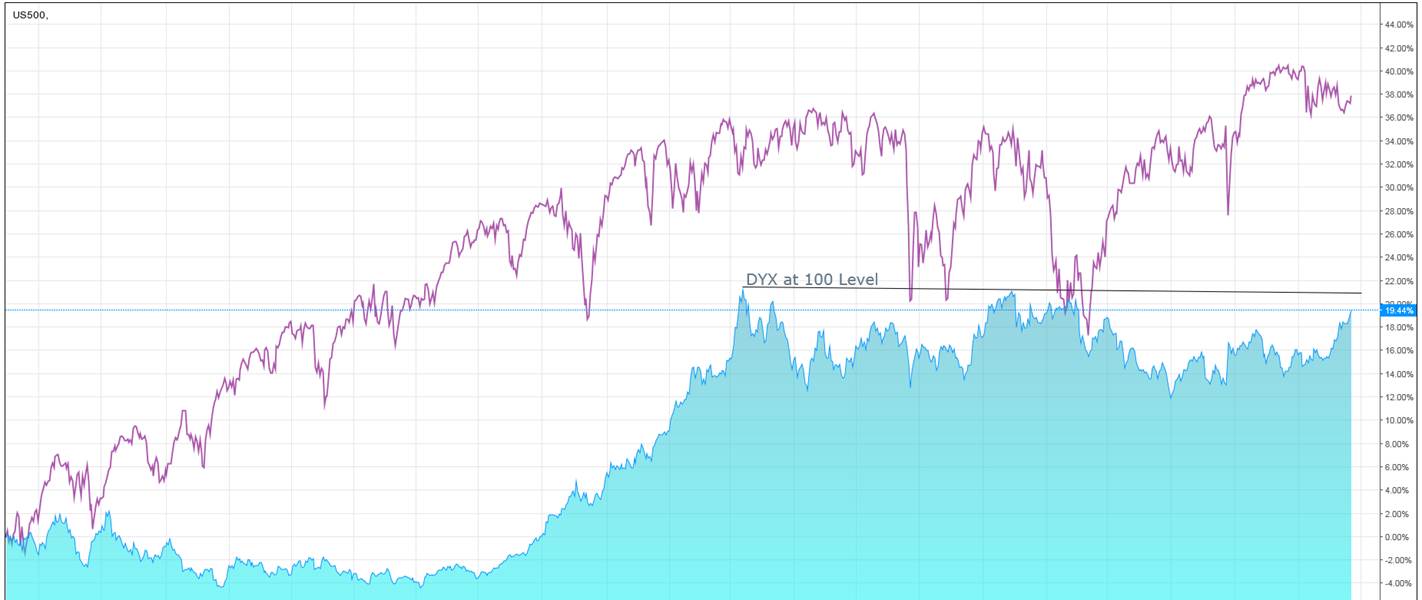
On 17 March 2015, the day of EUR/USD bottom at 1.0461, the lowest the since 2003, the index made its first top touching the 100 Level. Since then the index retraced, entering in a 10 points trading range, between the 90 and 100 area. In parallel, the S&P 500 started to change its perception of the Dollar’s strength as any top at the 100 level has been followed by severe S&P 500 correction.
As of today, the Dollar Index is in the way of forming a triple top and the S&P 500 is trying to get back to some intermediate-trend resistances.
Surely past is never indicative of future market behaviors, but since March 2015 equity markets showed nervousness, or even disappointment, as the US Dollar gets too strong. We are once again around the 100 area and for sure a several traders will keep a close look at that level.
Author
Edoardo Fusco Femiano, CFTe
Independent Analyst
Edoardo is an independent trader and investment advisor with more than 10 years of experience in Portfolio Management, FX and Equity Trading, Investment Research and Risk Management within primary financial institutions (Vatican B

















