EUR/USD drops as monthly German inflation deflates faster-than-expected
- EUR/USD falls as the US Dollar steadies in a thin-trading weekend due to holidays in the US on account of Thanksgiving Day.
- ECB's Schnabel ruled out risks of inflation undershooting the bank's target.
- Investors await the Eurozone HICP data for fresh ECB interest rate guidance.

EUR/USD faces selling pressure in Thursday's North American session and declines below 1.0540 as the growth in the flash German Harmonized Index of Consumer Prices (HICP) data for November remains slower than expected. The Federal Statistics Office of Germany showed that the annual HICP rose steadily by 2.4%. However, economists expected the inflation data to have grown at 2.6%. Month-on-month HICP deflated by 0.7%, faster than expectations of a 0.5% decline. In October, the inflation data rose by 0.4%.
Moderate growth in the German inflation data is expected to boost market expectations that the European Central Bank (ECB) will cut interest rates by a larger-than-usual size of 50 basis points (bps). Earlier, less-dovish remarks from ECB board member Isabel Schnabel in her interview with Bloomberg on Wednesday forced traders to pate ECB large rate cut bets.
Schnabel said that she doesn't see any risk of inflation undershooting the bank’s target. She argued that the central bank stimulus doesn’t address the structural issues that the Eurozone is currently facing.
Going forward, investors will focus on flash Eurozone HICP data for November, which will be published on Friday. Economists expect the headline and core HICP - which excludes volatile items - to have accelerated to 2.3% and 2.8%, respectively.
Meanwhile, fears of a potential decline in Eurozone exports due to the imposition of hefty tariffs by US President-elect Donald Trump have slightly eased, which could offer more support to the Euro (EUR). ECB President Christine Lagarde said in an interview with the Financial Times (FT) in the early European session on Thursday, “Trump's lack of specificity on a level of potential European tariffs may signal that he is open to negotiation,” according to MACE News. Lagarde added, “It's difficult to make America great again if global demand is falling due to trade tariffs.”
Daily digest market movers: EUR/USD falls as US Dollar rebounds on Thanksgiving Day
- EUR/USD drops to near 1.0550 in the North American trading session on Thursday after posting a fresh weekly high near 1.0590 on Wednesday. The major currency pair faces pressure as the US Dollar (USD) gains temporary ground on a thin volume trading day amid a long weekend in the United States (US) on account of Thanksgiving Day.
- The US Dollar Index (DXY), which gauges the Greenback’s value against six major currencies, finds an interim cushion around 106.00 on Thursday and rebounds to near 106.40 after a sharp downside move the prior day. The Greenback will be influenced by market expectations for the Federal Reserve’s (Fed) likely interest rate action in the December meeting as the US economic calendar has nothing to offer.
- Traders see a 66% chance that the Fed will cut interest rates by 25 basis points (bps) to the 4.25%-4.50% range next month, according to the CME FedWatch tool. Fed rate cut prospects remain firm even though the US Personal Consumption Expenditure Price Index (PCE) data for October grew expectedly. Annual core PCE Price Index, the Fed’s preferred inflation gauge – which excludes volatile food and energy prices – rose by 2.8%, faster than 2.7% in September.
Technical Analysis: EUR/USD corrects from weekly high of 1.0600
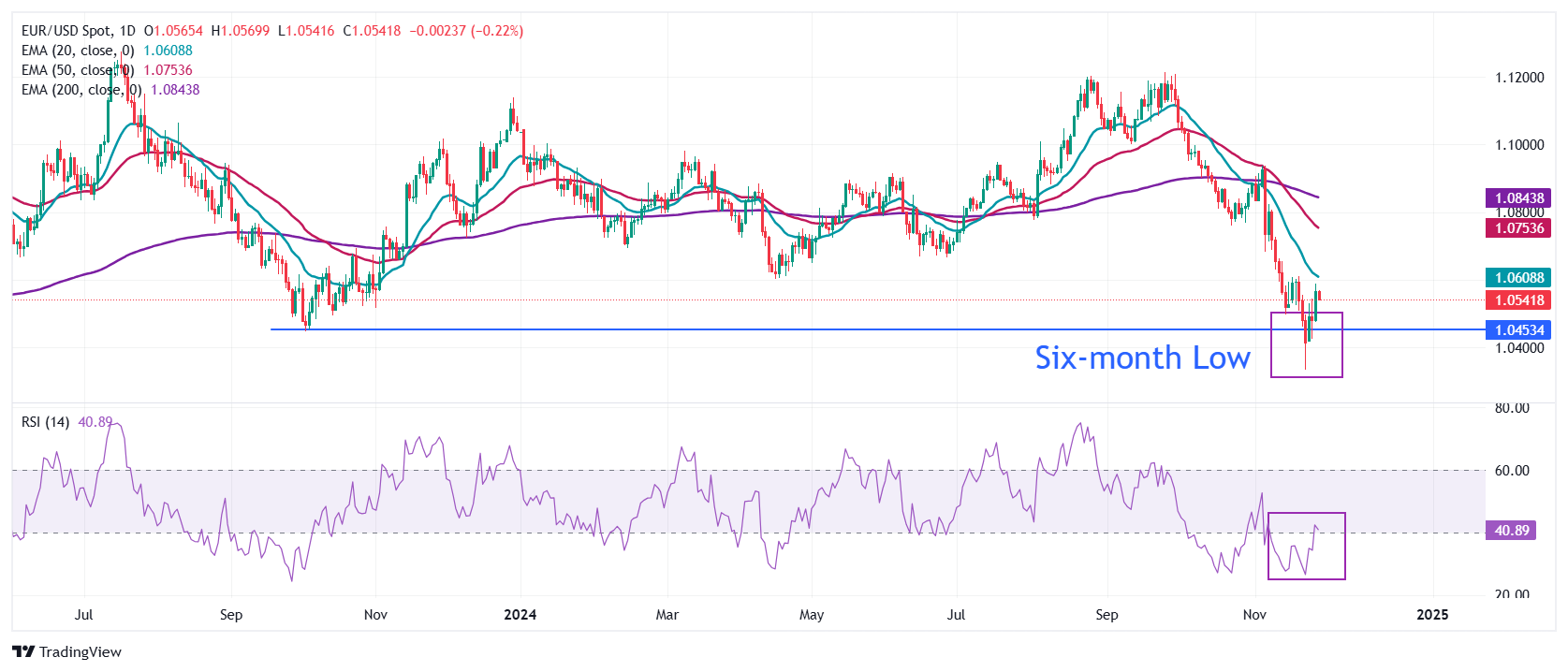
EUR/USD drops after failing to extend Wednesday’s rally above the round-level resistance of 1.0600. The recovery in the major currency pair appears to be a mean-reversion move, which could extend to near the 20-day Exponential Moving Average (EMA) around 1.0600. Still, the broader outlook would remain bearish as all short-to-long-term day EMAs are declining, pointing to a downside trend.
The 14-day Relative Strength Index (RSI) rebounded after conditions turned oversold and climbed above 40.00, suggesting that the bearish momentum has faded. However, the bearish trend has not been extinguished.
Looking down, the November 22 low of 1.0330 will be a key support for Euro bulls. On the flip side, the 50-day EMA near 1.0750 will be the key barrier.
(This story was corrected on November 28 at 08:01 GMT to say that EUR/USD posted a fresh weekly high near 1.0590 on Wednesday, not a fresh weekly low.)
Author

Sagar Dua
FXStreet
Sagar Dua is associated with the financial markets from his college days. Along with pursuing post-graduation in Commerce in 2014, he started his markets training with chart analysis.