Solana price jump of 5% on Tuesday is just a drop in the bucket as bullish tone dampens further
- Solana price ended its losing streak on Tuesday with Powell as the white knight.
- SOL traders are overthinking their next move as the overall Powell speech was hawkish.
- Biden added oil to the fire by ramping up harsh talk to China.

Solana (SOL) price was able to print a 5% gain after a three-day losing streak that accounted for roughly an 8% loss. Traders used the speech from US Fed Chair Jerome Powell to break the trend and print another good trading day, as the word "disinflationary" was their cue to start buying into Solana's price action. Traders are letting the dust settle and finding out that Jerome Powell's speech was actually not that dovish at all.
Solana is set to adjust with 20% drop to come
Solana price has been able to jump back above $24, thanks to one word from the mouth of Fed Chairman Jerome Powell: "Disinflationary." It appeared that the whole speech did not matter, and traders were cherry picking the words they wanted to hear. The mood is far from euphoric this morning as the hangover kicks in with the summary that the tone from Powell was hawkish. Geopolitical tail risks are elevated again after Biden's State of the Union, in which he put the Chinese relationship on edge with talk of the alleged spy balloon.
SOL is thus facing quite real headwinds and could soon see bullish traders drop off as fatigue builds. They had a good run in January, but February looks more challenging, which means that bulls will start looking for the next best thing to invest their money in. Expect Solana price to take a step back toward $18.66, which means a 20% correction with more US Dollar strength to come in along the way.
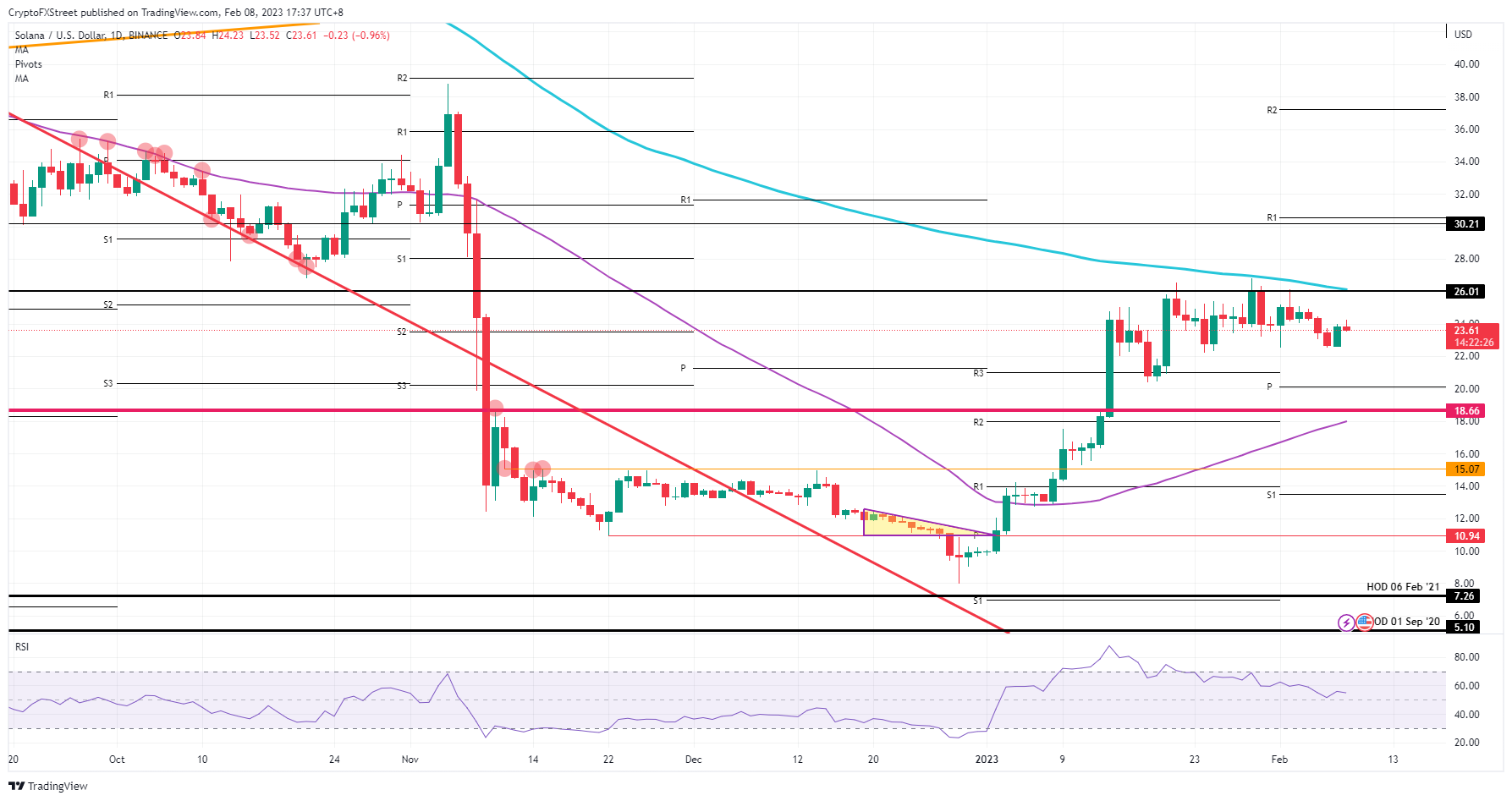
SOL/USD daily chart
If Solana price can get away from the current subdued mood, expect a fairly quick jump toward $26. That level is key to see if another $4 worth of gains can be projected in the near future. The $30 price tag is a pivotal historical level, and the 200-day Simple Moving Average (SMA) is nearby. The price target at $30 would fall in line with the monthly R1 resistance level and the Relative Strength Index nearing the overbought border again.
Author

Filip Lagaart
FXStreet
Filip Lagaart is a former sales/trader with over 15 years of financial markets expertise under its belt.