Is Bitcoin a safe haven amid Middle East tensions? Here's what you need to know
- Bitcoin has shaved 6% of its value since Iran's missile attacks on Israel.
- Gold has surged amid Bitcoin's plunge in the midst of geopolitical tensions.
- Bitcoin has shown better performance over a longer period than the precious metal.
Following Bitcoin's 6% decline since Iran's missile attack on Israel, several investors are questioning whether the cryptocurrency's alleged "safe haven" status still holds.
Bitcoin has declined while gold holds steady
Bitcoin has been on a decline since Tuesday following heightened war tensions between Israel, Hamas, Hezbollah and Iran. The top cryptocurrency, often dubbed digital gold, shaved off over $4,000 from its value within the past 24 hours, and it now trades around the $60,000 psychological level.
Notably, Bitcoin has recorded over $192 million in liquidation since the attack.
While Bitcoin declined in the face of geopolitical tension, gold surged briefly before seeing a correction on Wednesday.
Though its supporters call it "digital gold," Bitcoin keeps proving that it is not a true safe-haven asset like real gold.
— Jesse Colombo (@TheBubbleBubble) October 1, 2024
One example is how it plunged today on reports about Iran preparing to launch ballistic missiles. At the same time, gold surged. pic.twitter.com/yiwSpArcbK
According to precious metals analyst Jesse Colombo, both assets posted similar diverging moves when Iran attacked Israel in April 2024 and another October 7, 2023 attack on the latter. While gold saw a price rise, Bitcoin plunged.
This shows that investors trust more in gold's potential to serve as a safe haven.
Bitcoin's correlation to Nasdaq 100 and S&P 500
A possible reason for Bitcoin's shift in performance during geopolitical events is its rising correlation with the Nasdaq-100 and S&P 500 in recent times. This is evidenced by how BTC rose in tandem with the index after the Federal Reserve (Fed) decided to cut rates by 50 basis points on September 18. Another key move was their sharp decline following the "yen carry trade" unwinding on August 5.
"I have long maintained that Bitcoin behaves more like a speculative risk asset, similar to hot tech stocks, rather than a safe-haven asset," said Colombo.
I have long maintained that Bitcoin behaves more like a speculative risk asset, similar to hot tech stocks, rather than a safe-haven asset.
— Jesse Colombo (@TheBubbleBubble) October 1, 2024
This is evident in how closely Bitcoin's price movement tracks the tech-heavy Nasdaq 100 Index: pic.twitter.com/WuzOiZ6VVA
Bitcoin has performed better than gold in the longer term
While Bitcoin may behave like traditional risk assets in the short term, a BlackRock report last month showed that it has shown more resilience than gold in the longer term during these geopolitical tensions.
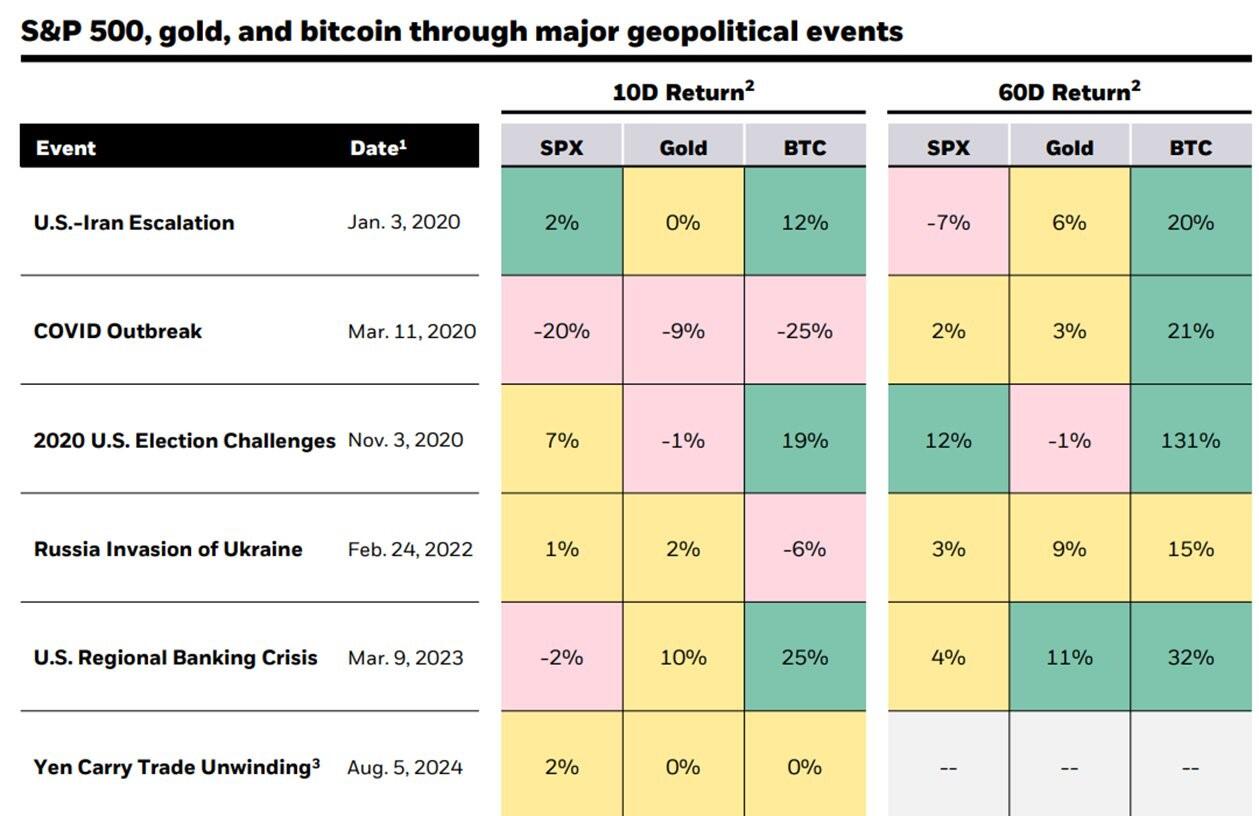
Bitcoin vs S&P 500 vs Gold
Additionally, crypto community members noted that the argument for Bitcoin being a safe haven is also related to inflation. Unlike gold, Bitcoin is deflationary by design, with a predictable supply growth rate capped at 21 million BTC.
Bitcoin, altcoins, stablecoins FAQs
Bitcoin is the largest cryptocurrency by market capitalization, a virtual currency designed to serve as money. This form of payment cannot be controlled by any one person, group, or entity, which eliminates the need for third-party participation during financial transactions.
Altcoins are any cryptocurrency apart from Bitcoin, but some also regard Ethereum as a non-altcoin because it is from these two cryptocurrencies that forking happens. If this is true, then Litecoin is the first altcoin, forked from the Bitcoin protocol and, therefore, an “improved” version of it.
Stablecoins are cryptocurrencies designed to have a stable price, with their value backed by a reserve of the asset it represents. To achieve this, the value of any one stablecoin is pegged to a commodity or financial instrument, such as the US Dollar (USD), with its supply regulated by an algorithm or demand. The main goal of stablecoins is to provide an on/off-ramp for investors willing to trade and invest in cryptocurrencies. Stablecoins also allow investors to store value since cryptocurrencies, in general, are subject to volatility.
Bitcoin dominance is the ratio of Bitcoin's market capitalization to the total market capitalization of all cryptocurrencies combined. It provides a clear picture of Bitcoin’s interest among investors. A high BTC dominance typically happens before and during a bull run, in which investors resort to investing in relatively stable and high market capitalization cryptocurrency like Bitcoin. A drop in BTC dominance usually means that investors are moving their capital and/or profits to altcoins in a quest for higher returns, which usually triggers an explosion of altcoin rallies.
Author

Michael Ebiekutan
FXStreet
With a deep passion for web3 technology, he's collaborated with industry-leading brands like Mara, ITAK, and FXStreet in delivering groundbreaking reports on web3's transformative potential across diverse sectors. In addition to