Guggenheim Partners seeks to invest over $500 million in Bitcoin, bets on long-term price increase
- Guggenheim Partners will gain exposure to the cryptocurrency market via Grayscale's Bitcoin trust.
- Whales are pouring money into BTC as large institutional investors join the market.
- BTC/USD is poised for long-term growth despite the short-term correction risks.

Guggenheim Partners, an investment company with over $200 billion assets under management, joined the ranks of the traditional financial institutions with exposure to the cryptocurrency market.
According to the filing with the US Securities and Exchange Commission, the company plans to invest over $500 million in Bitcoin indirectly, via Grayscale's Bitcoin Trust product (GBTC).
The Guggenheim Macro Opportunities Fund may seek investment exposure to Bitcoin indirectly through investing up to 10% of its net asset value in Grayscale Bitcoin Trust, the firm said in the filing.
Institutional investors realized Bitcoin benefits
Guggenheim Partners invest capital in a wide range of assets on behalf of high-profile institutional customers, including pension funds, sovereign wealth funds and large companies. Consequently, Guggenheim's involvement in Bitcoin would get them exposed to the new asset class.
The company describes cryptocurrencies as a medium of exchange, though the regulators in many countries do not consider Bitcoin and other digital coins as a legal means of payment. Meanwhile, according to the filing, Guggenheim acknowledges the regulatory risks along with high price volatility, fraud and the damage that might be caused by a potential crisis of confidence in Bitcoin's network.
Notably, Guggenheim is not the first Wall Street giant that ventures the new asset class. This year, such renowned traditional investors as Paul Tudor Jones and Stan Druckenmiller stated that they had already bought some digital coins to diversify their portfolios. Apart from that, Square and MicroStrategy poured some of their cash reserves into Bitcoin amid growing inflationary pressure and an extremely low-rate environment.
Whales are hoarding Bitcoins
The latest research conducted by the cryptocurrency exchange OKEx in partnership with the analytical company Catallact revealed that large investors had been hoarding Bitcoins in anticipation of a substantial price increase.
The number of institutional investors in Bitcoin has been growing steadily since 2013 and the process picked up in the middle of 2020. The researchers found out that institutional money's inflow tended to increase after large funds or asset-managers announced their Bitcoin exposure or intersect in cryptocurrency investments.
Thus, in May 2020, a famous macro investor Paul Tudor Jones announced the decision to invest in Bitcoin futures to protect the assets from inflation. A Nasdaq-listed business analytic company MicroStrategy followed suit and bought 21,454 BTC as a hedge against fiat money inflation. Since that time, the number of whales in the Bitcoin network has been growing steadily, which is confirmed by the data provided by the behavioural analytics company Santiment.
%20[10.34.25,%2030%20Nov,%202020]-637423195652869487.png)
Bitcoin's Holders Distribution
As the chart above shows, the number of wallets holding from 1,000 to 10,000 BTC increased by over 6%, from 2037 to 2162 since May 2020. While the growth might seem insignificant, it is worth considering that it translates into billions of dollars as each whale holds from $18.6 million to $1.86 billion in BTC.
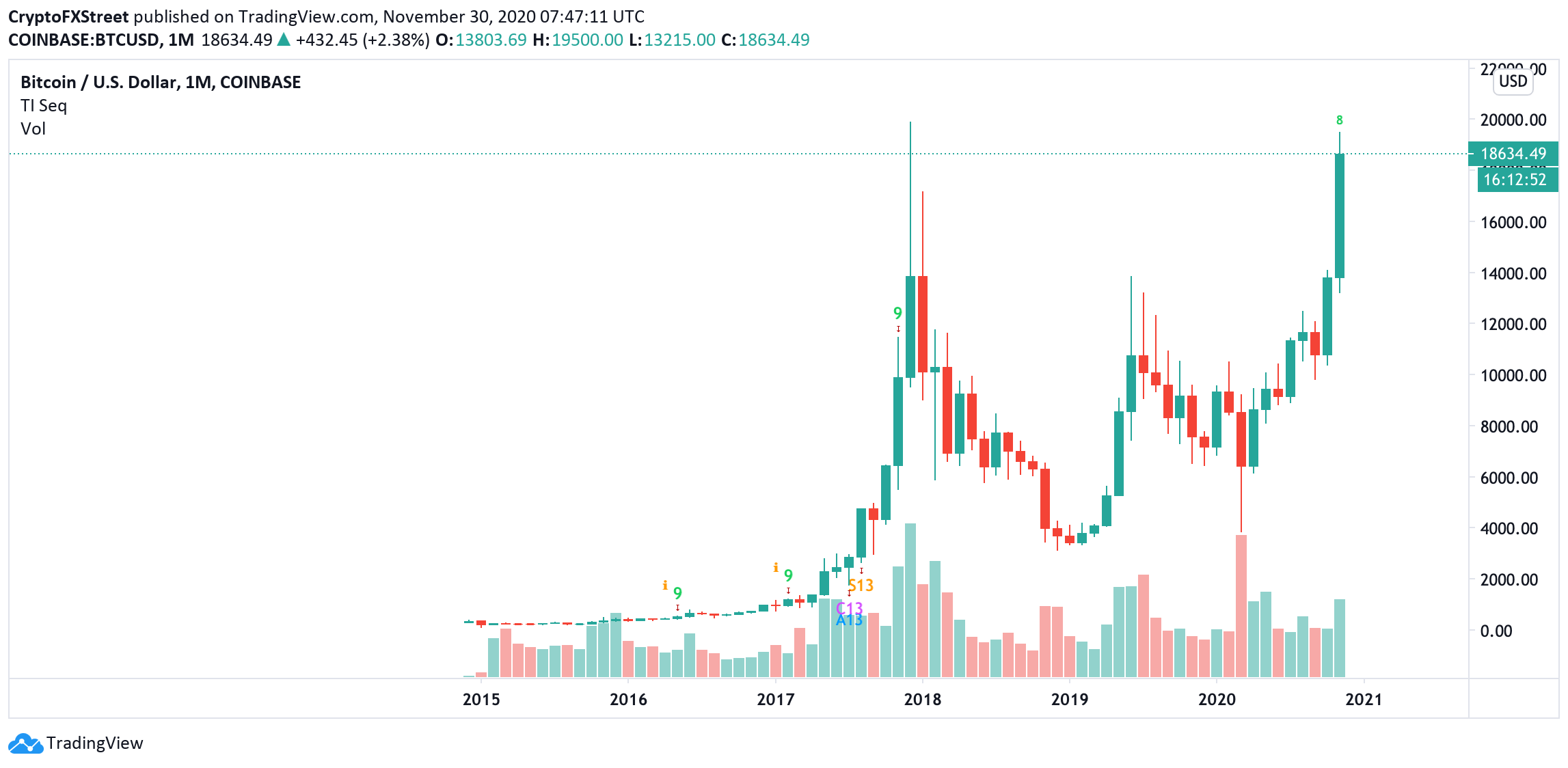
BTC/USD, monthly chart
At the time of writing, BTC/USD is changing hands at $18,650. The pioneer digital asset has gained over $5,000, 37% in less than a month and nearly 500% from the lows reached in Marche 2020. While the coin is still vulnerable to the downside correction towards $13,000, the long-term trend remains positive amid strong fundamentals, including the global central banks' ultra-easy monetary policies, reduced uncertainty on the financial markets and potential economic crisis accompanied by high inflation rates.
Author

Tanya Abrosimova
Independent Analyst