What could happen next with the Japanese Yen after BoJ´s hike?
- The Federal Reserve could ruin the Bank of Japan’s plans.
- Reduced interest rates’ gap could help the Japanese currency in the mid-term.
- The USD/JPY pair could shed additional 1,000 pips should central banks maintain their current paths.


So, the Bank of Japan (BoJ) finally woke up and surprised financial markets by raising its benchmark interest rate by 15 basis points (bps) to 0.15%- 0.25%. "Surprise" may be a bit too much, as several Japanese media anticipated the decision a few hours before it took place. As a result, the Japanese Yen (JPY) surged to 149.78 against the US Dollar (USD), its highest since mid-March.
BoJ Board members also outlined plans to halve monthly bond purchases, finally delivering some firmer monetary tightening in a world that is moving in the opposite direction. Global central banks engaged in massive tightening and pushed interest rates to record levels in 2022, as soaring inflation in the pandemic aftermath caught policymakers off guard. The BoJ, however, maintained its loosened policy and refused to move with the tie as the country battled deflation for roughly three decades.
The times, however, finally changed. The Consumer Price Index (CPI) in Japan rose 2.8% in the year to June, taking its toll on real earnings and households' purchasing power. BoJ policymakers had to be really concerned to make such announcements, which may seem conservative from any other country but Japan. The pace of price increases is beyond projections, but Board officials refrained from commenting on this.
At least, hiking rates is helping narrow the interest rate gap between Japan and its major counterparts and will likely result in JPY strength.
USD/JPY Technical Outlook
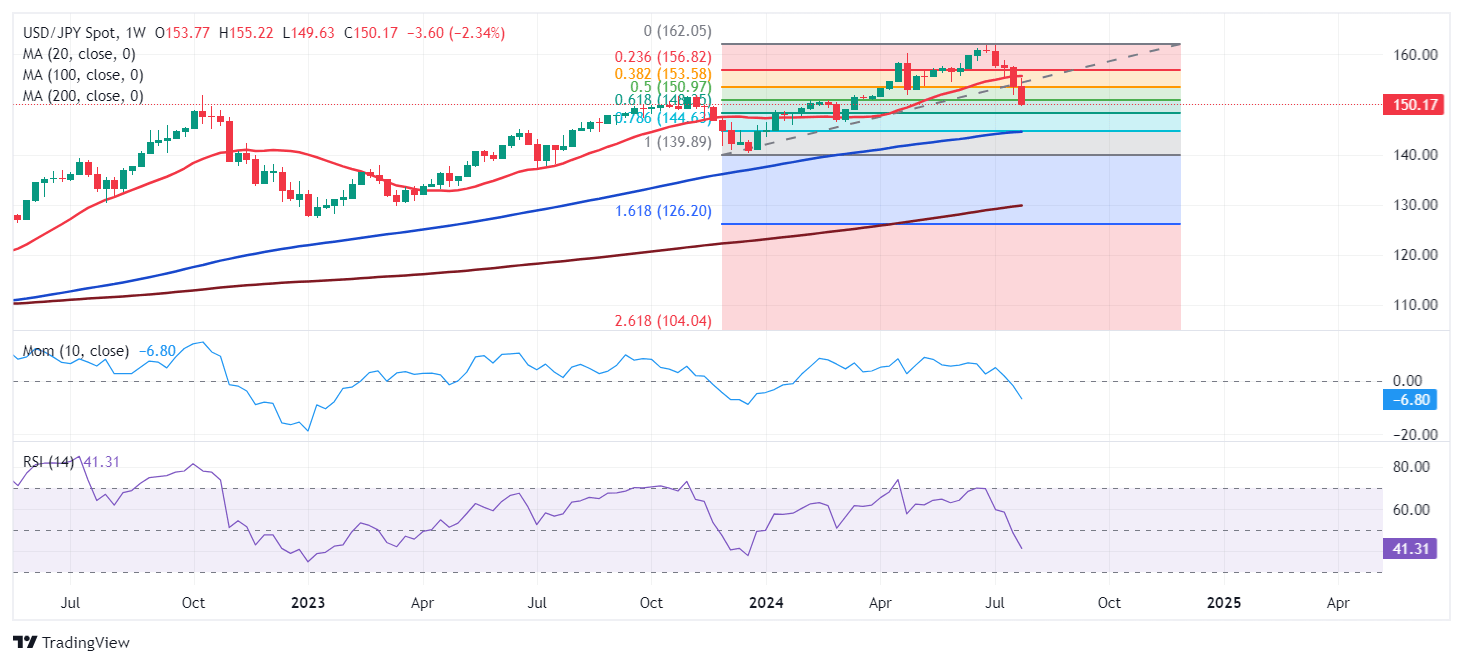
The USD/JPY pair hit a multi-year high of 161.94 amid the persistent JPY weakness due to central banks’ imbalances. The pair ran from the 140.00 price zone hit in December towards the mentioned high pretty much straight throughout the year and only started giving up in July, as investors rushed to price in a US Federal Reserve (Fed) interest rate cut.
The 61.8% Fibonacci retracement of the 140.24/161.94 rally at 148.58 is a potential bearish target and a critical breakout point. Once below it, bears will affirm their control over USD/JPY and aim to retest the aforementioned 140.00 area.
Of course, it will also depend on the Fed. Should the United States (US) central bank proceed with a September rate cut while leaving the door open for another one before year's end, the USD/JPY bearish case will remain strong.
The opposite scenario will spell trouble for BoJ officials, as the JPY may resume its slide, further hurting households’ pockets.
Premium
You have reached your limit of 3 free articles for this month.
Start your subscription and get access to all our original articles.
Author
Valeria Bednarik
FXStreet
Valeria Bednarik was born and lives in Buenos Aires, Argentina. Her passion for math and numbers pushed her into studying economics in her younger years.