US payrolls loss of 701,000 in March understates the labor market disaster
- Largest monthly decline in payrolls since 2009 misses half the month.
- Ten million jobless claims were filed in the last two weeks of March.
- US dollar retains market edge for safety as equities and yields fall.
- Bank of America said 85,000 small businesses asked for $22.2 billion in loans.

The near record drop in payrolls last month, only the 800,000 plunge in March 2009 was greater, is the forerunner of worse losses to come as US job numbers catch up with the labor market catastrophe prompted by the Coronavirus pandemic.
More than half of the workers let go in the March payrolls were from restaurants and bars which were among the first businesses to close in an effort to control the spread of the virus.
Since then layoffs have continued as half the US population is now under voluntary or mandated stay at home orders and the near shuttering of large parts of the economy has collapsed employment, causing the swiftest and probably the deepest economic downturn in post-war history.
Equities, Treasury yields and the dollar
Stocks had another losing week on burgeoning economic woes as he Dow dropped 360 points, 1.69% to 21,502 on Friday. It was down 2.7% on the week, its third negative week in four and 26.2% on the year. It is 28.8% below its all-time high of 29,568 on February 12 of this year.
The S&P 500 finished off 1.51% for its third negative day in four. On the week the average lost 2.08% also its third down week in the last four. On the year it has shed 22.97% and is 26.66% below its record of 3,393.52 from February 19. Both averages could easily surpass 2008 as their worst year when the S&P lost 38.5% and the Dow 33.6%.
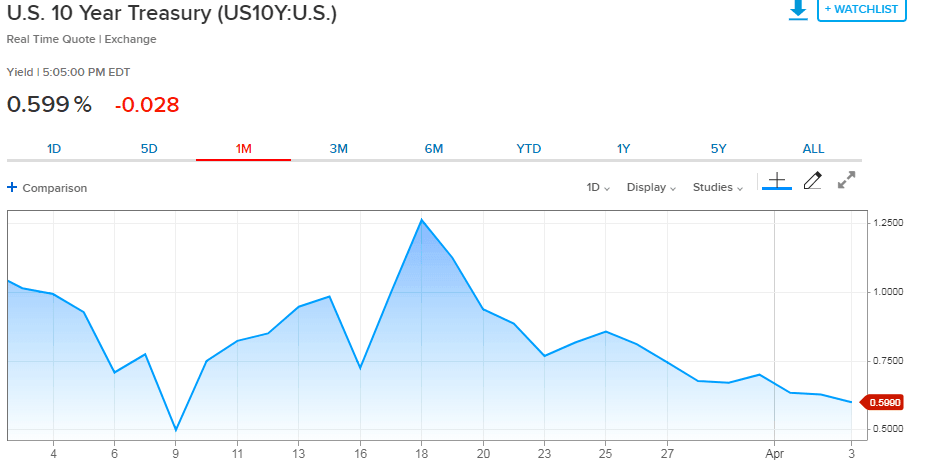
Treasury yields continued to ebb as the Federal Reserve purchase program announced at the emergency March 15 meeting slowly pushes prices higher and returns lower. The 10-year closed at 0.599% on Friday down from the 0.676% open on Monday. The 2-year yield lost 1 basis point on the week starting at 0.228% on Monday and finishing at 0.227% on Friday.
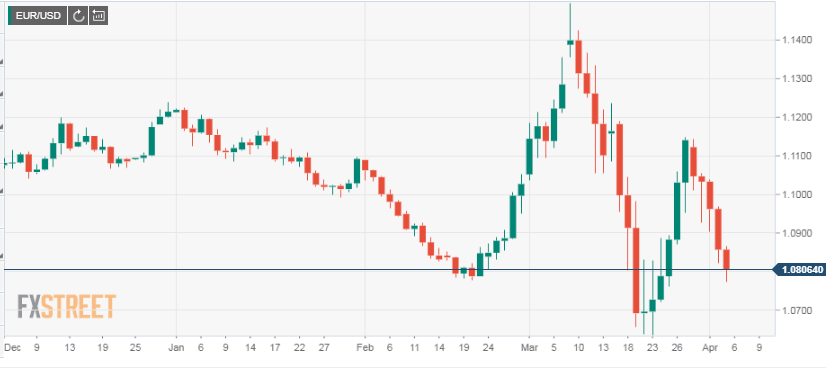
The dollar maintained its safety ascendancy as the economic news from the United States and Europe assumed ever more dire shape. On the week the US currency gained 1.62% against the Canadian dollar, 0.5% versus the Japanese yen, 3% against the euro and 2.8% versus the Australian dollar. Only in opposition to the British pound did it lose, 1.47%.
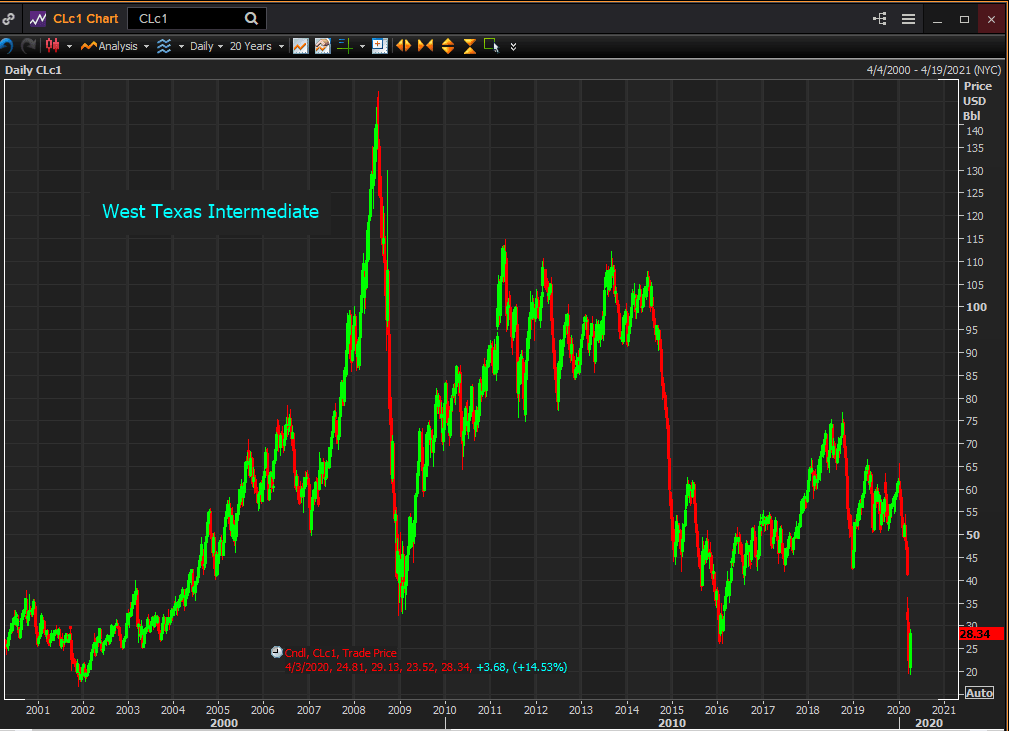
West Texas Intermediate (WTI, Clc1) had it best week on record rising 31.75% and adding 11.93% on Friday to close at $28.34. Nonetheless it remains down 53.59% on the year its worst performance since the start of this futures contract in 1983
Labor Department surveys
According to the Labor Department the timing of the twin surveys that provide the data for the NFP report, ending as usual in the middle of the month, means that many of the 10 million newly unemployed who filed claims after that will not be added to the rolls until the figures for April and the March revisions are issued on May 8.
The establishment survey which polls about 145,000 businesses for payrolls and the household survey which asks about 60,000 households for the unemployment rates are conducted by the Bureau of Labor Statistics, a division of the US Labor Department. Its standard methodology uses the week ending March 12 as a reference period. Layoffs began in earnest the following week.
Prior to the Coronavirus the US economy had been cruising along with unemployment and initial claims rates at or near the lowest in 50 years and looking to the recent US-China tract pact to restore manufacturing employment.
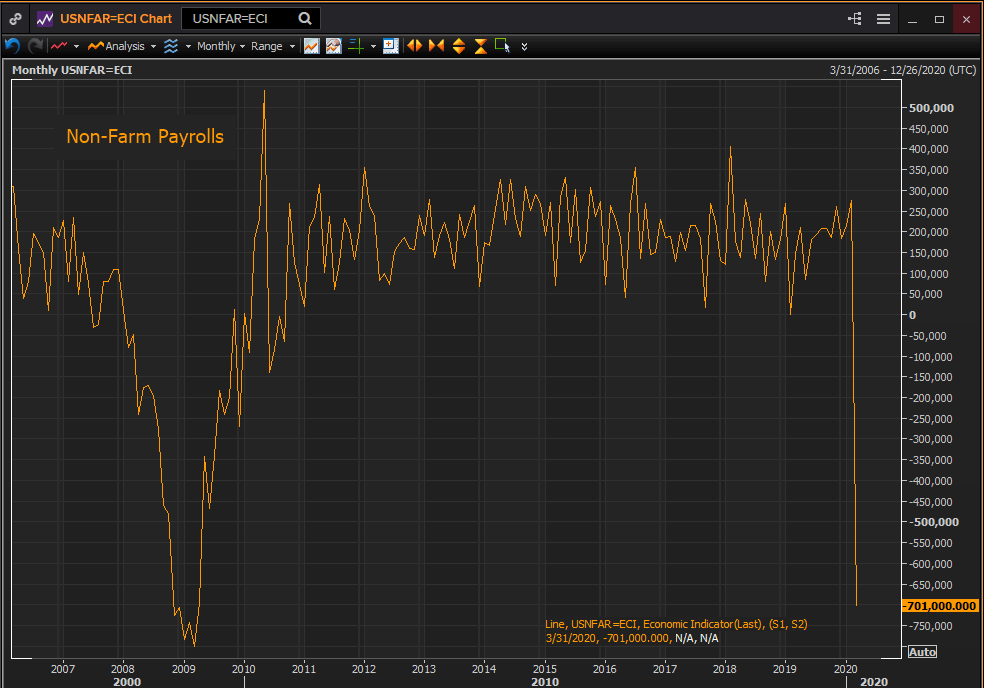
The jump in the unemployment rate from 3.5% to 4.4%, even though the largest one month increase since January 1975, almost certainly misses a large portion of the labor force now without work, a percentage that could skyrocket in estimates from 15% to 30% next month.
US unemployment benefits
The US unemployment insurance program is a joint operation of the federal and state governments. It provides 26 weeks of payments for most filers, is relatively easy to access on-line with direct deposit of funds in many cases and is consequently one of the first chores of any newly laid off worker.
Because of its near universal use and its weekly reporting it is the only statistics that has captured the astonishing rapidity of the employment catastrophe.
After lingering near five decade lows for over a year claims climbed from 211,000 in the first week of March to 281,000 in the second then overnight rocketed to 3.283 million in the week of March 20 and 6.648 in the following week.
The nearly 10 million new filers in two weeks are far and away the greatest 14-day totals in US annals. The next highest is 1.543 million in the last week of February and the first of March 2009.
Federal Paycheck Protection Program
The Bank of America announced on Friday after that it has received over 85,000 website applications for federal assistance totaling $22.22 billion.
Commercial banks are administering the program that is one of the keystones of Washington’s $2 trillion economic support package recently passed by Congress and signed by President Trump. The program will have at least $350 billion for distribution. If the funds are all used Treasury Secretary Steven Mnuchin has said more would be requested.
Among other banks participating are JP Morgan Chase, Wells Fargo, PNC, Citizens and Navy Federal Credit.
Author
Joseph Trevisani
FXStreet
Joseph Trevisani began his thirty-year career in the financial markets at Credit Suisse in New York and Singapore where he worked for 12 years as an interbank currency trader and trading desk manager.

















