Trade wars: Five signs Trump is losing to China – USD has room to rise
- The US-Sino trade spat is raising market volatility.
- Five significant developments are indicating President Trump is losing.
- The US Dollar has yet to react to developments.

"Trade wars are good and easy to win" – said US President Donald Trump on March 2018. Nearly a year and a half later, Chinese Industrial Output growth has fallen to the lowest levels since 2002 and Germany is on the verge of recession. However, the US economy continues growing at a satisfactory pace of 2.1% annualized in the second quarter.
So is Trump triumphant? No.
Recent developments have revealed the president's weaknesses. Here are five signs that expose it.
1) Huawei goes unpunished
The US has decided to delay the ban on Huawei – the Chinese telecom giant – by another 90 days. Commerce Secretary Wilbur Ross has announced his decision just after his boss said he "does not want the US to do business" with the firm and also due to security reasons.
The US and several allies suspect that Huawei equipment may contain backdoors allowing the Chinese army to spy on users of its network and phones. However, banning American companies – such as Google – any interaction with the firm may inflict economic damage.
Is the White House sacrificing American security interests for fear of inflicting damage on the economy? Or are security risks overblown, and the delay serves as a gesture of goodwill by a magnanimous president?
Both answers are possible if the decision is isolated.
2) Flip-flop on tariffs
The about-turn on Huawei comes less than a week after the White House announced another delay – postponing tariffs on around $160 billion worth of Chinese goods from September 1st to December 15th.
Trump announced these duties – initially covering around $300 billion worth of products – on August 1st. The administration realized that slapping levies on consumer goods such as phones, computers, and clothes would hurt the American consumer in the run-up to Black Friday and Christmas. That was not an analysis by Trump critics but the words of the president, who said that "We’re doing this for the Christmas season."
The 180-turn within 12 days was the first admission that the US tariffs are hurting US consumers – a self-inflicted loss in the trade war.
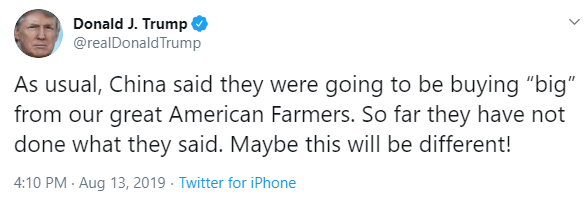
Apart from easing the pressure on American shoppers, it serves as a relief to Chinese exporters – an act of goodwill. After the announcement, Trump tweeted that China promised to be buying "big" from American farmers, "but have not done what they said. Maybe this will be different!" The tweet may be seen as a hint that China has agreed to purchase agricultural goods.
3) Farmers are struggling
Reuters has analyzed bank loans to farmers and has noted a decline of 17.5% in recent years. The publication also shows that Chapter 12 bankruptcies are jumping as "banks are calling in the loans and cutting them [farmers[ off."
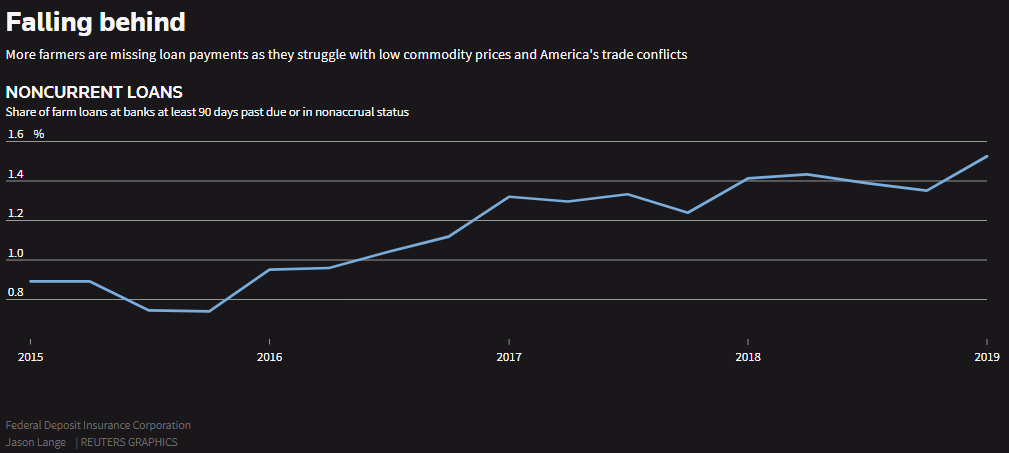
The pain is mostly felt in the Midwest and among soybean and grain producers. Sales of these agrifoods have fallen since both Mexico and China hit them with counter-tariffs.
Banks "do not want to be the ones caught holding the bad loans," said David Oppedahl of the Federal Reserve Bank of Chicago.
Even if farmers are struggling, did Trump get anything else in return from China?
No.
4) China promises countermeasures
On August 15th – just two days after the White House relented on most new levies – China said it "would be forced to take necessary countermeasures" if Trump moved forward with the new duties – even after reducing their span.
Stock markets, which had begun to recover from fears of a recession after only temporarily rising on Trump's tariff relief announcement, struggled once again.
And this brings us to another sign of weakness.
5) Constant blaming of the Fed
The president continually boasts about equities' performance, and some say he measures his success by the Dow Jones Industrial Average (DJIA).
And what happens when stocks fall? Trump blames the Federal Reserve. He called Fed Chair Jerome Powell "clueless" when the yield curve inverted and said the "Fed is holding us back." The president may have forgotten that he nominated Powell to lead the central bank.
And while he boasts that money is pouring into the US:
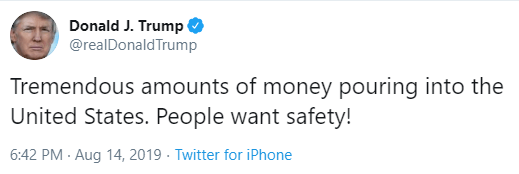
He is "not thrilled" by the consequence – a stronger Dollar, and blames the Fed for its high interest rate – days after the central bank cut rates.
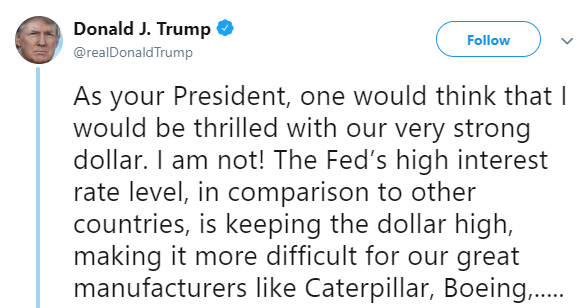
The frustration, contradictory tweets and rising rhetoric against the Federal Reserve and its Chair – nominated by the president – are all a sign of despair. This is not a president winning a trade war.
He is losing it.
The Dollar may rise if Trump continues losing
Trump's concerns about stock markets may push him to make further concessions to China and incur additional losses in the trade war. For markets, calmer commerce relations between the world's largest economies would be a boon. Tariffs and high uncertainty about them have caused investments in the US and elsewhere to halt. Lower duties and a better relationship between Washington and Beijing would not only lift stocks: may push investment higher as well.
If the Fed sees more certainty on the trade front and higher valuations for shares, the pressure to loosen monetary policy would wane. In turn, it would likely refrain from cutting interest rates in September and perhaps signal tighter monetary policy going forward. On this background, the greenback has room to rise – whether Trump is thrilled or not.
Author

Yohay Elam
FXStreet
Yohay is in Forex since 2008 when he founded Forex Crunch, a blog crafted in his free time that turned into a fully-fledged currency website later sold to Finixio.