|

Nonfarm Payrolls Preview: Get ready for some action this time

  • The US economy is expected to have added 160K new jobs in January.
  • Leading indicators ahead of the event offer mixed clues.
  • USD bullish ahead of the event, upbeat report to fuel its advance.

The American dollar is heading into the release of the US monthly Nonfarm Payroll report with a firm pace, backed by robust US data release in the last few days. Not outrageously positive but above expected, the number highlights the better shape of the US economy, when compared to those of its major counterparts.

The US economy is expected to have added 160K new jobs in January, while the unemployment rate is foreseen stable at 3.5%. Average hourly earnings are expected to have bounced, forecasted to result at 0.3% MoM and 3.0% YoY.

Back in December, the economy added modest 145K new jobs, after a notable increase of 256K in November. Wages have ticked lower, but remained at the upper end of their latest range, while the unemployment rate hovers around a five-decade low. That said, the health of the US employment sector has not been an issue for long.

Leading indicators mixed

Ahead of the event, signs coming from what are considered leading indicators are mixed. There’s a pretty even number of positive and negative hints, although those considered positive are quite strong, lifting odds of an upbeat outcome.

The ADP survey showed that the US economy added 291K new jobs in January, the largest increase in the last  12 months. The University of Michigan Consumer Confidence index surged in the month to 99.8, close to its multi-year highs.

Also, The 4-week moving average for the jobless claims figure has been trending down for the last month, from 224k to a 211.75k average, although the continuing Jobless claims average is neutral for January.

The ISM reports came in mixed, as employment the sub-component of the manufacturing index rose from 45.2 to 46.6, while that on the non-manufacturing index retraced from 54.8 to 53.1.

Quite a disappointment, the Challenger Job Cuts report indicated that the number of corporate layoffs went up in the month, rising to 67.735K.

The most lagging indicator is the JOLTS Job Opening, which showed that jobs openings in November decreased from 7.36M to 6.8M.

US jobs report pre-release checklist – Feb 7th, 2020

Previous Non-Farm PayrollsNegativeDecember's 145K job growth disappointed a bit, triggering a -0.47 deviation. November's outstanding figure was also revised slightly down, from 266K to 256K.
Challenger Job CutsNegativeThe number of corporate layoffs went up in January, from 32.843K to 67.735K, the biggest figure in the last 11 months. 
Initial Jobless Claims PositiveThe 4-week moving average for the jobless claims figure has been trending down for the last month, from 224k to a 211.75k average.
Continuing Jobless Claims NeutralThe last four weekly releases for the total number of unemployment claims has been mixed, with two weeks beating expectations and the two others disappointing them.
ISM Non-Manufacturing PMI NegativeEmployment sub-index in the services sector retraced from 54.8 to 53.1, disappointing expectations (55.2) for a higher release.
ISM Manufacturing PMI PositiveEmployment sub-component in the ISM Manufacturing PMI rose a bit, from 45.2 to 46.6, the second rise in the last seven months, but still in contraction territory.
University of Michigan Consumer Confidence Index PositiveUMich consumer survey rose to 99.8 in January, very close to its multi-year highs.
Conference Board Consumer Confidence Index PositiveCB consumer survey went back to the positive track with a 3-point increase in January, from 128.2 to 131.6. Consumer mood is quite optimistic.
ADP Employment Report PositiveADP private employment report smashed expectations with an enormous 291K job gain in January, the biggest in the last 12 months. This is the most-correlated-to-NFP leading indicator, so it's a huge positive. 
JOLTS Job Openings NegativeJob openings notably decreased in November from 7.36M to 6.8M, the fifth disappointment in the last seven releases. Even if this is a lagging indicator, it shows hiring has slowed down recently. 

Dollar’s possible reaction to different scenarios

The greenback retains its strength ahead of the release, which means that it would need little to maintain its bullish stance. Better than expected numbers will likely see it reaching fresh weekly highs, particularly against European currencies.

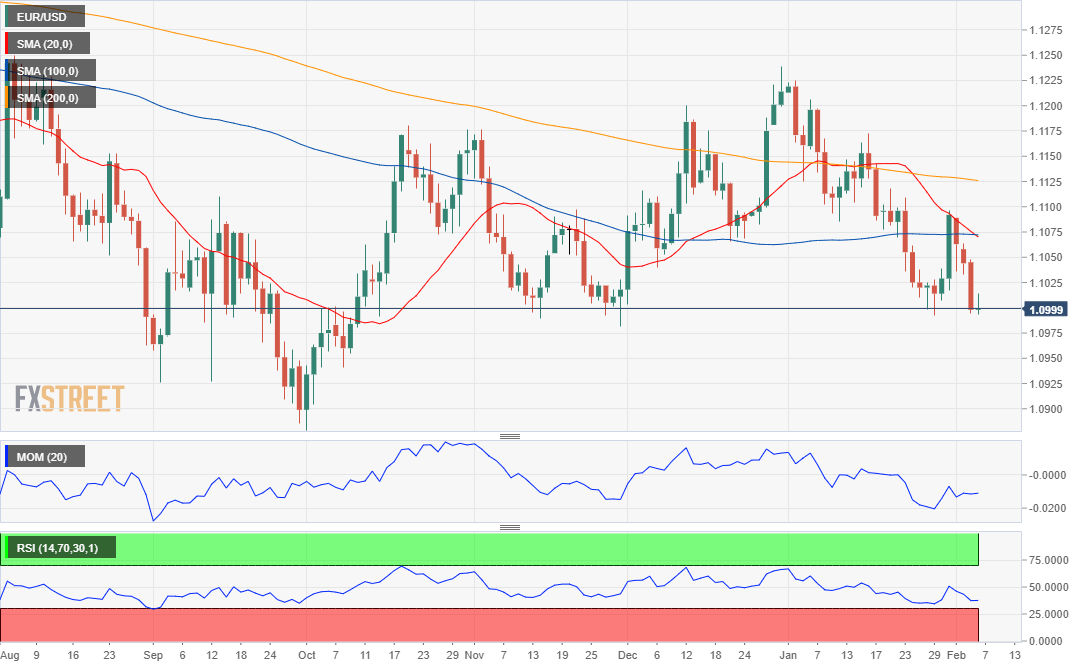
The EUR seems the one with more chances of collapsing, as it’s barely holding above 1.1000, while German data continue to suggest a deepening economic slowdown. Large stops are suspected below 1.0980, where the pair bottomed by the end of November. If those stops are triggered, the pair could approach the 1.0900 mark.
The Pound is in no better shape, although solid UK data is giving it some support. Nevertheless, concerns that the UK won’t be able to reach a deal with the EU before year-end weigh. Sterling is the most reluctant to react to US data, which means that the NFP report has to be quite upbeat to trigger a GBP/USD slump.

USD/JPY is another pair that can react sharply to the headline. The pair has been on the rise alongside Wall Street and Treasury yields. A strong employment report will fuel them all. Watch for an upward acceleration above 110.28, January monthly high.

Finally, the Aussie has found some support in rising equities, leaving AUD/USD trapped between a rock and a hard place: rallying Wall Street and a stronger dollar. A critical support level comes at 0.6670 a multi-year low. Below it, a steeper decline is to be expected.

Below expected numbers will be the perfect excuse to take some profits out of the table, although only if the headline comes below 100K, the dollar could be under some severe selling pressure. 

Author

Valeria Bednarik

Valeria Bednarik was born and lives in Buenos Aires, Argentina. Her passion for math and numbers pushed her into studying economics in her younger years.


More from Valeria Bednarik
Share:

Editor's Picks

EUR/USD consolidates above 1.1800 as trades await Eurozone CPI and US data

The EUR/USD pair struggles to capitalize on the previous day's modest bounce from the 1.1780-1.1775 area, or over a one-week low, and oscillates in a narrow band during the Asian session on Wednesday. Spot prices currently trade around the 1.1815 zone, nearly unchanged for the day, as traders keenly await the release of the flash Eurozone consumer inflation figures.

GBP/USD consolidates ahead of Bank of England rate decision

The Pound Sterling traded in a narrow range against the US Dollar on Tuesday, edging modestly higher to near 1.3700 as markets adopted a cautious stance ahead of the Bank of England's first policy decision of 2026. GBP/USD opened the session at 1.3665 and touched an intraday high near 1.3707, with the pair consolidating below the multi-year high of 1.3869 posted in late January.

Gold extends recovery toward $5,050 as US-Iran tensions boost haven demand

Gold price builds on the previous recovery toward $5,050 in the Asian session on Wednesday. The precious metal extends the rebound after a historic and volatile sell-off last week. Traders weigh the next round of US economic signals amid a resurgent demand for safe-haven assets and renewed US-Iran geopolitical tensions.

Top Crypto Gainers: WLFI, ATOM, and JUP post mild gains amid market sell-off

World Liberty Financial, Cosmos, and Jupiter posted a mild recovery on Tuesday, defying the broader cryptocurrency market-wide sell-off. However, the technical outlook for WLFI and ATOM remains mixed as short-term recovery challenges the prevailing bearish momentum.

Gold and silver recovery continues, but equities sink as tech is shunned

The risk recovery is on pause as we move through Tuesday. After signs that a recovery in precious metals could boost overall risk appetite earlier today, a nasty sell off in tech stocks has pushed the Nasdaq and the S&P 500 down by 1.7% and 1.1% respectively.

Ripple slides as low retail, institutional demand weigh

Ripple edges lower, trading marginally below $1.60 at the time of writing on Tuesday as bulls and bears battle for control. The cross-border remittance token rose to $1.66 on Monday, but profit-taking and risk-off sentiment in the broader crypto market led to the ongoing correction.