Markets generally agree that recession is inevitable

Outlook: Today is going to be a day of clearing up multiple messes, as though the global economy was a roomful of toddlers and toys (and dirty diapers). We also have some inexplicable outcomes, like the yesterday’s crash of the 1-month yield by 55 bp to 3.40% at the close, indicating a panicky buying frenzy at the short end. As WolfStreet points out, this took the 1-month down 134 bp since March 31. Worse, the 2-month was “very well behaved, smiled all day long, ticked up 1 basis point to 5.04%, and was up 25 basis points since March 31. There is now an unspeakably crazy spread of 164 basis points between the one-month yield and the two-month yield – a sign that some people are panicking and piling into whatever they will be out of at face value in about one month.”
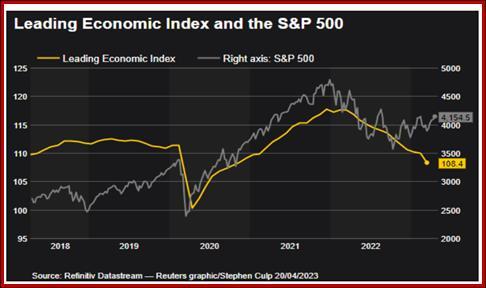
We suspect the mishmash of mostly bad economic data drove the scaredy-cats into the 1-month. As noted before, markets generally agree that recession is inevitable. The Conference Board names mid-year for it to begin and other measures, like the Philly Fed index, point that way, too, not to mention inverted yield curves all over the place. The housing market is already there. Bloomberg in particular has nothing but negative and doom/gloom headlines, even when there is little doomy and gloomy in the stories themselves. Some real evidence--crude oil prices fell to the lowest since March 12. Still, oil traders are notoriously panicky and overreactive to narratives.
This is probably not going to be the dog that didn’t bark in the night. In other words, we probably are going to get a recession, even as we suffer a labor shortage amid daily reports of this company or that sector shedding workers. As Chicago Fed Goolsbee said, this is a weird economy. And yet we also have sticky inflation and a Fed that persists in saying, mostly, it has not seen evidence the 2% target is going to get met anytime in the foreseeable future, so “higher for longer” is not a dead duck. And yet the CME Fed Watch tool shows only 6.5% expect the rate to be 5-5.25% by the Dec 13 meeting (the level we expect after the May hike, now only 11 days away).
It's messy, push-me/pull-you, and generally noisy. Reuters reports that Philly Fed Pres Harker said in a speech yesterday at Wharton was solid standard orthodoxy: “Some additional tightening may be needed to ensure policy is restrictive enough to support both pillars of our dual mandate. Once we reach that point, which should happen this year, I expect that we will hold rates in place and let monetary policy do its work.”
“Harker said the economy remains strong and inflation is coming down, albeit slowly. Compared to the 5% annualized rise in the personal consumption expenditures price index, he sees inflation falling to 3% to 3.5% this year and to 2% in 2025. Harker said the current 3.5% unemployment rate should move up to around 4.4% this year, in a period where growth will be tepid. The bank president also said that last month’s financial sector issues may show down the economy “but the full extent is still unclear.”
It doesn’t get more conventional, same-message than that (Waller, Mester, Bullard) It also verifies that the market, in the form of the Conference Board index and yields, is running headlong into the Fed. Some pundits say the market is always right and it just takes a while for the Fed to get the message and move into line. We would like to believe the Fed, really a Boy Scout troop, has a genuine commitment to the holy grail mandate to tame inflation and to hell with whether the landing is soft or hard. But the recession evidence is indeed piling up.
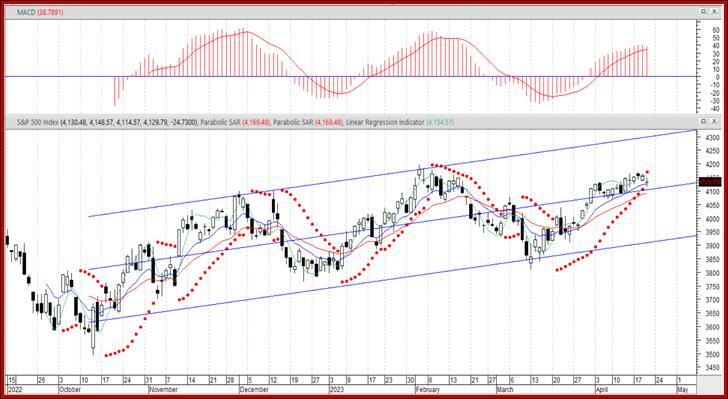
Forecast: The dollar consolidation that might have become an authentic rally seems to be ending, and the reason, insofar as there is one, is the interest rate outlook. The Fed is expected to stop at one more of 25 bp in May, while both the Bank of England and the ECB may have as much as 75 bp in store. Those hikes will just be getting their teeth into the respective economies when the Fed will be contemplating cuts, or so the Fed funds futures indicate. Somewhat strangely, this outlook is a buttress for the US stock market—don’t sell in May and go away because you will just be back in hardly any time at all. The MACD—the leading indicator of a downward correction—might point that way now but the overall trajectory is hardly gloomy.
This is an excerpt from “The Rockefeller Morning Briefing,” which is far larger (about 10 pages). The Briefing has been published every day for over 25 years and represents experienced analysis and insight. The report offers deep background and is not intended to guide FX trading. Rockefeller produces other reports (in spot and futures) for trading purposes.
To get a two-week trial of the full reports plus traders advice for only $3.95. Click here!
This is an excerpt from “The Rockefeller Morning Briefing,” which is far larger (about 10 pages). The Briefing has been published every day for over 25 years and represents experienced analysis and insight. The report offers deep background and is not intended to guide FX trading. Rockefeller produces other reports (in spot and futures) for trading purposes.
To get a two-week trial of the full reports plus traders advice for only $3.95. Click here!
Author

Barbara Rockefeller
Rockefeller Treasury Services, Inc.
Experience Before founding Rockefeller Treasury, Barbara worked at Citibank and other banks as a risk manager, new product developer (Cititrend), FX trader, advisor and loan officer. Miss Rockefeller is engaged to perform FX-relat
















