Shopify Earnings News: SHOP stock gets massacred as market scoffs at bare beat
- Canada's most important tech firm, Shopify, posted adjusted beat for Q1.
- GAAP EPS, however, fell to a loss due to higher costs.
- Q2 guidance shows some compression on margins.
- SHOP stock plunges 20% following earnings.


Shopify (SHOP) checked most of the boxes during its first-quarter earnings results late Tuesday, but that just wasn’t enough for the market’s outsized ambitions.
The eCommerce solution has traded down more than 20% on Wednesday morning as the broader market tumbles in tandem. Both the S&P 500 and NASDAQ are down more than 0.3% at the time of writing.
Shopify earnings: Not quite good enough
The major points of the earnings release were positive. Shopify earned $0.20 in adjusted earnings per share (EPS) in the first quarter on sales of $1.86 billion. That profit figure beat consensus by 3 cents per share. Revenue rose 23% YoY, beating the Wall Street consensus by $10 million.
However, investors drew ire from Shopify’s $-0.21 GAAP loss, which underperformed the $0.05 GAAP profit produced a year earlier. Management blamed higher marketing expenses and rising costs for its merchant and subscription units. Wall Street analysts had been expecting $0.08 in GAAP EPS.
The market also seemed to be annoyed that gross margin is forecast to fall by half a percentage point in Q2, but that just seems to be a result of gross margin rising four percentage points to 51.4% due to ending the company’s foray into logistics last year.
Additionally, changes in the company’s pricing for various seller plans may place further downward pressure on margins in the rest of the year.
CEO Harley Finkelstein was not dissuaded by the market’s reaction, calling his company its “strongest version” in Shopify’s short history.
Indeed, there are plenty of healthy data points from the quarter. For instance, gross payments volume grew to $36.2 billion compared to $27.5 billion a year earlier.
Shopify’s Merchant segment saw revenue rise 20% YoY, while its Subscription segment posted revenue 34% higher YoY.
Monthly recurring revenue rose 32% YoY to $151 million in March.
Nasdaq FAQs
The Nasdaq is a stock exchange based in the US that started out life as an electronic stock quotation machine. At first, the Nasdaq only provided quotations for over-the-counter (OTC) stocks but later it became an exchange too. By 1991, the Nasdaq had grown to account for 46% of the entire US securities’ market. In 1998, it became the first stock exchange in the US to provide online trading. The Nasdaq also produces several indices, the most comprehensive of which is the Nasdaq Composite representing all 2,500-plus stocks on the Nasdaq, and the Nasdaq 100.
The Nasdaq 100 is a large-cap index made up of 100 non-financial companies from the Nasdaq stock exchange. Although it only includes a fraction of the thousands of stocks in the Nasdaq, it accounts for over 90% of the movement. The influence of each company on the index is market-cap weighted. The Nasdaq 100 includes companies with a significant focus on technology although it also encompasses companies from other industries and from outside the US. The average annual return of the Nasdaq 100 has been 17.23% since 1986.
There are a number of ways to trade the Nasdaq 100. Most retail brokers and spread betting platforms offer bets using Contracts for Difference (CFD). For longer-term investors, Exchange-Traded Funds (ETFs) trade like shares that mimic the movement of the index without the investor needing to buy all 100 constituent companies. An example ETF is the Invesco QQQ Trust (QQQ). Nasdaq 100 futures contracts allow traders to speculate on the future direction of the index. Options provide the right, but not the obligation, to buy or sell the Nasdaq 100 at a specific price (strike price) in the future.
Many different factors drive the Nasdaq 100 but mainly it is the aggregate performance of the component companies revealed in their quarterly and annual company earnings reports. US and global macroeconomic data also contributes as it impacts on investor sentiment, which if positive drives gains. The level of interest rates, set by the Federal Reserve (Fed), also influences the Nasdaq 100 as it affects the cost of credit, on which many corporations are heavily reliant. As such the level of inflation can be a major driver too as well as other metrics which impact on the decisions of the Fed.
Shopify stock forecast
Shopify stock is trading at its lowest level since November of last year. SHOP stock will need to close back above $68, a level from recent lows, in order to regain neutral standing. For now, the violence is likely to continue.
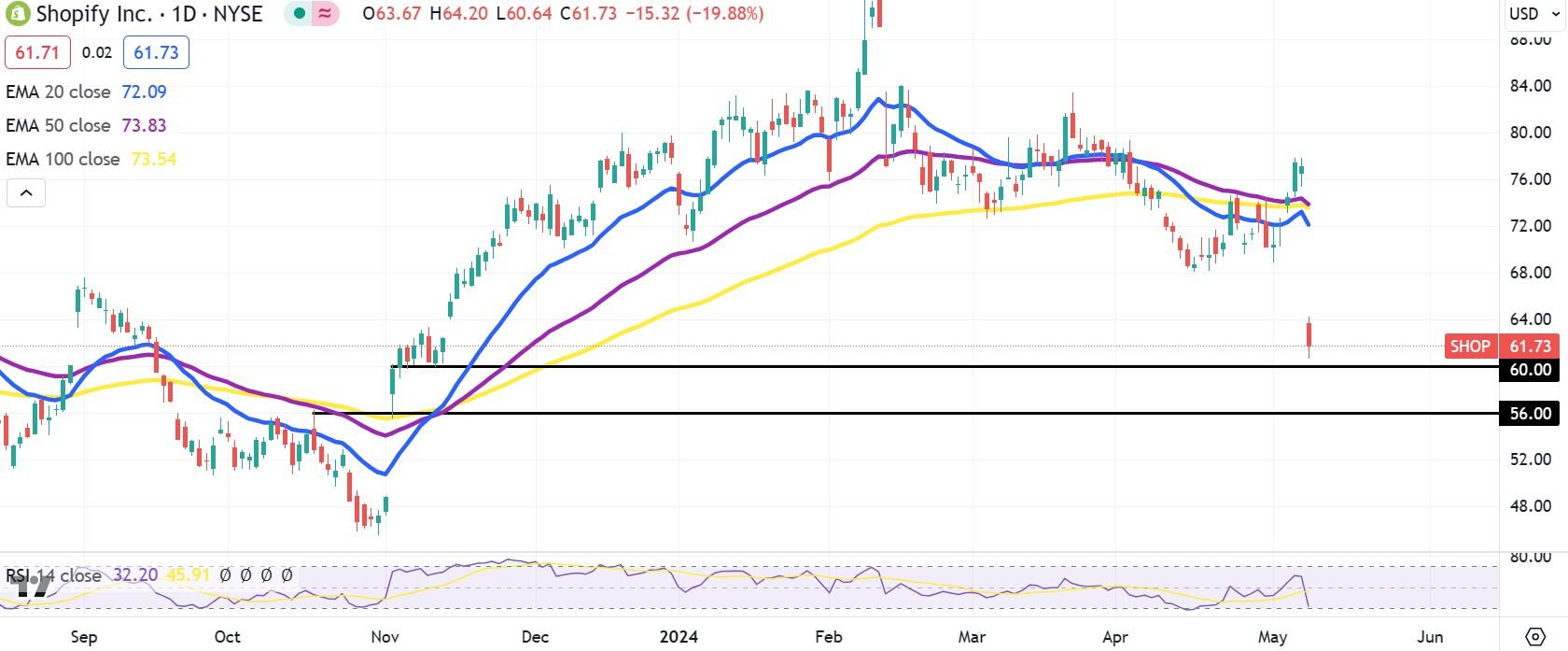
SHOP daily stock chart
Premium
You have reached your limit of 3 free articles for this month.
Start your subscription and get access to all our original articles.
Author
Clay Webster
FXStreet
Clay Webster grew up in the US outside Buffalo, New York and Lancaster, Pennsylvania. He began investing after college following the 2008 financial crisis.