Key Change That Nobody Talks About

Last week, everyone focused on the stock market sell-off. Reasonably enough, given the paceof the declines. But the analysts failed to pay enough attention to the very important shift. That change may be more important than Trump’s victory in the presidential election. Willthe critical switch make gold shine – or dull?
Three Important Legacies of Yellen’s Fed Tenure
A crucial change is behind us. Powell is the new boss. Yellen is out. For better or worse, shedoesn’t serve as the Fed Chair any longer. Although economists rated Yellen’s tenure veryhighly, President Trump didn’t renominate her for the position. Rightly or not? We don’t care.Let journalists debate endlessly – we will analyze the crucial Yellen’s imprints on the Fed, which could affect the gold market in the future.
First, Yellen focused mostly on the labor market, not without some successes. We don’tattribute it solely to her, but the unemployment rate fell from 6.7 to 4.1 percent under hertenure. As a reminder, the Fed has a dual mandate: maximum employment and stable prices. Although many Fed officials used to worry about high inflation, she was different. Yellendidn’t fear the uptick in inflation as long as there was a slack in the labor market. She, thus,believed that ultra low interest rates could and should stay near zero for far longer thanpreviously thought to combat unemployment. Yellen hiked them not earlier than in December2015. Since then, she gradually raised them to the range of 1.25 percent to 1.5 percent, whichis still very low. The gradual tightening was positive for gold, which would have likelystruggled more, had monetary policy been more aggressive. If Jerome Powell continuesthis cautious policy, gold may shine, despite rising interest rates.
Second, Yellen managed to start the unwinding of the Fed’s massive balance sheet, withouttriggering stock market turmoil. After unconventional actions of Bernanke, she had to getback to normal monetary policy, but not too fast. She definitely succeeded. If anything, the Fed is behind the curve. This is why gold wasn’t strongly hit by the Fed’s tightening.The U.S. central bank raised interest rates a few times, but the financial conditionsremained easy.
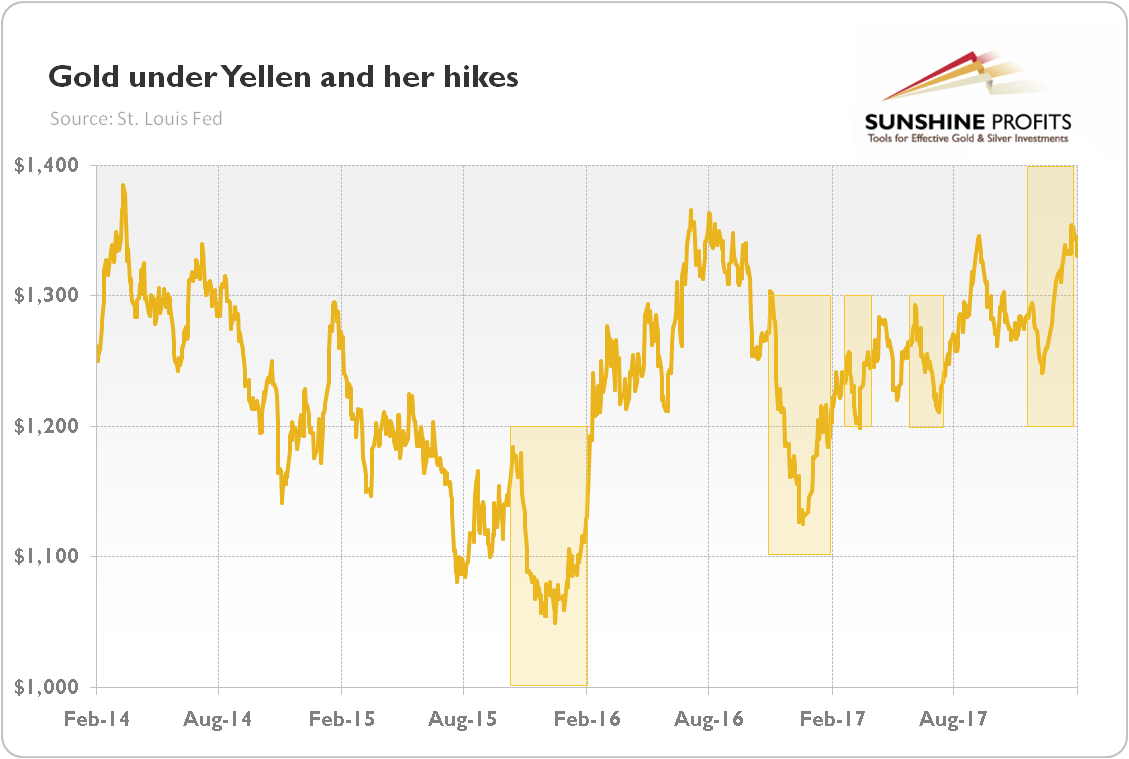
Third, Yellen mastered communication with the public. She held quarterly news conferencesand smoothly telegraphed the Fed’s moves well in advance. Thanks to well-plannedexpectations guidance, Yellen – contrary to Bernanke who triggered a taper tantrum by hisunexpected remarks in 2013 – avoided any major stumbles. The clear communicationtransformed gold’s reaction function. The yellow metal now reacts more to the changesin the rate hike expectations than to real monetary policy decisions. Sell the rumor, buythe fact – as one can see in the chart below.
Chart 1: Gold prices under Yellen’s Fed tenure
Jerome Powell – Great Continuator or Game Changer?
Jerome Powell is now the new Fed Chair. Analysts expect that he will continue Yellen’sstance. But will he? How you play depends on your opponent. Yellen faced a sluggishrecovery. But Powell sees tax cuts, higher economic growth, very low unemployment andperhaps finally rising wages. He will have to deal with the accelerating inflation, so Powellcould move faster on normalization. Actually, such a scenario scared some investors last weekinto deciding to sell their equities. As people weren’t sure what to expect of Powell, goodeconomic data turned out once again to be bad news for the financial markets. Surprisingly strong payrolls make traders to worry that the Fed will tighten its stance more. Hence, unlessPowell convinces the markets that he will continue Yellen’s gradual approach, gold mayreact paradoxically for a safe-haven: decline on bad news and rise on good news.
But will he intervene to calm the financial markets? We don’t bet on that. Greenspan cutinterest rates after the stock market declined 35 percent in the three months after he becamethe Fed Chair, but the current downturn is much smaller. Actually, we have seen somerebound since Friday. Another paradox: the correction in stock prices may help Powell indoing his job, because lower equity prices could relieve concerns about the formation ofdangerous asset bubbles.
Conclusions
The conclusion is clear: although the latest declines were a tough welcome for Powell, theymay actually be helpful for him. He is expected to continue Yellen’s policy. It is generallytrue, but economic conditions changed as well as the composition of the FOMC in 2018. It isnow more hawkish than last year.
Given these developments, the shift from Yellen to Powell may importantly strengthen thehawks among the Fed. Hence, unless the correction evolves into turmoil, we still expectthree (or even four) hikes this year. Indeed, according to CME data, the Fed remains ontrack to lift the federal funds rate in March. The market odds of a hike are above 75 percent.Higher interest rates should theoretically be negative for gold. But the usual link seemsto be broken now. The part of the answer is the U.S. dollar. Another issue is that we are inthe late stages of the economic cycle – as the cycle matures, volatility increases and investorsstart to buy more gold as a hedge.Tomorrow, we will see the newest CPI report, which may affect the markets, given thatinflation worries were one of the key reasons behind the recent stock market volatility. Staytuned!
Want free follow-ups to the above article and details not available to 99%+ investors? Sign up to our free newsletter today!
Author
Arkadiusz Sieroń
Sunshine Profits
Arkadiusz Sieroń received his Ph.D. in economics in 2016 (his doctoral thesis was about Cantillon effects), and has been an assistant professor at the Institute of Economic Sciences at the University of Wrocław since 2017.

















