Gold Price Forecast: XAU/USD retreated after testing the $2,200 mark

XAU/USD Current price: $2,177.23
- The US Dollar recovered despite not-so-encouraging United States macroeconomic data.
- Wall Street shrugged off the negative tone of its overseas counterparts and trades in the green.
- XAU/USD trades neutral in the near term, bullish pressure eased.
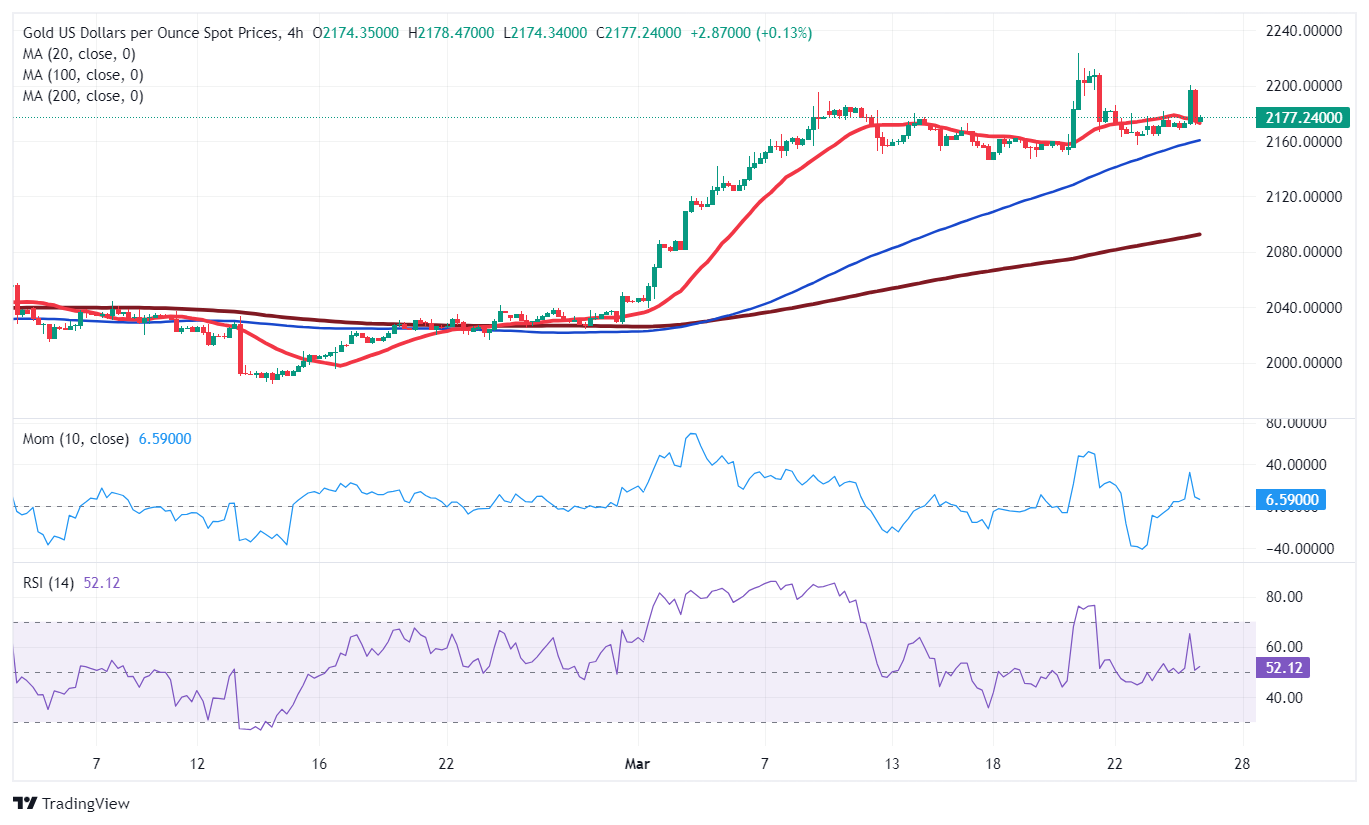
Gold surged early on Tuesday, pushing XAU/USD to $2,200.03. The pair retreated early in the American session and currently trades around its daily opening in the $2,170 region amid a broad US Dollar recovery. The Greenback maintained a weak tone throughout the first half of the day but changed course following the release of mixed United States (US) macroeconomic data.
The US published February Durable Goods Orders, which were up 1.4% in February, better than the 1.3% anticipated and reversing the previous 6.9% slump. Additionally, the Conference Board Consumer Confidence Index declined further in March to 104.7 from a downwardly revised 104.8 in February. The former February estimate was 106.7, the lowest reading in four months. The report showed that the Expectations sub-index, which measures consumers' short-term outlook for income, business, and labor market conditions, was sharply lower to 73.8. A reading below 80 indicates increased expectations of an upcoming recession. Finally, the Richmond Fed Manufacturing Index declined to -11 in March from -5 in the previous month.
The US Dollar recovered alongside Wall Street. American indexes shrugged off the soft tone of their overseas counterparts and trade in the green. Finally, government bond yields remain stable and below their recent highs.
XAU/USD short-term technical outlook
The XAU/USD daily chart shows the Momentum indicator diverging from price action. The indicator extended its slide within positive levels, while the bright metal posted a higher high and a higher low. The Relative Strength Index (RSI) indicator, on the other hand, advances near overbought readings. Finally, Gold keeps developing above bullish moving averages, with the 20 Simple Moving Average (SMA) heading sharply higher around $2,146.10, providing dynamic support.
The 4-hour chart shows easing bullish pressure, but there are no signs of an upcoming decline. XAU/USD keeps developing above all its moving averages, although the 20 SMA turned lower above bullish longer ones. Technical indicators, in the meantime, hover around their midlines without clear directional strength.
Support levels: 2,163.40 2,146.10 2,134.70
Resistance levels: 2,192.10 2,2006.45 2,222.65
Author

Valeria Bednarik
FXStreet
Valeria Bednarik was born and lives in Buenos Aires, Argentina. Her passion for math and numbers pushed her into studying economics in her younger years.
















