GBP/USD Forecast: Boris' Brexit move lifts the pound, potentially creating a sell opportunity
- GBP/USD has jumped above 1.29 after UK PM Johnson intervened in Brexit talks.
- Doubts about a breakthrough, Trump's coronavirus, and Non-Farm Payrolls could bring the cable back down.
- Friday's four-hour chart is showing minor upside momentum.

Taking it to the top-level – Prime Minister Boris Johnson will speak with European Commission President Ursula von der Leyen on Saturday. The news of the PM's intervention triggered hopes for a Brexit breakthrough and boosted the pound. However, there are reasons to doubt that sterling would hold onto these gains.
Johnson's move comes one day after von der Leyen announced legal action against the UK. Brussels sent a formal notice, which is the first step ahead of going to court on the Internal Markets Bill. The controversial legislation knowingly violates the Brexit Withdrawal Agreement and aims to fully derail the already sensitive talks on future relations.
Will the British leader cede ground to the bloc? That happened last year when he agreed to allow for a customs border on the Irish Sea. However, the IMB violates that concession, and the EU will likely be more skeptical. Moreover, the telephone call takes place when markets are closed, and investors may prefer to refrain from taking risk ahead of the weekend.
GBP/USD also faces pressures from the other side of the pond. Around six months after Johnson told the world he has coronavirus, President Donald Trump tweeted a similar message, adding to uncertainty ahead of the elections and supporting the safe-haven dollar.
There are several differences between the COVID-19 stories of both blond leaders. Johnson reported symptoms of coronavirus when little was known about it, and eventually became gravely ill. Trump was diagnosed due to exposure to his aide Hope Hicks and is reportedly doing perfectly well. Knowledge about treating the virus has substantially evolved since then.
Nevertheless, Trump is 74 years old and is overweight, thus being at higher risk. His rival Joe Biden is older and both men shared the same stage at the presidential debate on Tuesday. Uncertainty about the elections and also the fiscal stimulus package have substantially risen.
See Trump's coronavirus adds uncertainty in three ways, stocks have more room to fall
On Thursday, Republicans and Democrats failed to reach an agreement on the next relief deal. Friday's Non-Farm Payrolls report may push lawmakers into action, especially as it is expected to show a slowdown in job growth.
Economists expect an increase of around 850,000 positions in September and a minor drop in the unemployment rate from 8.4% to 8.2%. On the other hand, figures leading toward the publication beat estimates, opening the door to an upside surprise, lifting the dollar.
See
- Nonfarm Payrolls Preview: Eagerly waiting for an upbeat report
- US Employment Situation Report September Preview: A challenge to define normality
Overall, there is considerable potential that the current jump in GBP/USD may make way for a fall, as experienced in previous days.
GBP/USD Technical Analysis
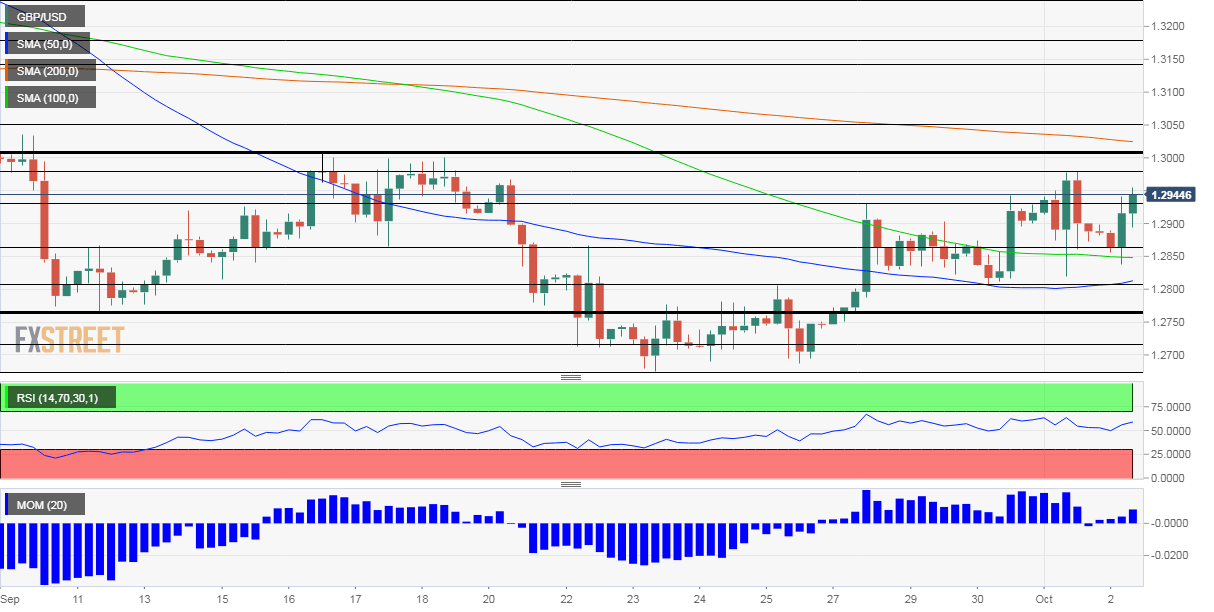
Pound/dollar has bounced off the 100 Simple Moving Average on the four-hour chart and is trading above the 50 SMA. On the other hand, it is depressed below the 200 SMA and upside momentum has yet to pick up.
Support is at 1.2860, a swing high from late September. It is followed by 1.2810, a low point early this week, and 1.2760, which separated ranges last week.
Resistance is at 1.2980, the weekly high, followed by 1.30, which is a round number and capped GBP/USD last week. Further above, 1.3050 looms.
More: Who will be the next president? Markets seem to care more about Congress' actions (for now)
Author

Yohay Elam
FXStreet
Yohay is in Forex since 2008 when he founded Forex Crunch, a blog crafted in his free time that turned into a fully-fledged currency website later sold to Finixio.
















