|

Nonfarm Payrolls Preview: Eagerly waiting for an upbeat report

  • The US is expected to have added modest 850K new jobs in September, but signs said otherwise.
  • The market focus is still on a possible stimulus package from the US Congress ahead of elections.
  • Dollar acting as safe-haven may continue to depend on sentiment with the NFP report.

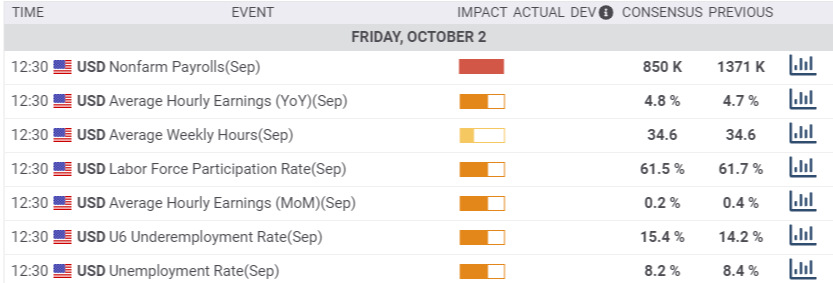
The US will publish this Friday its latest update on employment data. Expectations are that the country has added 850K new jobs in September, weaker than the previous month’s total of 1.37M. However, analysts are also expecting the unemployment rate to have ticked down to 8.2% from 8.4% in the previous month.
Politics and the pandemic get in the way

The Nonfarm Payroll report has a political component this time, as it will be the last before the US presidential election. Trump has been backed by solid macroeconomic numbers throughout the first three years of his mandate, but things changed this 2020 with the pandemic. The country lost over 20 million job’s positions between March and April when lockdowns were imposed globally to contain the outbreak.

The US rushed into reopening the economy, which resulted in quite a substandard recovery, at the expense of 7.4 million coronavirus contagions and over 210K deaths. Elections will be the result of the people’s judgment, on whether such cost worth it.

Positive hints suggesting an upbeat outcome

According to the latest ADP survey, the private sector added a significant amount of new jobs in September, 749K vs the 650K expected. The report indicated that the manufacturing sector was the one growing the most. Worth noting that the ADP report has trailed the Nonfarm Payroll report since the pandemic started, which somehow suggest a stronger-than-anticipated outcome for the monthly report.

Consumer confidence has also surged in September, according to CB and the University of Michigan, both reaching their highest since the pandemic started. Additionally, the ISM indexes showed that the employment sub-component has continued to improve.

The number of layoffs has increased in September to 118.804K from 115.762K in August, while JOLTS Job Openings showed that the number of hires increased to 6.61M in July.

On a negative note, weekly jobless claims are stubbornly stable above 850K per week, while the previous monthly report missed expectations and came in worse than the July reading.

US jobs report pre-release checklist – Oct 2nd, 2020

Previous Non-Farm PayrollsNegativeThe US economy added 1.37M jobs in August, slightly worse than expected and a smaller figure than in July.
Challenger Job CutsNeutralThe number of corporate layoffs has been steady around 115-120K for the last two months, two times higher than the pre-pandemic averages but far from the COVID-19 peak. 
Initial Jobless Claims NegativeFirst-time employment claims have stabilized around 870K for the last weeks, failing to continue the post-pandemic downtrend.
Continuing Jobless Claims NeutralThe number of unemployment benefit receivers keeps trending down, although at a slow pace, sitting at 12.58M in mid-September. 
ISM Services PMI PositiveThe employment sub-index in the US main services survey jumped over 5 points in August, continuing its recovery but still in contraction territory (47.9).
ISM Manufacturing PMI PositiveThe employment sub-index in the US main manufacturing survey keeps recovering, very close to jumping to positive territory, at 49.6 in September.
University of Michigan Consumer Confidence Index PositiveThe UMich consumer sentiment survey picked up in September rising to 78.9, a post-pandemic high.
Conference Board Consumer Confidence Index PositiveThe Conference Board Consumer Confidence Index® broke above 100 in September for the first time.
ADP Employment Report PositivePrivate sector employment added 749K jobs in September, a better-than-expected figure for an indicator that has lost correlation to the NFP during the pandemic.
JOLTS Job Openings PositiveThe number of hires rose to 6.61M in July, and although it is still a lagging indicator, it shows the recovery the US labor market saw during early summer months. 


Dollar’s possible reaction to different scenarios

Ahead of the release, the market is more interested in whether the US Congress would or would not agree on a stimulus package than on macroeconomic data.  The dollar is moving on sentiment. In this scenario, an upbeat report could play against the greenback, as stocks will likely advance. A disappointing number, on the other hand, could have the opposite effect, sending stocks lower and investors into the safe-haven dollar.

The Pound is tied to Brexit headlines, which means GBP/USD could be the less interesting pair to trade within the NFP release. Commodity-linked currencies, on the other hand, have been quite responsive to risk-sentiment, and hence, maybe the preferred ones to play.

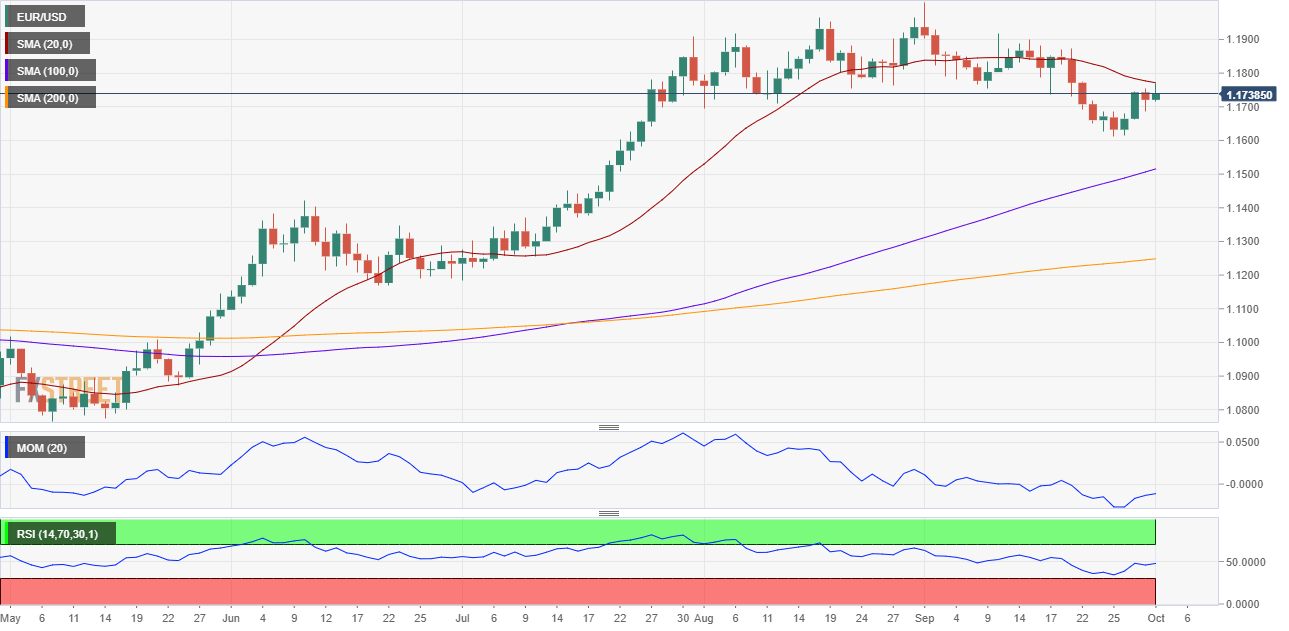
As for the EUR, the only reason for the pair to run is the dollar’s weakness. The shared currency is among the weakest high-yielding ones, which means a more interesting movement may take place should the report ends up boosting the dollar’s demand.
Author

Valeria Bednarik

Valeria Bednarik was born and lives in Buenos Aires, Argentina. Her passion for math and numbers pushed her into studying economics in her younger years.


More from Valeria Bednarik
Share:

Editor's Picks

AUD/USD remains above 0.7200 after China's trade data

AUD/USD sits above 0.7200 in the Asian session on Tuesday, near its highest level since May 14. The US Dollar stays under pressure as a rallying Japanese Yen outweighs support from hawkish Fed bets and geopolitical tensions. This, along with firming expectations for another RBA rate hike later this month, acts as a tailwind for the Aussie. However, mixed China trade balance data keep the pair restricted.

USD/JPY stabilizes at around 154.00 as markets assess BoJ outlook

USD/JPY fluctuates at around 154.00 in the American session on Tuesday after rebounding from the six-month low it touched below 153.00 earlier in the day. Nevertheless, the upside attempts resemble technical corrections for now as Japan's upbeat wage growth data and Q2 GDP revision cement bets on a BoJ rate hike next week and continue to support the Japanese Yen.

Gold holds around $4,400, but for how long?
Gold (XAU/USD) remains on the back foot during American trading hours on Tuesday, even as the US Dollar (USD) remains on the defensive. Rising Oil prices and expectations of a Federal Reserve (Fed) rate hike weigh on the precious metal. At the time of writing, XAU/USD trades around $4,400 after reaching an intraday high near $4,443.
XRP ticks up as bullish derivatives, EMA support signal breakout
Ripple (XRP) is grinding upward and getting closer to a short-term breakout above $1.40 on Tuesday. This uptick follows the remittance token's defense of support at $1.38, after a short-lived attempt to breach selling pressure at $1.50 last week.
Europe in focus: September 2026
Six major net contributors demanded substantial cuts to the European Commission’s proposed 2028–2034 EU budget. Germany, Denmark, the Netherlands, Austria, Finland and Sweden issued a joint position on 27 August calling for the nearly €2 trillion proposal to be reduced by several hundred billion euros and rejecting additional common EU borrowing.
Diesel’s record $100 warning: The oil shock hiding in plain sight

The Oil market may look calmer than it did a few months ago, but diesel is sending a very different message. The US diesel crack spread, the premium of ultra-low sulphur diesel futures over WTI, recently surged above $100 per barrel for the first time, reaching an intraday record of just over $102.00.