FOMC April Minutes: The first shoe drops
- Federal Reserve hints the time for talking rates may be here.
- FOMC minutes suggest rapid economic growth could tip policy.
- The minutes are an official and edited Fed communication.

“We are not even thinking about thinking about raising rates,” Federal Reserve Chair Jerome Powell, June 10, 2020.
Apparently, the governors have changed their minds.
Federal Reserve officials at the April meeting stated that improving economic growth would justify a discussion of interest rate policy, reported the minutes of the session issued at 2:00 pm on Wednesday.
“A number of participants suggested that if the economy continued to make rapid progress toward the Committee’s goals, it might be appropriate at some point in upcoming meetings to begin discussing a plan for adjusting the pace of asset purchases,” the meeting precis stated.
Growth and inflation
Economic growth and inflation in the US are running at rates that in any prior Fed would have alarm bells ringing and Treasury yields racing higher.
The US economy expanded at a 6.4% annual rate in the first quarter. The Atlanta Fed estimate for the second is running at 10.1%. Fed projections in March were for a 6.5% expansion this year.
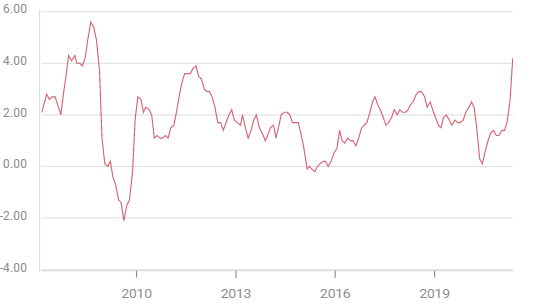
Consumer price inflation has tripled in four months. The Consumer Price Index (CPI) has jumped from 1.4% in January to 4.2% in April and is expected to continue at elevated levels for several months. Commodity prices are at a six year high and wages are beginnning to creep higher as businesses offer raises to secure workers.
CPI
Except for the April jobs numbers, which at 260,000 were barely one-quarter of the forecast total, the economy appears to be firing on all cylinders.
At the April meeting the Federal Reserve Open Market committee (FOMC) voted to keep the fed funds target range at 0.0% to 0.25%, where it has been since last March, and to continue buying $120 billion in bonds, split two-thirds in short-termTreasuries and one-third in mortgage backed assets.
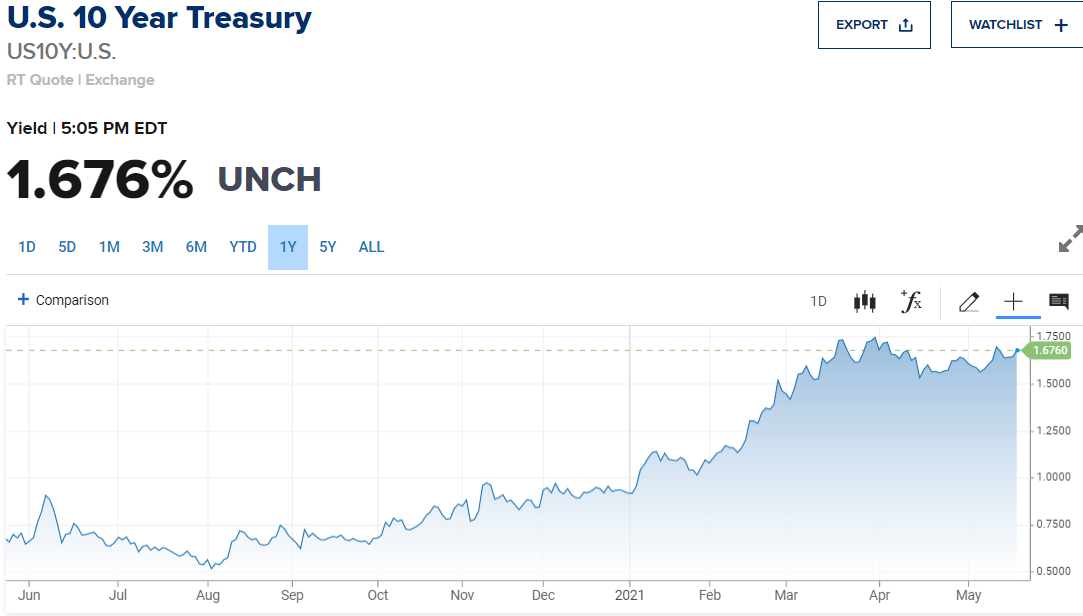
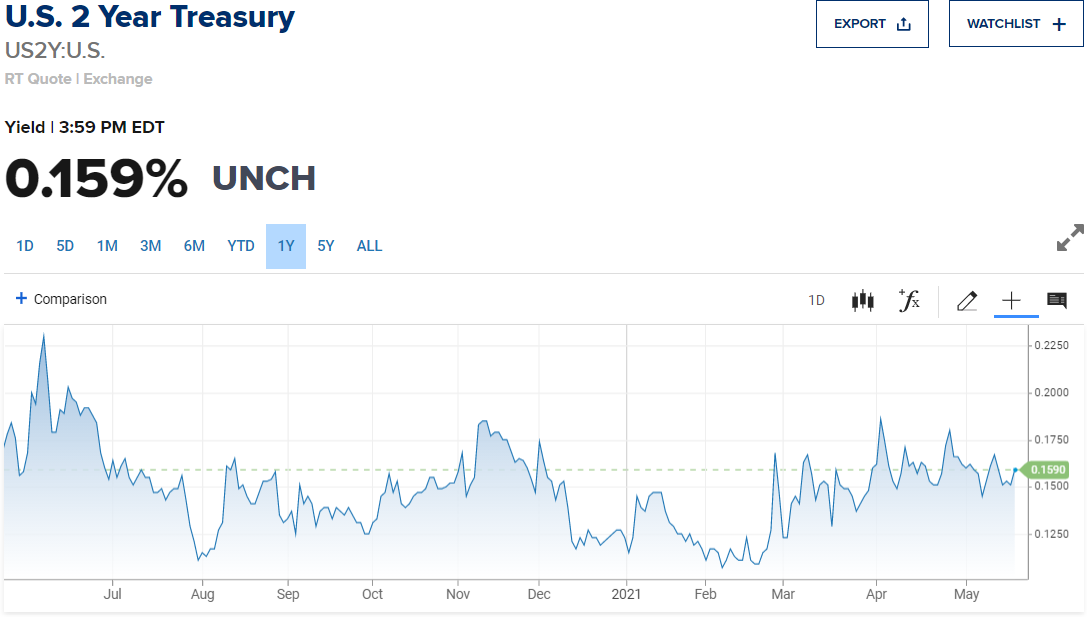
These purchases are concentrated at the short end of the yield curve and are the reason the 2-year yield has added but 4 basis points to to 0.159% this year while the 10-year has added 76 points to 1.676%.
Markets
Markets reacted swiftly to the potential policy change.
The 10-year bond rose 3 basis points to 1.676%, though it had been as high as 1.692% immediately after the release.
CNBC
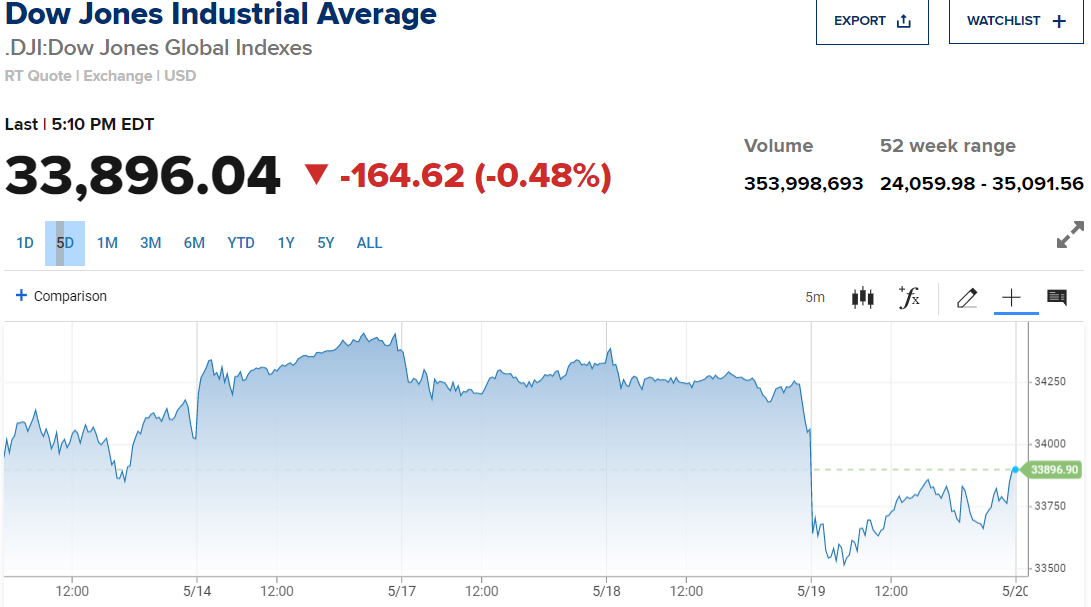
Equities sank at the release with the Dow losing as much as 472 points before recovering to close at 33,896.04, -164.62 points, -0.48%. The S&P 500 lost 12.15 points, 0.29%, to 4,115.68 and the NASDAQ shed 3.90 points, 0.03%, to 13,299.74.
CNBC
The dollar rose modestly in all the major pairs, adding about 35 points against the euro after the release and 48 on the day, closing at 1.2174. The USD/JPY rose 31 points to 109.21.
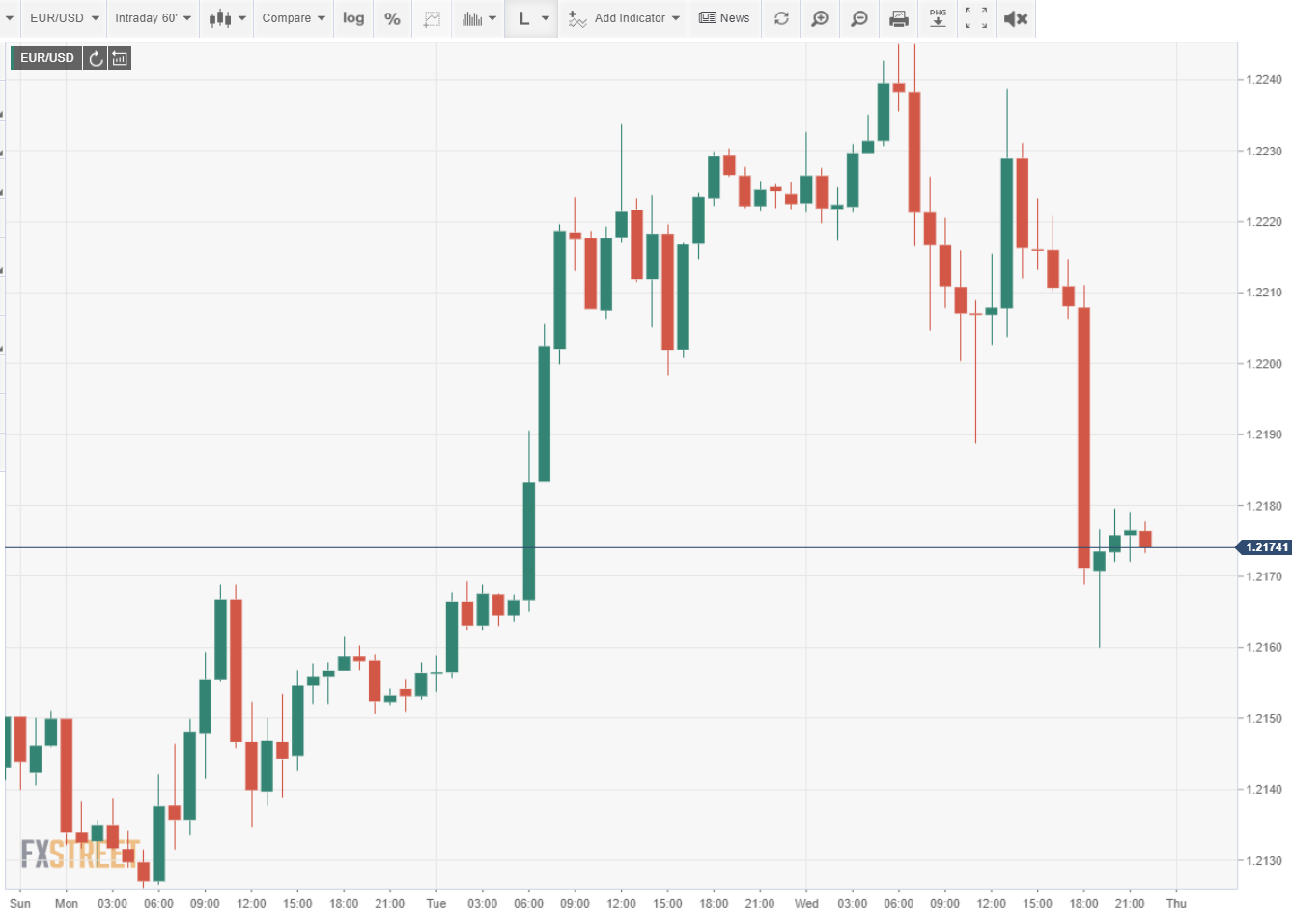
The edited minutes are an official Fed release. They are as much a part of policy communication as the FOMC statement itself.
Markets were restrained in their response, but this is the turning point in the pandemic battle.
Unless the economy falters, the next rate move is higher.
Author

Joseph Trevisani
FXStreet
Joseph Trevisani began his thirty-year career in the financial markets at Credit Suisse in New York and Singapore where he worked for 12 years as an interbank currency trader and trading desk manager.
















