EUR/USD Weekly Forecast: US Dollar rally has just begun
- Solid United States employment data smashed the odds for an interest rate cut.
- Hotter-than-anticipated European inflation to maintain the ECB on the dovish path.
- EUR/USD faces immediate resistance at 1.0197, the September 2022 monthly high.

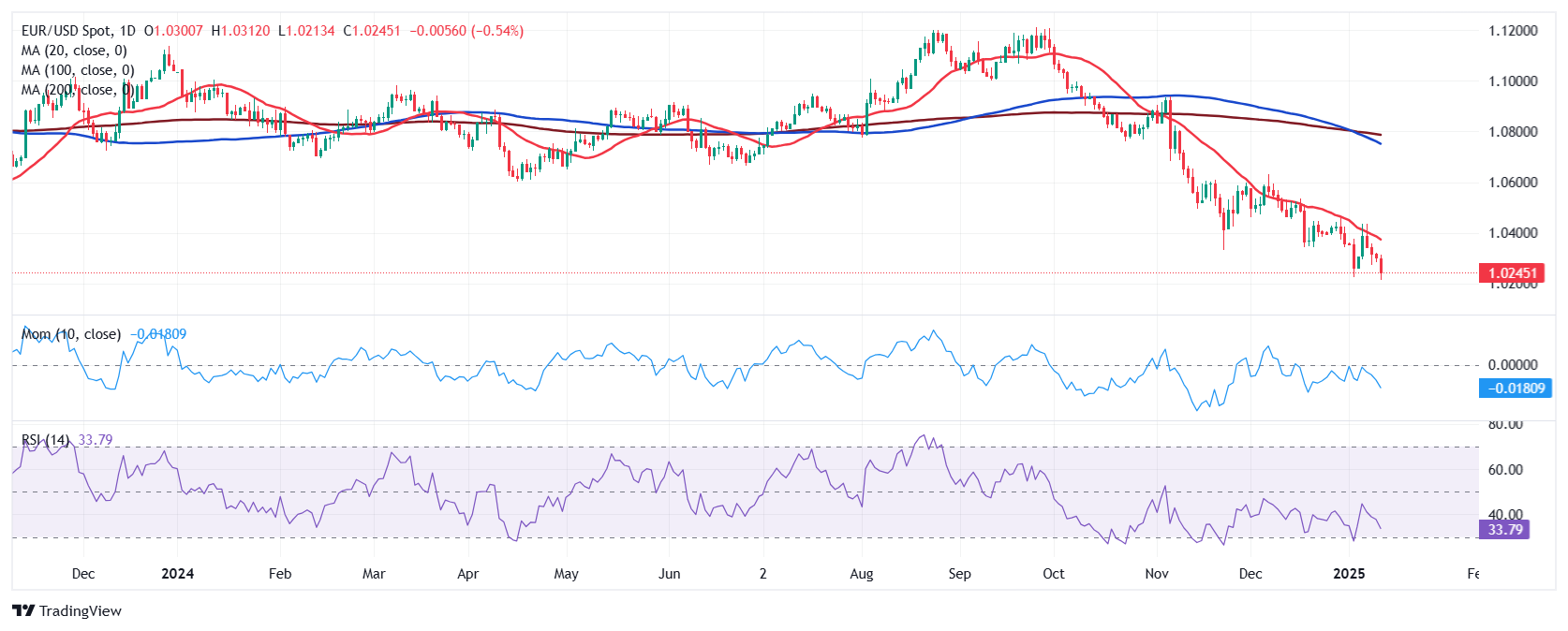
The EUR/USD pair remained under selling pressure this week, with the US Dollar (USD) retaining its overall strength. The Greenback benefited from risk-aversion bouts, triggered by United States (US) President-elect Donald Trump’s tariffs plan. The pair heads into the weekend trading at around 1.0250, not far from the multi-year low posted on Friday at 1.0212.
Trade-war: Trump tariffs heat financial boards
The Washington Post reported on Monday that Donald Trump's transition team was working on narrowing tariffs, focusing only on key sectors deemed vital to national security, such as defence, medical supplies and energy, narrowing the universal tariffs plan that Trump anticipated during his campaign. Latter in the day, however, Trump denied the headlines, saying that the story about paring back tariffs was wrong.
The EUR/USD pair jumped to 1.0431 with the initial headlines, as markets welcomed the idea of limited tariffs. Trump’s denial, on the other hand, boosted the US Dollar (USD) while sending stocks into a selling spiral.
Fears resumed mid-week when CNN reported that Trump was considering declaring a national economic emergency to impose widespread tariffs. Using the International Economic Emergency Powers Act (IEEPA) will unilaterally authorize a president to manage imports during a national emergency.
FOMC Minutes: Politics should not be in the way, but they are
The Federal Open Market Committee (FOMC) released the Minutes of the December Federal Reserve (Fed) monetary policy meeting on Wednesday, and the document brought some negative headlines.
Yet what caught investors’ attention is that the Minutes showed almost all members judged that the upside risk to inflation has increased. Officials mentioned “potential changes in trade, immigration, fiscal, and regulatory policies” as the reasons behind their fresh growth and inflation-related concerns. Without saying it, officials said they are concerned about what Trump’s policies would mean to the economy.
Solid US employment data
Meanwhile, the US released multiple employment figures. The December ADP Employment Report showed that the private sector added 122K new jobs in the month, missing expectations of 140K. Additionally, Initial Jobless Claims for the week ended January 3 increased by 201K, better than the 218K expected and below the previous 211K. Also, US-based employers announced 38,792 cuts in December, a 33% decrease from the 57,727 cuts announced one month prior. It is up 11% from the 34,817 cuts announced in the last month of 2023, according to the Challenger Job Cuts report.
Finally, on Friday, the US published the Nonfarm Payrolls (NFP) report, which showed 256,000 new jobs were added in December. The reading was much stronger than the 160,000 anticipated and the November 212,000 reading. Even further, the Unemployment Rate edged lower to 4.1% from 4.2%, while the Labor Force Participation remained steady at 62.5%. Finally, annual wage inflation, as measured by the change in the Average Hourly Earnings, declined to 3.9% from 4%.
Markets turned risk-averse with the news, with the US Dollar rallying and stocks plummeting, as such figures suggest the Federal Reserve (Fed) will refrain from cutting interest rates in the upcoming months.
No good news in Europe
European data fell once again short of encouraging. The preliminary estimate of the German Harmonized Index of Consumer Prices (HICP) was higher than anticipated, as the index rose 2.8% on its yearly comparison, above the 2.6% anticipated and the previous 2.4%. Retail Sales in the country fell 0.6% in November, while Factory Orders declined by 5.4% in the same period.
The Eurozone HICP rose 2.7% in the year to December as expected, yet the Producer Price Index (PPI) was down 1.2% YoY in November, higher than the previous -3.3% or the -1.3% expected.
The European Central Bank (ECB) will likely continue trimming interest rates. That would keep the Euro on the downside, while a hawkish Fed means a stronger US Dollar. EUR/USD at parity is in the foreseeable future.
For the upcoming week, the focus will be on the US Consumer Price Index. The country will publish it next Wednesday, and Retail Sales will be published on Thursday. Other than that, the macroeconomic calendar has little relevant to offer.

EUR/USD technical outlook
From a technical perspective, the EUR/USD pair is down for a fifth consecutive week and there are no technical signs that suggest an interim bottom is nearby. Indeed, EUR/USD is oversold in the weekly chart, yet the Relative Strength Index (RSI) indicator keeps heading south despite being at 28. The Momentum indicator in the same chart bounced just modestly from extreme levels but remains far below its midline, not enough to suggest an upcoming bounce. Finally, the 20 Simple Moving Average (SMA) has accelerated its slump and crossed below a flat 100 SMA, reflecting sellers’ strength.
In the daily chart, EUR/USD has plenty of room to extend its slide. Technical indicators head south within negative levels, still far from oversold readings. Even further, the EUR/USD pair posted lower lows after a couple of failed attempts to overcome a bearish 20 SMA, currently providing dynamic resistance at around 1.0380. In the same chart, the 100 SMA crossed below the 200 SMA after holding above it for roughly five months. Both moving averages stand around the 1.0800 level, not only anticipating additional slides but also reflecting sellers’ strength.
September 2022 high at 1.0197 is the immediate support level, ahead of the 1.0100 figure. A break below the latter exposes parity, albeit further slides seem unlikely in the upcoming days. The 1.0300 - 1.0330 area provides near-term support ahead of the 1.0400 mark.
US Dollar PRICE Last 7 days
The table below shows the percentage change of US Dollar (USD) against listed major currencies last 7 days. US Dollar was the strongest against the British Pound.
| USD | EUR | GBP | JPY | CAD | AUD | NZD | CHF | |
|---|---|---|---|---|---|---|---|---|
| USD | -0.04% | 1.03% | -0.19% | 0.02% | 0.52% | 0.40% | 0.30% | |
| EUR | 0.04% | 1.05% | -0.15% | 0.05% | 0.54% | 0.43% | 0.33% | |
| GBP | -1.03% | -1.05% | -1.16% | -0.99% | -0.50% | -0.61% | -0.71% | |
| JPY | 0.19% | 0.15% | 1.16% | 0.20% | 0.69% | 0.58% | 0.48% | |
| CAD | -0.02% | -0.05% | 0.99% | -0.20% | 0.48% | 0.38% | 0.28% | |
| AUD | -0.52% | -0.54% | 0.50% | -0.69% | -0.48% | -0.11% | -0.21% | |
| NZD | -0.40% | -0.43% | 0.61% | -0.58% | -0.38% | 0.11% | -0.10% | |
| CHF | -0.30% | -0.33% | 0.71% | -0.48% | -0.28% | 0.21% | 0.10% |
The heat map shows percentage changes of major currencies against each other. The base currency is picked from the left column, while the quote currency is picked from the top row. For example, if you pick the US Dollar from the left column and move along the horizontal line to the Japanese Yen, the percentage change displayed in the box will represent USD (base)/JPY (quote).
Author

Valeria Bednarik
FXStreet
Valeria Bednarik was born and lives in Buenos Aires, Argentina. Her passion for math and numbers pushed her into studying economics in her younger years.














