EUR/USD Weekly Forecast: Awful Nonfarm Payrolls back Fed’s “lower for longer” rates
- US employment data disappointed big in April, spurring a dollar sell-off.
- Beyond employment, US macroeconomic figures suggest a substantial economic comeback.
- EUR/USD has room to extend its advance once beyond the 1.2150 resistance level.

Mixed US data and cooling expectations for higher rates in the country fueled risk-appetite heading into the weekend. EUR/USD trades around 1.2140, recovering all of the previous week´s losses and nearing its monthly high at 1.2150. Quite a disappointing US employment report has fueled the dollar’s sell-off at the end of the week, as the numbers confirmed the US Federal Reserve stance of keeping rates lower for longer.
Earlier in the week, US Federal Reserve voting members repeated chief Jerome Powell´s message. Inflation could rise in the upcoming months, but such an advance would likely be temporary and would not trigger any alarm, nor would it force their hands into changing the current ultra-loose monetary policy. Wall Street rallied, with the DJIA reaching record highs, while US Treasury yields held at the lower end of their latest range, far below the peaks seen early in April.
Border reopenings could revive the services sector
The American economic comeback has become more evident in the last few days. What is also clear is that the country is recovering at a faster pace than its major counterparts. The immediate consequence is soaring stocks amid confidence in future developments, to the detriment of the dollar’s demand against high-yielding rivals. However, gains are limited, with the EUR/USD pair developing far below its 2021 peak at 1.2349.
The EU economy is also turning the corner from the coronavirus crisis. Officials have begun analyzing easing travel restrictions on the bloc as the immunization campaign has gathered speed. At both shores of the Atlantic, the services sector has been the most battered by the pandemic-related restrictions. Borders reopening this summer is what it takes to complete reviving the economy. The US is also ahead of the Union in this matter, as some states already offer coronavirus vaccines to tourists.
Good news and bad news
German data surprised on the upside. March Retail Sales soared 7.7% MoM, while Factory Orders in the same month rose a whopping 27.8% YoY, largely surpassing the market’s expectations. EU Retail Sales were up 12% in the same period, while the Producer Price Index hit 4.3% YoY.
Markit published the final readings of its April PMIs estimates, which suffered downward revisions. Nevertheless, the manufacturing sector continued to expand in the month at a solid pace, with the German index printing at 66.2. Services output, however, returned to contraction territory as the PMI for the county resulted in 49.9, while that of the whole Union was confirmed at 50.5.
The US official ISM Manufacturing PMI came in at 60.5, while the ISM Services PMI printed at 62.7, both below expected but largely signaling a continued expansion in both sectors. The focus, however, was put on employment-related data. The latest weekly unemployment claims report contracted to 498K, its lowest reading since February 2020. Worth noting that such a contraction in unemployment benefits does not count on the April Nonfarm Payroll report, which collects data up to two weeks before the release.
However, official data showed that the US added a measly 266K new jobs in April, far below the almost 1 million expected. The unemployment rate increased to 6.1%, instead of decreasing to 5.8%, while the participation rate increased modestly to 61.7%. Wages rose by more than anticipated, but resulted way below average, adding to the market’s concerns. Finally, stocks retreated with the figures, while US Treasury yields plunged.
What’s next in the calendar
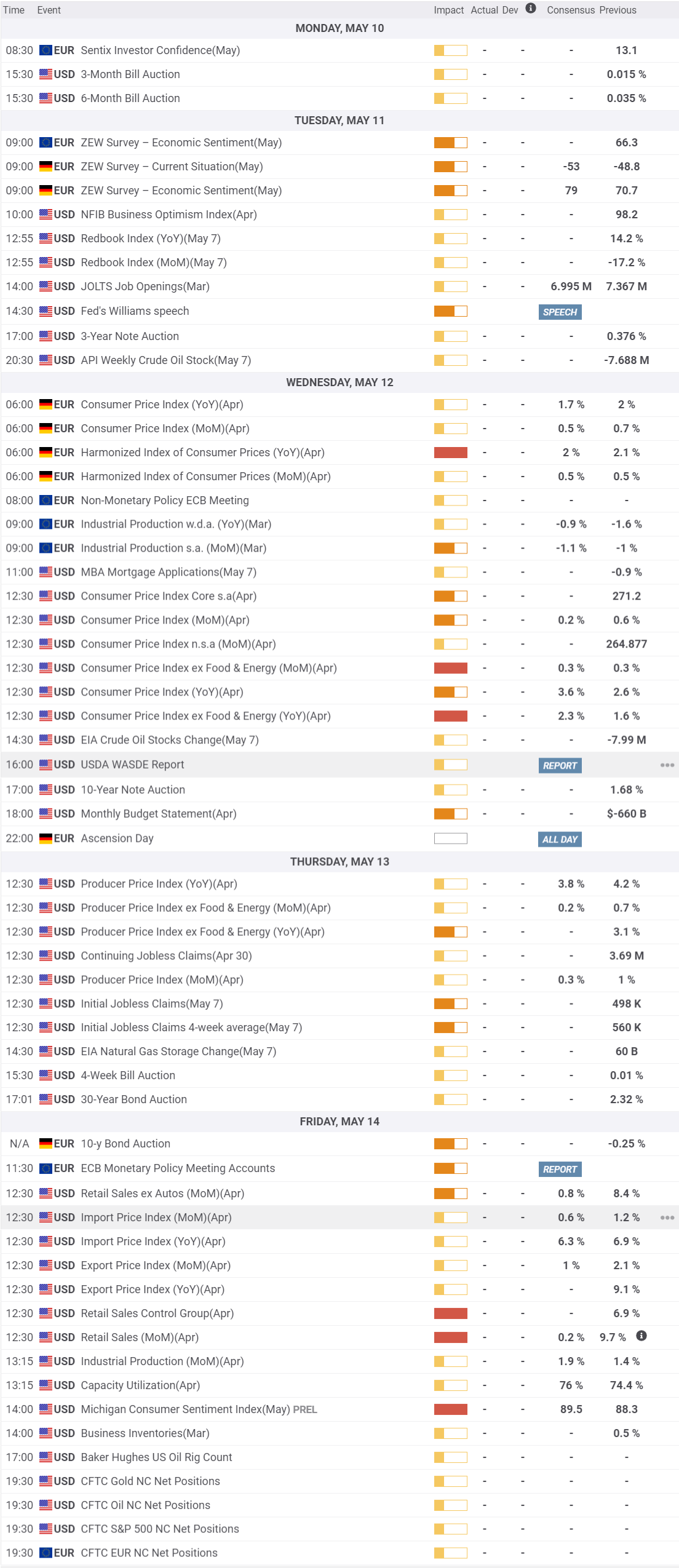
The upcoming one will be a light-data week. The most relevant macroeconomic event will be US April Retail Sales to be released next Friday. The same day the US will publish the preliminary estimate of the May Michigan Consumer Sentiment Index, foreseen at 89.5 from 88.3 in April. On Wednesday, the country will release April inflation figures, although their impact will likely be more limited than usual.
On Monday, the EU will unveil May Sentix Investor Confidence, while on Tuesday, Germany will publish the May ZEW Survey on Economic Sentiment, expected to have improved after April’s disappointment. The country will also release April inflation figures later into the week.
EUR/USD technical outlook
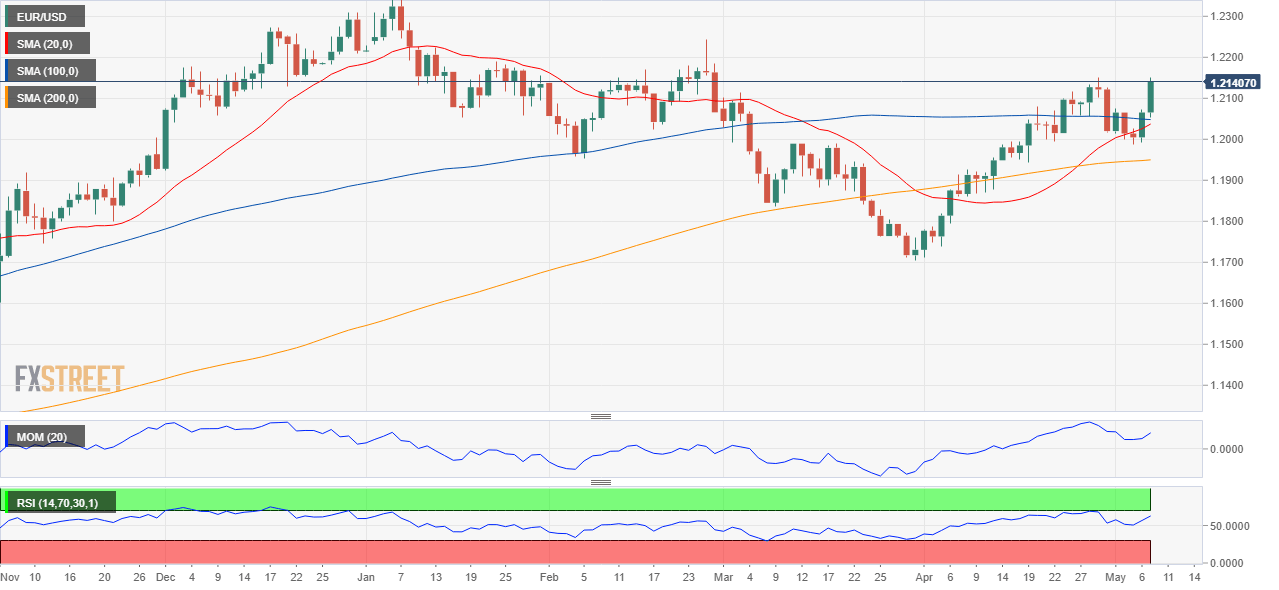
The EUR/USD pair is currently trading near its April monthly high and seems poised to extend its advance in the days to come. The long-term picture indicates that investors are yet to make up their minds, but the risk remains skewed to the upside. The weekly chart shows that the pair keeps seesawing around a directionless 20 SMA closing above it. The longer moving averages remain far below the current level, maintaining their bullish slopes. Technical indicators have turned back north but within neutral and familiar levels.
On a daily basis, EUR/USD lacks momentum, but the risk is skewed to the upside. The pair is developing above all of its moving averages, with the 20 SMA advancing but still below a directionless 100 SMA. The Momentum indicator is holding just above its midline, although the RSI indicator picked up, aiming north at around 60.
A steeper advance could be expected on a break above 1.2150, heading toward 1.2242, March’s monthly high. Beyond this last, the main bullish target is 1.2349, this year´s high. 1.2045 is the immediate support level, followed by 1.1980. A daily close below this last could open the door for a downward extension toward the 1.1870 price zone.
EUR/USD sentiment poll
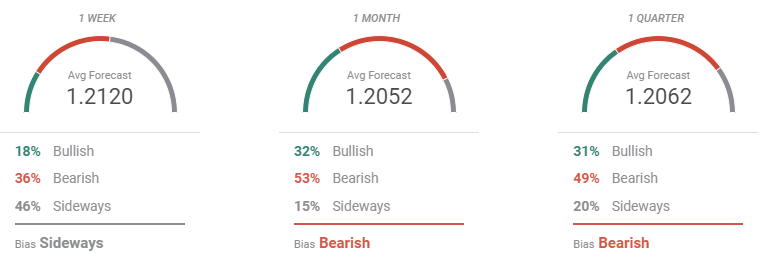
The FXStreet Forecast Poll shows that speculative interest believes that at some point, the dollar will have to advantage its major rivals amid the faster pace of recovery. In the case of the EUR/USD pair, it’s expected to remain around the current levels, above the 1.2100 threshold, with those looking for little action being the most. The bearish case gains adepts as time goes by, as the pair is expected to fall according to the monthly and quarterly perspectives. Worth noting that bears are around 50% of the polled experts in both cases and that the pair is seen anyway holding above 1.2000.
The Overview chart indicates that higher targets are becoming more likely. The weekly moving average aims higher with a nice accumulation around 1.2200. The monthly moving average also turned north, as the downward potential has decreased. The picture is mixed in the longer-term perspective, as there’s a large accumulation of possible targets in the 1.17/1.20 region, although there are also higher highs that balance the average.
Related Forecasts:
GBP/USD Weekly Forecast: Can America's cooldown send sterling above 1.40? UK GDP, US consumer eyed
Author

Valeria Bednarik
FXStreet
Valeria Bednarik was born and lives in Buenos Aires, Argentina. Her passion for math and numbers pushed her into studying economics in her younger years.
















