The election, Trump's Dollar policy, and the future of the Yen
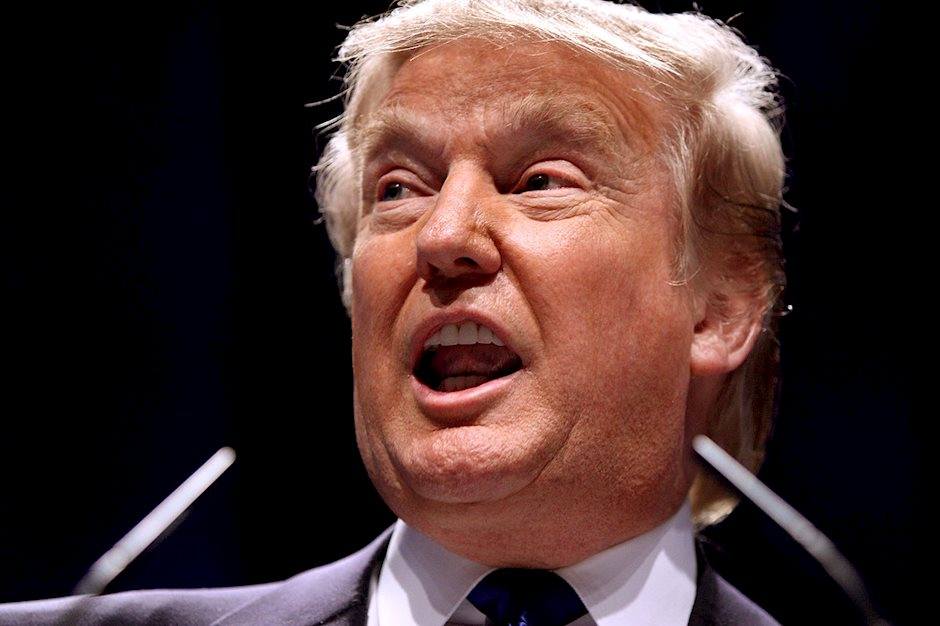

After an assassination attempt on former President Donald Trump and drop out of President Biden, Kamala Harris has been endorsed as the Democratic candidate to compete against Trump in the upcoming November US presidential election. This crucial election will significantly impact the markets, the future of the US dollar, and the economy.
In November, all seats in Congress and one-third of Senate seats will be up for election. There are 34 Senate seats at stake. Currently, 23 seats are held by Democrats or their allies, and 11 by Republicans. Polls indicate a slight Republican advantage in both the Senate and Congress.
Recent polls show Donald Trump leading Kamala Harris in several key swing states for the 2024 presidential election:
Nevada: Trump leads by 10 points (50% to 40%).
Florida: Trump leads by 10 points (49% to 39%).
Arizona: Trump leads by 6 points (48% to 42%).
Georgia: Trump leads by 10 points (51% to 46%).
Wisconsin: Trump is tie (48% to 48%)
Pennsylvania: Varies by poll, with one showing Trump leading by 2 points (45% to 43%).
Virginia: Harris leads by 5 points (49% to 44%).
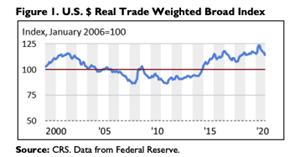
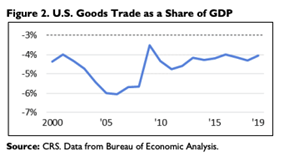
The US trade deficit in goods has surpassed $1 trillion annually. To address this issue, Republicans propose implementing baseline tariffs on foreign-made goods, passing the Trump Reciprocal Trade Act, and tackling unfair trading practices. Their argument suggests that as tariffs on foreign producers increase, it could potentially allow for reduced taxes on American workers, families, and businesses. The Trump administration's strategy aims to boost exports while reducing imports, which, according to traditional economic theory, would tend to strengthen the US dollar. However, it's important to note that the actual economic outcomes of such policies can be complex and may not always align with theoretical predictions.
Source: Congressional research service
Source: Congressional research service
From 2002 to 2008, the US dollar depreciated by 25%, yet the merchandise trade deficit increased by 75%, suggesting factors beyond exchange rates were at play. Similarly, between 2011 and 2018, the dollar appreciated by 26%, accompanied by a 20% rise in the trade deficit. This persistent trade deficit, spanning decades despite currency fluctuations, indicates that fundamental economic factors are more influential than exchange rates alone. These factors include interest rate differentials, the Fisher effect, and inflation differentials such as Purchasing Power Parity (PPP). Additionally, the US dollar's status as a key reserve currency and safe haven asset further complicates its relationship with trade balances.
Source: Adopted from Reuters
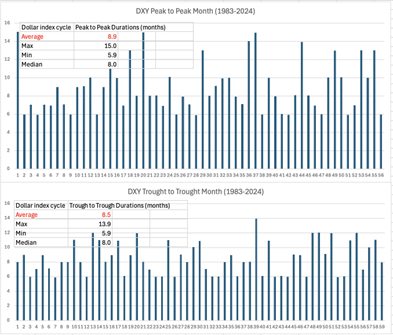
Historical patterns suggest the US dollar typically peaks every 8 months on average, with the most recent peak occurring in October 2023. Based on this trend, the next peak could be expected around July 2024. However, current Federal Reserve fund rate futures indicate a 91.7% probability of a 25 basis point rate cut in the near term. Furthermore, market expectations suggest one or two additional rate cuts by December. These anticipated rate reductions are likely to exert downward pressure on the US dollar, potentially weakening it before the September Federal Open Market Committee (FOMC) meeting.
Though Trump still leads in the polls, Joe Biden's exit from the presidential race has caused investors to unwind Trump-trade positions, increasing market volatility. The Cboe Volatility Index (.VIX) reached its highest level since April 2024. This has led to speculation that the Federal Reserve will cut rates due to rising unemployment and easing CPI, weakening the US dollar.
Comparing the US to a contrasting country, Japan presents a different monetary approach. Over the past three years, the Japanese yen has experienced a persistent decline, losing more than one-third of its value since the start of 2021. This sustained weakening has significantly altered Japan's currency landscape, impacting its economic competitiveness and trade dynamics. Japan's Ministry of Finance has asked the Bank of Japan to intervene in the currency market and expedite interest rate hikes to strengthen the yen.
Source: deriv MT5
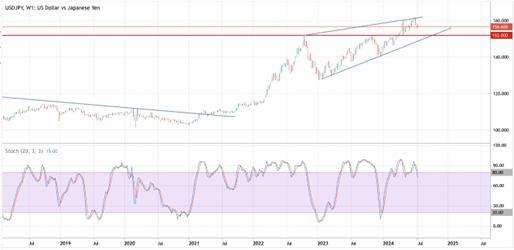
Technical analysis of the USD/JPY shows a recent correction from 161.94 to 155.36, suggesting that if the 158.85 resistance holds, a further decline towards the 152 support level is expected. The stochastic indicator is in the overbought zone, rejecting the resistance level, and is likely to prompt USD/JPY to test the support.
Conclusion
The upcoming US election between Kamala Harris and Donald Trump promises to significantly impact markets, the US dollar, and the economy. With Trump leading in key swing states and Republicans showing an edge in congressional polls, major policy shifts are possible. While Trump's strategy aims to boost exports which may potentially strengthen the dollar, multiple factors influence currency dynamics. Expected Federal Reserve rate cuts could weaken the dollar, contrasting with Japan's efforts to bolster the yen. These divergent approaches underscore the complex interplay of global economic forces. As the election approaches, traders should prepare for market volatility and currency shifts. The result could significantly change US economic policies and international relations, making it a pivotal event in the months ahead.
Author
Prakash Bhudia
Deriv
Prakash Bhudia, HOD – Product & Growth at Deriv, provides strategic leadership across crucial trading functions, including operations, risk management, and main marketing channels.