EUR/USD Price Forecast: Bears looking to defy the 1.0800 mark

EUR/USD Current price: 1.0845
- The European Central Bank trimmed interest rates by 25 bps as expected.
- Upbeat United States data pushed the US Dollar into fresh weekly highs.
- EUR/USD is oversold in the near term, but there are no signs of downward exhaustion.
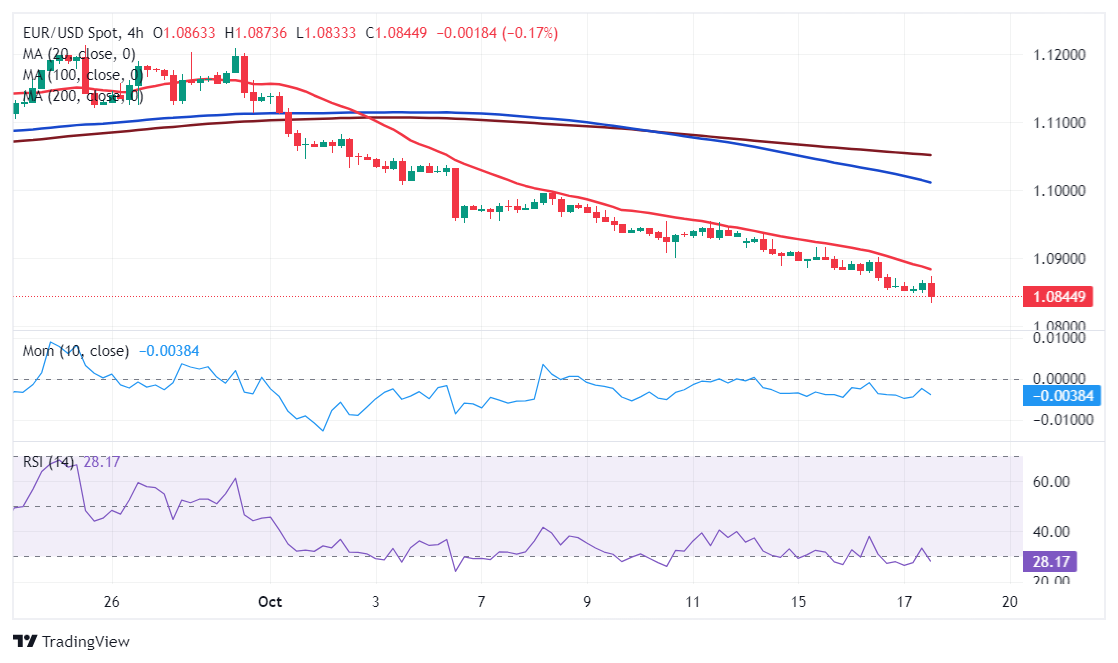
The EUR/USD pair remained under pressure throughout the first part of Thursday, bottoming at 1.0848 ahead of the European Central Bank (ECB) monetary policy decision and United States (US) macroeconomic data. Additionally, market players started looking at the US Presidential run, as polls show a very tight result three weeks ahead of the election.
The ECB decided to lower the benchmark interest rate, the so-called Rate on Deposit Facility, by 25 basis points (bps) from 3.5% to 3.25%. In fact, the three key ECB interest rates were lowered by 25 bps. The accompanying statement noted that “the disinflationary process is well on track,” albeit adding that “domestic inflation remains high, as wages are still rising at an elevated pace.”
The announcement had a limited impact on EUR/USD, with the pair seesawing within a 15 pips’ range. Anyway, the pair dipped to fresh multi-week lows following the release of upbeat US data. The country published September Retail Sales, which rose by 0.4% in the month, while the Philadelphia Fed Manufacturing Survey jumped to 10.3 in October from 1.7 in September. Finally, Initial Jobless Claims for the week ended October 11 rose by 241K, below the 260K anticipated.
As ECB President Christine Lagarde starts the press conference, the EUR/USD pair keeps approaching the 1.0800 mark.
EUR/USD short-term technical outlook
From a technical perspective, the EUR/USD pair is poised to extend its slump. The daily chart shows it continues to post lower lows and lower highs and that it is currently developing below all its moving averages. The 20 Simple Moving Average (SMA) keeps gaining downward traction, although well above directionless 100 and 200 SMAs. Technical indicators, in the meantime, maintain their firmly bearish slopes, reaching oversold readings yet without signs of downward exhaustion.
In the near term, and according to the 4-hour chart, the risk also skews to the downside. A bearish 20 SMA keeps providing intraday resistance, currently at around 1.0885, while the longer ones accelerate south above the shorter one. At the same time, the Momentum indicator hovers directionless within negative levels, while the Relative Strength Index (RSI) indicator heads south at around 26, still favoring another leg south despite oversold conditions.
Support levels: 1.0805 1.0770 1.0735
Resistance levels: 1.0885 1.0920 1.0960
Author

Valeria Bednarik
FXStreet
Valeria Bednarik was born and lives in Buenos Aires, Argentina. Her passion for math and numbers pushed her into studying economics in her younger years.

















