|

EUR/USD Forecast: Waiting for Biden and the Fed

EUR/USD Current Price: 1.1883

  • The US Federal Reserve is set to release the Minutes of its latest meeting.
  • Markit upwardly revised its Services PMIs for the Union in March.
  • EUR/USD is overbought in the near-term, the bearish potential is still limited.
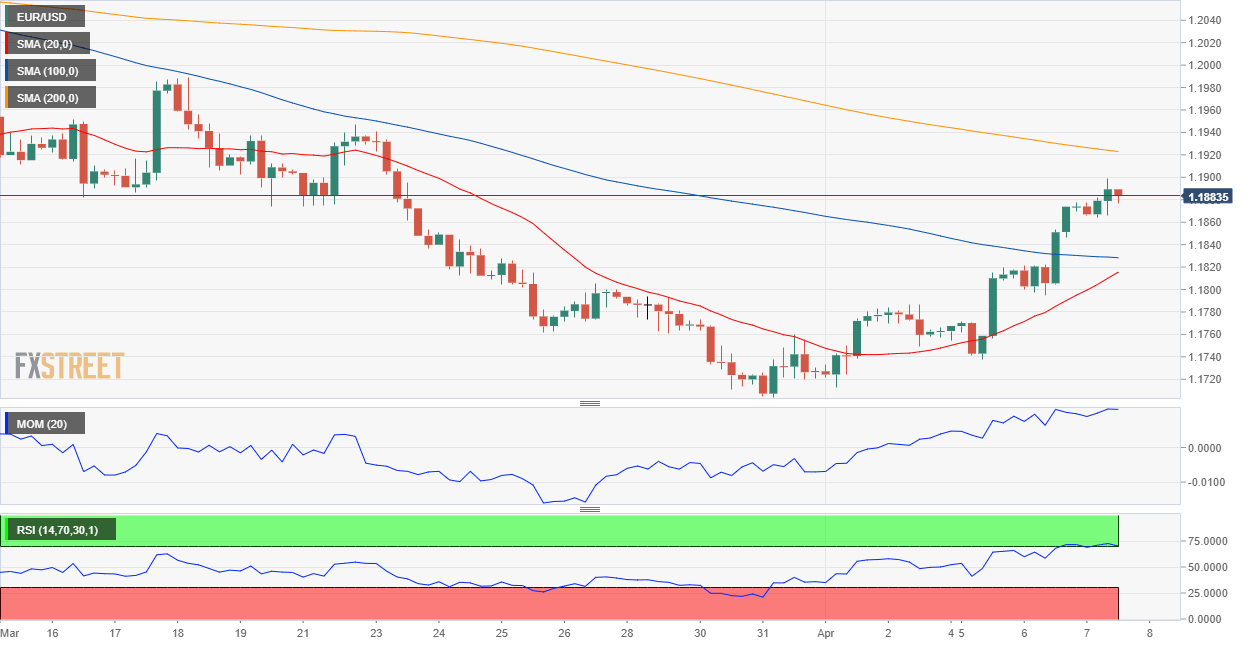
The EUR/USD pair approached the 1.1900 level after encouraging EU data which underpinned the shared currency while weaker US Treasury yields undermined the greenback throughout the first half of the day. Markit published the final readings of its March Services PMIs for the EU, and most of them were upwardly revised. The German index was confirmed at 51.5, while for the whole Union, it printed at 49.6, better than the previously estimated 48.8.

Meanwhile, stocks remain around their opening levels as investors wait for US President Joe Biden’s speech and the FOMC Meeting Minutes. The US has just released the February Goods Trade Balance, which posted a deficit of $71.1 billion, worse than the $ -70.5 billion expected.

EUR/USD short-term technical outlook

The EUR/USD pair retreats modestly from a daily high of 1.1898 but retains most of its intraday gains. The 4-hour chart shows that the pair has reached overbought conditions and may correct lower, although the downside potential is well limited. In the mentioned time-frame, technical indicators hold within overbought levels without directional strength, while the pair keeps developing above its 20 and 100 SMAs, with the shorter advancing below the longer one.

Support levels: 1.1840 1.1795 1.1750

Resistance levels: 1.1910 1.1950 1.1995

View Live Chart for the EUR/USD

Author

Valeria Bednarik

Valeria Bednarik was born and lives in Buenos Aires, Argentina. Her passion for math and numbers pushed her into studying economics in her younger years.


More from Valeria Bednarik
Share:

Editor's Picks

AUD/USD bulls regain control above 0.6950 amid USD retreat

AUD/USD regains traction and extends the previous day's bounce from the weekly low, aiming for 0.7000 in Asia on Friday. The overnight pullback in US bond yields keeps the US Dollar below an 18-month high, which in turn offers some support to the pair. Meanwhile, hawkish RBA expectations also keep the major underpinned.

USD/JPY holds gains near 158.00 after Japan's weak Household Spending data

USD/JPY clings to gains around 158.00 after data showed on Friday that Japan's Household Spending fell for the ninth straight month, undermining the Japanese Yen. Meanwhile, the US Dollar remains depressed as the overnight fall in US bond yields counters a hawkish Fed and geopolitical uncertainties, could cap any downside in the pair.

Gold remains range-bound below $4,200

Gold has given up some ground after an initial bullish attempt to reach weekly highs, returning to below the $4,200 mark per troy ounce on Friday. The US Dollar’s strong upside momentum, combined with rising US Treasury yields across the curve, seems to keep further gains in the yellow metal under scrutiny.

Has Bitcoin really escaped the macro forces it was built to fight?
Over 17 years ago, Satoshi Nakamoto designed Bitcoin (BTC) on the back of a global financial crisis as an alternative to the global monetary system outside the control of central banks, governments and traditional intermediaries. This raises a key question: has Bitcoin really become independent of the macroeconomic forces it was built to challenge?
The Euro is not the sick man of Europe. France's bond market is
EUR/USD remains under pressure, near the 17-month low of 1.1161 reached on Monday. The pair has lost more than 7% since its yearly peak, as concerns over France's public finances increasingly weigh on the single currency. But behind the weakness of the Euro (EUR), the problem does not necessarily lie with the European economy as a whole.
Has Bitcoin really escaped the macro forces it was built to fight?
Over 17 years ago, Satoshi Nakamoto designed Bitcoin (BTC) on the back of a global financial crisis as an alternative to the global monetary system outside the control of central banks, governments and traditional intermediaries. This raises a key question: has Bitcoin really become independent of the macroeconomic forces it was built to challenge?














