|

AUD/USD Forecast: Slide set to continue despite oversold conditions

AUD/USD Current Price: 0.6122

  • RBA Meeting Minutes could shed some light about the meeting called for later this week.
  • Falling equities and commodities weighed on the Aussie at the beginning of the week.
  • AUD/USD at risk of falling further amid continued risk-aversion.
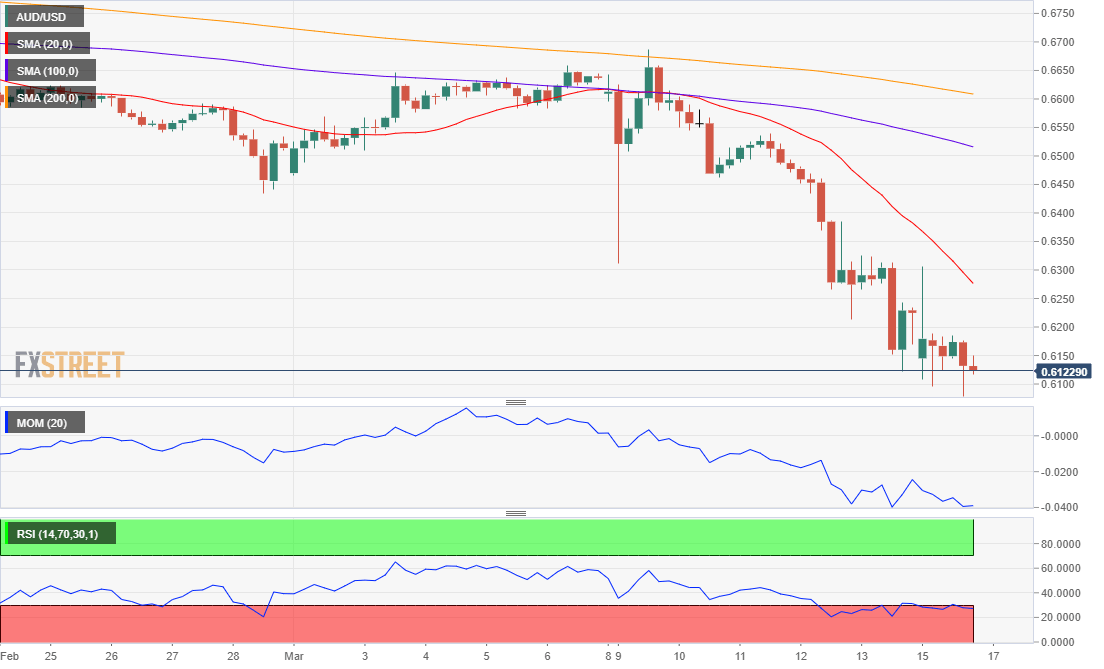
The Australian dollar kept shedding ground against its American rival this Monday, down for a sixth consecutive day. The pair fell to 0.6078, its lowest since November 2008, heading into the Asian opening trading at around 0.6120. The pair peaked at 0.6303 at the beginning of the week, as the Fed’s unexpected decision to cut rates by 100 bps hit the greenback, although the movement was short-lived. The pair quickly turned south as equities plummeted, while commodities also came under strong selling pressure, as investors rushed into government bonds. The pair has bounced just modestly as demand for the greenback paused following dismal US data.

The RBA will release the Minutes of its latest meeting this Tuesday, although as it happens with other data, the market will probably see it as old news. More relevant, the Australian Central Bank has scheduled a meeting for next Thursday, and will likely cut rates further.

AUD/USD short-term technical outlook

The AUD/USD pair is bearish according to the 4-hour chart, although extreme daily oversold conditions lift odds for a bullish corrective movement. Nevertheless, the short-term picture shows that technical indicators remain within negative levels, with the RSI consolidating within oversold levels, as the pair keeps developing below bearish moving averages.

Support levels: 0.6120 0.6090 0.6060

Resistance levels: 0.6225 0.6250 0.6280

View Live Chart for the AUD/USD

Author

Valeria Bednarik

Valeria Bednarik was born and lives in Buenos Aires, Argentina. Her passion for math and numbers pushed her into studying economics in her younger years.


More from Valeria Bednarik
Share:

Editor's Picks

USD/JPY bulls pause near 160.75 amid intervention risks

USD/JPY is consolidating below 160.75 in Thursday's Asian trading, with intervention fears lending support to the Japanese Yen and capping the pair's upside amid a modest US Dollar downtick. The signing of a US-Iran peace deal to end the war and reopen the Strait of Hormuz undermines the Greenback's reserve-currency status.

AUD/USD rebounds toward 0.7050 on US-Iran deal optimism

AUD/USD bounces back toward 0.7050 in the Asian session on Thursday as the US Dollar retreats from its highest level since late March, touched in reaction to the Fed's hawkish tilt the previous day. The US and Iran electronically signed a MoU aimed at ending the war and reopening the Strait of Hormuz, boosting investors' confidence and undermining the safe-haven USD.

$4,300 reclaimed: Gold bounces as US-Iran peace deal signing offsets Fed’s hawkish hold

Gold is reversing the previous slump early Wednesday, regaining $4,300 after finding fresh buyers near $4,250. The US Dollar retreats as US-Iran peace deal optimism overshadows hawkish Fed outlook. Technically, Gold needs a sustained break above the 21-day SMA near $4,390 to revive the recovery.

Binance founder CZ urges governments to tokenize stock markets and launch sovereign stablecoins

Binance founder Changpeng Zhao has called on governments to tokenize their stock markets and issue sovereign stablecoins, arguing that blockchain technology can expand access to capital markets and increase the global use of national currencies. In an X post on Wednesday, CZ said countries should "tokenize their stocks, allowing worldwide buyers."

A new era for the Fed
The Fed has shifted to a more hawkish stance at the first meeting chaired by Kevin Warsh. Although rates were left unchanged, there will be meaningful adjustments to how the Federal Reserve operates in the coming months and years. There are two main takeaways from today’s meeting, firstly what the Fed did, and secondly, what they are planning to do.
Why a hawkish RBA is no longer enough to lift the Australian Dollar

The Reserve Bank of Australia delivered more than what markets expected: a hawkish hold that should have supported the Aussie. But markets widely ignored it, focusing instead on slowing economic growth and proving that central bank messaging alone isn’t always enough to drive currencies.