AUD/USD Analysis: Chinese GDP could interrupt the run

AUD/USD Current Price: 0.6825
- Australian mixed employment data gave some hope to policymakers.
- China scheduled to publish Q3 GDP, Retail Sales, and Industrial Production.
- AUD/USD technically bullish, next move depending on Chinese data.
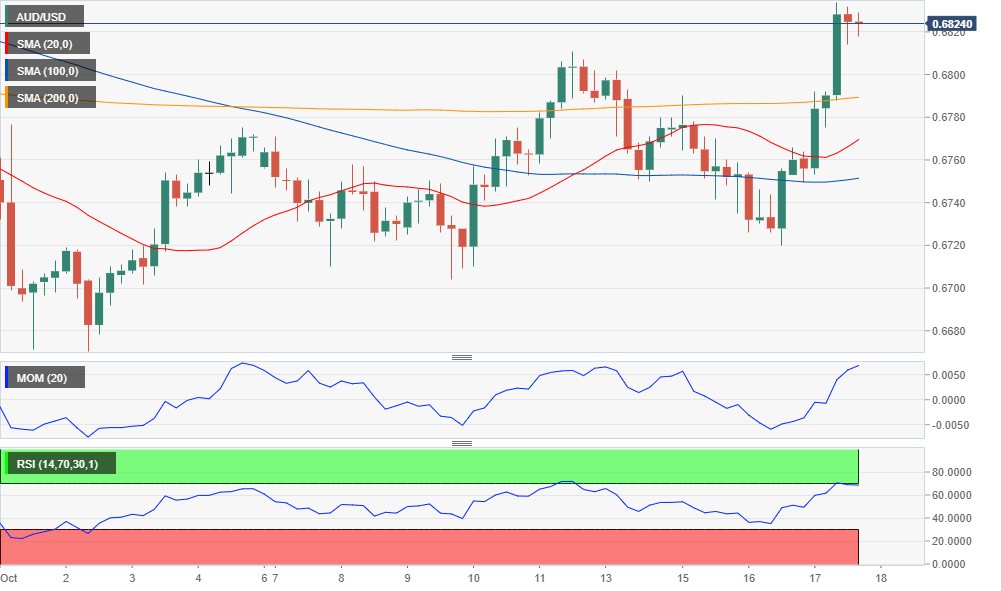
The AUD/USD pair is trading in the 0.6820 price zone, not far from a one-month high set at 0.6832 this Thursday. The pair rallied ever since the day started, despite a mixed employment report. According to the official announcement, the country added 14.7K new jobs in September, slightly below the 15.0K expected. However, full-time jobs were up by 26.2K will part-time jobs declined by 11.4K. The unemployment rate fell to 5.2%, although the participation rate also shrunk, from 66.2% to 66.1%. The RBA aims for an unemployment rate of 4.5%, which means there’s a long way to go, but at least it’s moving in the right direction.
During the upcoming Asian session, RBA’s Governor Lowe is due to speak at the International Monetary Fund, in Washington DC, and may give some hints on monetary policy. Also, China will publish September Retail Sales, foreseen at 7.8% from 7.5% previously, and Industrial Production, expected to improve to 5.0% from4.4%. More relevantly, the country will unveil Q3 Gross Domestic Product, seen up by 1.5% QoQ, and by 6.1% YoY.
AUD/USD short-term technical outlook
The AUD/USD pair is comfortably consolidating around 0.6825, retaining the bullish stance in the short-term. In the 4 hours chart, the pair has broken above all of its moving averages, with the 20 SMA gaining upward traction between directionless larger ones, which somehow limits the upward potential. The Momentum indicator maintains its bullish slope within extreme overbought levels, while the RSI consolidates at around 68, maintaining the risk skewed to the upside.
Support levels: 0.6805 0.6770 0.6730
Resistance levels: 0.6860 0.6895 0.9620
Author

Valeria Bednarik
FXStreet
Valeria Bednarik was born and lives in Buenos Aires, Argentina. Her passion for math and numbers pushed her into studying economics in her younger years.