Breaking: US Nonfarm Payrolls rise by 517,000 in January vs. 185,000 expected

The data published by the US Bureau of Labor Statistics (BLS) revealed on Friday that Nonfarm Payrolls rose by 517,000 in January. This reading came in much higher than the market expectation of 185,000 and followed December's increase of 260,000.
Further details of the publication revealed that the annual wage inflation, as measured by Average Hourly Earnings, came in at 4.4%, compared to analysts' estimate of 4.9%. Additionally, the Labor Force Participation Rate improved modestly to 62.4% and the Unemployment Rate dropped to 3.4% from 3.5% in December.
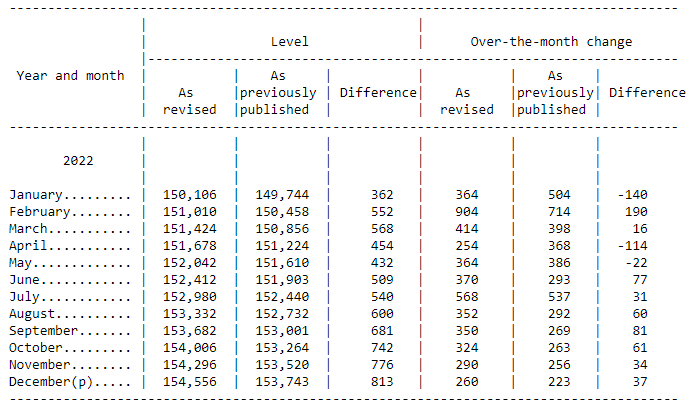
"The change in total nonfarm payroll employment for November was revised up by 34,000, from +256,000 to +290,000, and the change for December was revised up by 37,000, from +223,000 to +260,000," the BLS noted in its press release. "With these revisions, employment gains in November and December combined were 71,000 higher than previously reported."
Market reaction
The US Dollar gathered strength against its rivals with the initial reaction and the US Dollar Index was last seen rising 0.3% on the day at 102.05.
Follow our live coverage of market reaction to the US jobs report.
-
Nonfarm Payrolls expected to show a decline of United States job growth, market consensus at 185K for January.
-
US Dollar traders will scrutinize Average Hourly Earnings data, which could give inflation and Fed policy hints.
-
The Bureau of Labor Statistics also releases the Unemployment Rate, expected to rise a tad to 3.6%.
The US Bureau of Labor Statistics (BLS) will release the US Nonfarm Payrolls (NFP) report on Friday, February 3 at 13:30 GMT. The US economy is expected to have added 185,000 jobs in January, according to market estimates. The US ADP employment Report showed that private sector hiring just added 106,000 jobs in the last month, which was below both the forecast of 178,000 and December's 253,000 private employment growth. This seems to increase the chance of a worse-than-expected NFP result. Lower US employment figures could weigh down the US Dollar.
The US Dollar has been meandering near 10-month lows against its major rivals, as markets read the latest comments by Federal Reserve (Fed) Chairman Jerome Powell as largely dovish.
Powell referred repeatedly during a news conference to the "disinflationary" process that now appeared to be underway, which markets view as the Fed could be turning a corner on its tightening cycle. While that justifies a weaker USD, the move may have gone too far. This should imply the beckoning of an upside correction in the US Dollar should the Nonfarm Payrolls headline number deliver a positive surprise.
Nonfarm Payrolls expectations for January are modest
Friday's United States (US) economic docket highlights the release of the closely-watched US monthly labor market data for January. And, the Nonfarm Payrolls expectations are that the economy added 185K jobs during the reported month, down from the 223K job additions in December. The Unemployment Rate is anticipated to tick slightly higher to 3.6% in January.
Aside from the headline NFP number, investors will closely examine the Average Hourly Earnings, which could offer fresh insight into the possibility of any further rise in inflationary pressures. The US Average Hourly Earnings are expected to print 4.9% YoY in January, up from 4.6% reported in December while on a monthly basis, the wage growth is seen unchanged at 0.3% in the reported period.
NBF analysts expect a worse-than-consensus headline number for the NFP report: “Payroll growth could come in at 150K. The household survey is expected to show a similar gain. This development could leave the unemployment rate unchanged at 3.5%, assuming the participation rate stayed put at 62.3%.”
Volatile EUR/USD to be impacted again by US Nonfarm Payrolls report
The Nonfarm Payrolls report is scheduled for release at 13:30 GMT on Friday, February 3. As the dust settles over the dovish Federal Reserve and the European Central Bank monetary policy decisions, the EUR/USD pair has entered a phase of downside consolidation near the 1.0900 threshold. Weaker US employment details could trigger a fresh leg down in the USD and provide an additional boost to the main currency pair.
In contrast, any positive surprise could offer legs to the ongoing USD recovery but any upside could be limited amid increased expectations that the US central bank will pause its rate-hiking cycle. This is what revives the US Dollar bears and suggests that the path of least resistance for the EUR/USD pair is to the upside.
Dhwani Mehta, Analyst at FXStreet, offers a brief technical overview and outlines important technical levels to trade the EUR/USD pair: “With a potential bullish crossover on the daily chart, represented by the bullish 100-Daily Moving Average (DMA) piercing the flattish 200 DMA from below, the upside appears more compelling for the EUR/USD pair. The 14-day Relative Strength Index (RSI) is holding comfortably above the midline, keeping buyers hopeful. The pair needs to recapture the 1.0950 psychological barrier to resume the uptrend toward the 1.1000 round figure.
“On the downside, the EUR/USD pair could extend the correction toward the bullish 21 DMA at 1.0837 should the previous day’s low fail to offer support. Further south, the January 31 low at 1.0802 will come to the rescue of the Euro buyers, ” Dhwani adds further.
Nonfarm Payrolls related content
About the Nonfarm Payrolls report
The Nonfarm Payrolls report, published by the US Bureau of Labor Statistics, lists all new jobs created in nonfarm sectors over the previous month.
Job market data is strongly linked to the monetary policy of the US Federal Reserve, which can cause large fluctuations in financial markets. The NFP number is released alongside revisions to data from previous months, which are also closely watched by currency and stock traders.
Better-than-expected readings are generally considered favorable (or bullish) for the US Dollar, while worse-than-expected numbers are considered negative (or bearish) for the Greenback. The Unemployment Rate and Average Hourly Earnings numbers are often just as important as the NFP headline.
Author

FXStreet Team
FXStreet
Composed of a group of economic journalists and FX experts, the FXStreet content team produces and oversees all content published on FXStreet. It provides a purely journalistic approach to the Forex market.