US Dollar choppy after Powell says US deficit unsustainable
- The US Dollar turns flat ahead of US session after gaining in early trading.
- The bond market is signalling issues ahead with Trump’s spending plans.
- The US Dollar index hovers around 106.00 after harsh warnings from Powell on spending.

The US Dollar (USD) is in a very choppy pattern this Tuesday, range trading between a profit and a loss. The markets saw first the bond market putting questions on the spending plans from former US President Donald Trump after a supreme court ruling on a legal matter, puts Trump back on track for the White House in November. US Federal Reserve Chairman Jerome Powell came out with harsh warnings during the European Central Bank symposium that the US deficit is getting unsustainable and needs to be addressed.
On the US economic front, the calendar only saw the US JOLTS report coming up. A surprise uptick while normally a decline was expected. Although markets reacted very tepid on the number, as it is a lagging number and markets rather will want to see the ADP number or the actual Nonfarm Payrolls number on Friday.
Daily digest market movers: US deficit concern
- At 13:30 GMT, Fed Chairman Jerome Powell and ECB President Christine Lagarde participated in a panel about monetary policy at the ECB Forum on Central Banking in Sintra, Portugal. Main element that markets zoomed in on was a comment from Powell saying that the US deficit is unsustainable.
- The JOLTS Job Openings figure for May came in at a surprising 8.14 million, overshooting the 7.9 million expected, against the previous count of 8.059 million.
- Equities renain on the backfoot with both European and US equities in the red after JOLTS and Fed-ECB comments.
- The CME Fedwatch Tool is broadly backing a rate cut in September despite recent comments from Fed officials. The odds now stand at 59.9% for a 25-basis-point cut. A rate pause stands at a 34.7% chance, while a 50-basis-point rate cut has a slim 5.4% possibility.
- The US 10-year benchmark rate trades near 4.44% and prints a new high for the week.
US Dollar Index Technical Analysis: Flip a coin
The US Dollar Index (DXY) is gaining on the back of some risk-off sentiment that entered the markets late Monday. The change of heart came after the US Supreme Court ruling that fell partially in favor of former US President Donald Trump. With the DXY now gaining more momentum, the threat grows by the day the Japanese government might intervene to safeguard the Japanese Yen (JPY).
On the upside, the pivotal level of 105.89 is being regained, which is a must have for additional gains. Once a daily close has taken place above that level, marching above the red descending trend line in the chart below at 106.26 and the peak of April at 106.52 are the two main resistances ahead of a fresh nine-month high. That would be reached once 107.35 is being broken to the upside.
On the downside, 105.53 is the first support ahead of a trifecta of Simple Moving Averages (SMA). Next down is the 55-day SMA at 105.25, safeguarding the 105.00 round figure. A touch lower, near 104.75 and 104.46, both the 100-day and the 200-day SMA form a double layer of protection to support any declines together with the green ascending trendline from last December.
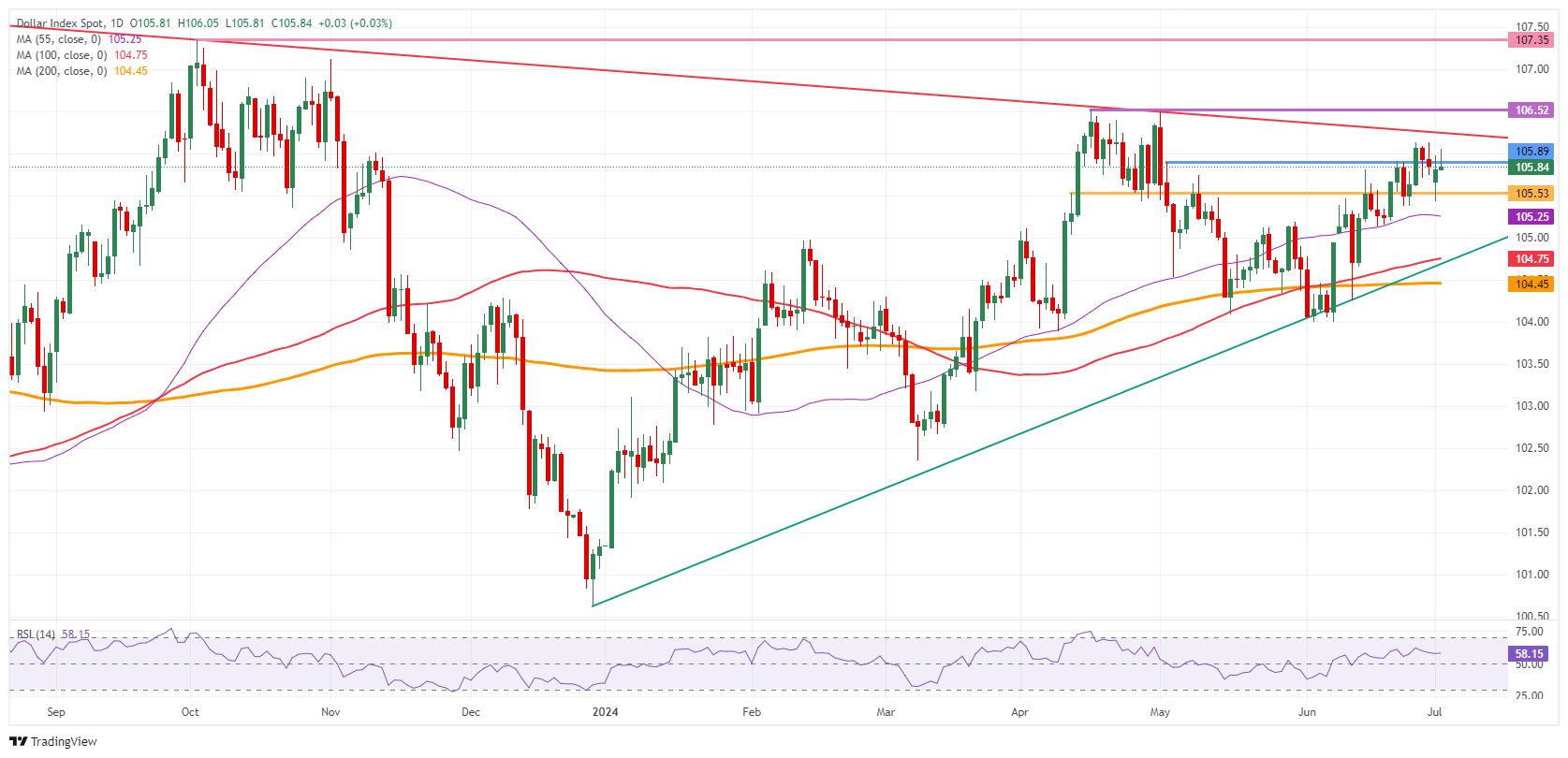
US Dollar Index: Daily Chart
Banking crisis FAQs
The Banking Crisis of March 2023 occurred when three US-based banks with heavy exposure to the tech-sector and crypto suffered a spike in withdrawals that revealed severe weaknesses in their balance sheets, resulting in their insolvency. The most high profile of the banks was California-based Silicon Valley Bank (SVB) which experienced a surge in withdrawal requests due to a combination of customers fearing fallout from the FTX debacle, and substantially higher returns being offered elsewhere.
In order to fulfill the redemptions, Silicon Valley Bank had to sell its holdings of predominantly US Treasury bonds. Due to the rise in interest rates caused by the Federal Reserve’s rapid tightening measures, however, Treasury bonds had substantially fallen in value. The news that SVB had taken a $1.8B loss from the sale of its bonds triggered a panic and precipitated a full scale run on the bank that ended with the Federal Deposit Insurance Corporation (FDIC) having to take it over.The crisis spread to San-Francisco-based First Republic which ended up being rescued by a coordinated effort from a group of large US banks. On March 19, Credit Suisse in Switzerland fell foul after several years of poor performance and had to be taken over by UBS.
The Banking Crisis was negative for the US Dollar (USD) because it changed expectations about the future course of interest rates. Prior to the crisis investors had expected the Federal Reserve (Fed) to continue raising interest rates to combat persistently high inflation, however, once it became clear how much stress this was placing on the banking sector by devaluing bank holdings of US Treasury bonds, the expectation was the Fed would pause or even reverse its policy trajectory. Since higher interest rates are positive for the US Dollar, it fell as it discounted the possibility of a policy pivot.
The Banking Crisis was a bullish event for Gold. Firstly it benefited from demand due to its status as a safe-haven asset. Secondly, it led to investors expecting the Federal Reserve (Fed) to pause its aggressive rate-hiking policy, out of fear of the impact on the financial stability of the banking system – lower interest rate expectations reduced the opportunity cost of holding Gold. Thirdly, Gold, which is priced in US Dollars (XAU/USD), rose in value because the US Dollar weakened.
Author

Filip Lagaart
FXStreet
Filip Lagaart is a former sales/trader with over 15 years of financial markets expertise under its belt.