US Dollar rolls through markets after retail sales uptick
- The US Dollar jumps higher on the back of US Retail Sales data.
- Traders are pricing in a Trump victory with the Fed keeping a lit on projections.
- The US Dollar index moves higher and trades near a pivotal level for more upside.


The US Dollar (USD) rallies on Tuesday due to Tuesday's data and several events that took place overnight. First and foremost for financial markets was the interview with US Federal Reserve (Fed) Chairman Jerome Powell, which disappointed traders hoping to hear anything on guidance, but his lips remained sealed. In Milwaukee, former US President Donald Trump took the stage after his shooting over the weekend, announcing that Ohio senator J.D. Vance will be his running mate.
On the economic front, it all revolves around the consumer, with US Retail Sales and Import/Export Prices for June being published. Retail Sales were jawbreaking with upbeat numbers for the month of June and previous revisions were all revised upwards. The US consumer looks to be back and happy to spend.
Daily digest market movers: Retail recovers
- With former US President Trump picking J.D. Vance as running mate, the main theme for Trump’s campaign becomes very clear, as Senator Vance is known for his call for more harsh and severe measures against China. This means a bigger and broader tariff package against China and other countries that import goods to the US.
- The monthly Retail Sales data for June has been released, together with the Import-Export Price Index:
- Retail Sales went from 0.1% to 0.0%, with the previous 0.1% revised to 0.3%.
- Retail Sales ex Autos seen growing to 0.4% after the -0.1% in May. That same -0.1% has been revised to 0.1%.
- As usual, revisions of the previous numbers will be more important and market-moving than the actual data.
- The monthly Import Price Index went from -0.2% to 0.0%.
- The monthly Export Price Index went from -0.7% to -0.5%.
- At 14:00 GMT, the Business Inventories data for May came out, and they rose from 0.3% to 0.5%.
- At the same time, the NAHB Housing Market Index for July by the National Association of Home Builders went from 43 down to 42.
- Equity markets are very mixed with no clear pattern, besides that, European equities are on the back foot. US futures are marginally in the green.
- The CME Fedwatch Tool shows an 89.4% chance of a 25 basic points (bps) interest rate cut by the Fed in September and 10.4% for a 50 bps cut. An unchanged scenario with no rate change is off the table.
- The US 10-year benchmark rate trades at 4.20%, flirting with the yearly lows.
US Dollar Index Technical Analysis: Recovering
The US Dollar Index (DXY) is recovering, with traders pricing in some severe trade wars coming up should former President Trump win the elections in November. By picking J.D. Vance as his running mate, Trump has chosen a US Senator who outspokenly disfavors China and wants to limit foreign countries’ influences and imports on the US economy. Trade wars and tariffs are often seen as supportive of the US Dollar, which was the case at the start of 2018 when Trump started by slapping tariffs on Chinese imports and made the DXY rally 16% over two years with the tariffs in place.
On Tuesday, the DXY is still below all three major Simple Moving Averages (SMA) after its meltdown last week. The first barrier to recovery is the 200-day SMA at 104.37. Next, the 100-day SMA resides near 104.81, while the declining 55-day SMA is trading at 105.03.
On the downside, the weak spot has been identified now at 103.99/104.00. Expect to see pressure mounting on that level with each test. Certainly, when the DXY bounces off that level each time, the bounces' highs would become smaller until the support gives way. A technical element to look out for could be that the 55-day SMA starts to break below the 100-day SMA and/or the 200-day SMA, risking a ‘death cross’ in technical terms, which is a catalyst for a substantially longer-term sell-off.
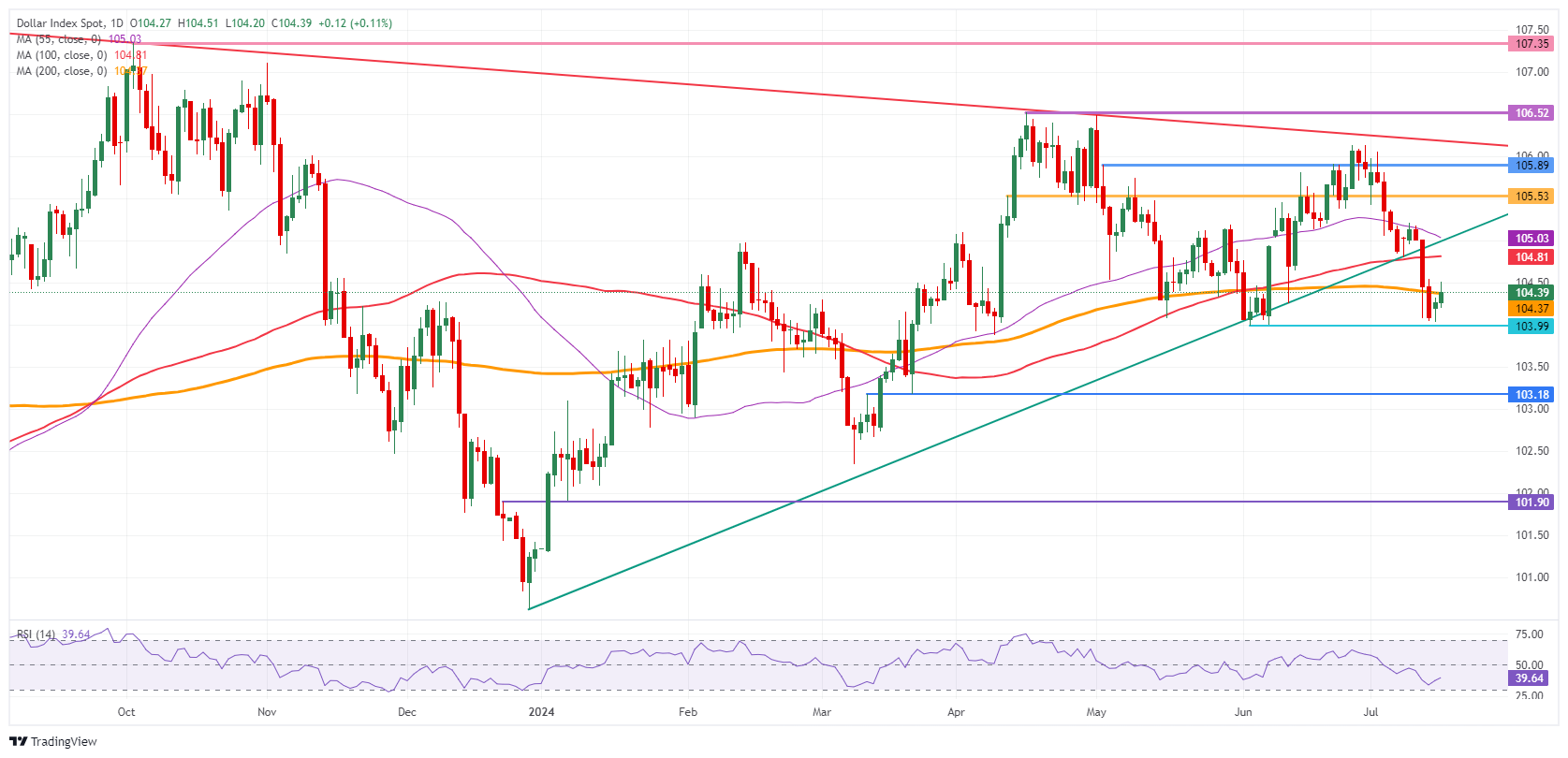
US Dollar Index: Daily Chart
Risk sentiment FAQs
In the world of financial jargon the two widely used terms “risk-on” and “risk off'' refer to the level of risk that investors are willing to stomach during the period referenced. In a “risk-on” market, investors are optimistic about the future and more willing to buy risky assets. In a “risk-off” market investors start to ‘play it safe’ because they are worried about the future, and therefore buy less risky assets that are more certain of bringing a return, even if it is relatively modest.
Typically, during periods of “risk-on”, stock markets will rise, most commodities – except Gold – will also gain in value, since they benefit from a positive growth outlook. The currencies of nations that are heavy commodity exporters strengthen because of increased demand, and Cryptocurrencies rise. In a “risk-off” market, Bonds go up – especially major government Bonds – Gold shines, and safe-haven currencies such as the Japanese Yen, Swiss Franc and US Dollar all benefit.
The Australian Dollar (AUD), the Canadian Dollar (CAD), the New Zealand Dollar (NZD) and minor FX like the Ruble (RUB) and the South African Rand (ZAR), all tend to rise in markets that are “risk-on”. This is because the economies of these currencies are heavily reliant on commodity exports for growth, and commodities tend to rise in price during risk-on periods. This is because investors foresee greater demand for raw materials in the future due to heightened economic activity.
The major currencies that tend to rise during periods of “risk-off” are the US Dollar (USD), the Japanese Yen (JPY) and the Swiss Franc (CHF). The US Dollar, because it is the world’s reserve currency, and because in times of crisis investors buy US government debt, which is seen as safe because the largest economy in the world is unlikely to default. The Yen, from increased demand for Japanese government bonds, because a high proportion are held by domestic investors who are unlikely to dump them – even in a crisis. The Swiss Franc, because strict Swiss banking laws offer investors enhanced capital protection.
Author
Filip Lagaart
FXStreet
Filip Lagaart is a former sales/trader with over 15 years of financial markets expertise under its belt.