US Dollar slumps after weak US ADP Employment, Fed policy in focus
- The US Dollar falls on expectations that the Fed will deliver a dovish guidance.
- Investors see the Fed acknowledging progress in inflation and growing risks to labor market strength.
- After the Fed policy, the US NFP report for July will be the key trigger for the US Dollar.

The US Dollar (USD) extends its downside in Wednesday’s New York session ahead of the monetary policy announcement by the Federal Reserve (Fed) at 18:00 GMT. The US Dollar Index (DXY), which tracks the Greenback’s value against six major currencies, falls sharply below 104.00 on downbeat United States (US) ADP Employment Change for July. Fresh private sector payrolls came in lower at 122K than estimates of 150K and the former release of 155K, upwardly revised from 150K. This has raised doubts over the US labor market strength.
Meanwhile, 10-year US Treasury yields tumble to a fresh multi-month low near 4.11% on expectations that the outcome of the Fed policy will not be favorable for the consistency of the restrictive interest rate framework.
Investors see the Fed leaving interest rates unchanged in the range of 5.25%-5.50% consecutively for the eighth meeting. However, the communication on the interest rate guidance is expected to be dovish due to cooling inflationary pressures and moderating labor market strength.
Unicredit Research said in a note, The Fed will likely leave rates unchanged but send a clear signal that it's getting closer to cutting rates and could do so as soon as September.”
Daily digest market movers: US Dollar declines on weak US ADP Employment
- The US Dollar underperforms its major peers, except the Australian Dollar (AUD), on Wednesday. The Greenback weakens on expectations that the Fed will turn dovish this time. Investors await the monetary policy statement and the Fed Chair Jerome Powell’s conference to know how soon and how much the central bank will reduce interest rates this year. The Aussie weakens after expected decline in annual Q2 Consumer Price index (CPI) print.
- According to the CME FedWatch tool, 30-day Federal Fund Futures pricing data shows that the central bank will reduce interest rates by 25 basis points (bps) from their current levels in the September meeting. The data also shows that there will be two rate cuts instead of one as projected by policymakers in the latest Fed dot plot.
- The expectations for the Fed to deliver dovish guidance have been prompted by downside risks to inflation remaining persistent and easing labor market strength. US CPI slowed more than expected in May and June, suggesting that the disinflation process has resumed, which reversed in the first quarter of the year. Meanwhile, moderating job demand and a more than two-year high Unemployment Rate have indicated that the labor market has ceased to be resilient.
- Volatility in the FX domain will last the entire week as the US ISM Manufacturing Purchasing Managers’ Index (PMI) and the Nonfarm Payrolls (NFP) for July are lined up for release, which will be published on Thursday and Friday, respectively.
- Meanwhile, the market sentiment remains firm despite deepening fears of widening Middle East conflict. The killing of Hamas leader Ismail Haniyeh in an Israeli air strike on Tehran has prompted risks of a potential escalation in the Israel-Iran war. Historically, geopolitical tensions turn investors risk-averse but investors have already priced in Middle East woes.
US Dollar Price Today:
US Dollar PRICE Today
The table below shows the percentage change of US Dollar (USD) against listed major currencies today. US Dollar was the strongest against the Australian Dollar.
| USD | EUR | GBP | JPY | CAD | AUD | NZD | CHF | |
|---|---|---|---|---|---|---|---|---|
| USD | -0.24% | -0.09% | -1.70% | -0.41% | -0.01% | -0.72% | -0.44% | |
| EUR | 0.24% | 0.17% | -1.47% | -0.16% | 0.22% | -0.47% | -0.19% | |
| GBP | 0.09% | -0.17% | -1.66% | -0.34% | 0.04% | -0.62% | -0.34% | |
| JPY | 1.70% | 1.47% | 1.66% | 1.38% | 1.71% | 1.01% | 1.34% | |
| CAD | 0.41% | 0.16% | 0.34% | -1.38% | 0.37% | -0.31% | -0.02% | |
| AUD | 0.01% | -0.22% | -0.04% | -1.71% | -0.37% | -0.69% | -0.41% | |
| NZD | 0.72% | 0.47% | 0.62% | -1.01% | 0.31% | 0.69% | 0.29% | |
| CHF | 0.44% | 0.19% | 0.34% | -1.34% | 0.02% | 0.41% | -0.29% |
The heat map shows percentage changes of major currencies against each other. The base currency is picked from the left column, while the quote currency is picked from the top row. For example, if you pick the US Dollar from the left column and move along the horizontal line to the Japanese Yen, the percentage change displayed in the box will represent USD (base)/JPY (quote).
Technical Analysis: US Dollar dips below 104.00
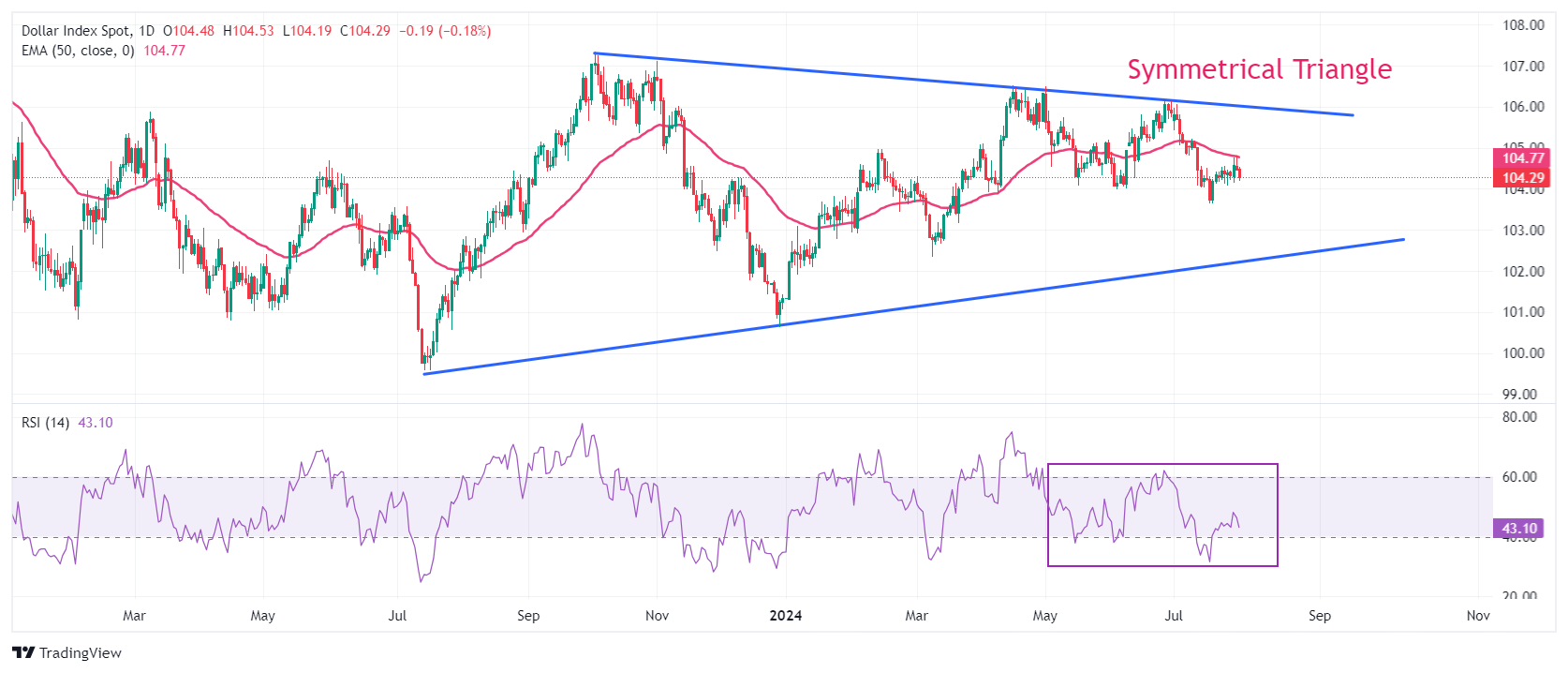
The USD Index trades in a Symmetrical Triangle formation, on a daily timeframe, which exhibits a sharp volatility contraction. The above-mentioned chart pattern results in a sideways trend with lower volume and smaller ticks. The near-term trend remains bearish as the 50-day Exponential Moving Average (EMA) around 104.77 is acting as major barricade for the US Dollar bulls.
The 14-day Relative Strength Index (RSI) oscillates in the 20.00-60.00 range, suggesting that the overall trend is bearish. While the bearish momentum is inactive.
On the upside, July 9 high at 105.20 and a three-month high near 106.00 will be key resistances for the US Dollar. While July 17 low at 103.65 and March 8 low at 102.35 will be key support areas.
Economic Indicator
Fed Interest Rate Decision
The Federal Reserve (Fed) deliberates on monetary policy and makes a decision on interest rates at eight pre-scheduled meetings per year. It has two mandates: to keep inflation at 2%, and to maintain full employment. Its main tool for achieving this is by setting interest rates – both at which it lends to banks and banks lend to each other. If it decides to hike rates, the US Dollar (USD) tends to strengthen as it attracts more foreign capital inflows. If it cuts rates, it tends to weaken the USD as capital drains out to countries offering higher returns. If rates are left unchanged, attention turns to the tone of the Federal Open Market Committee (FOMC) statement, and whether it is hawkish (expectant of higher future interest rates), or dovish (expectant of lower future rates).
Read more.Next release: Wed Jul 31, 2024 18:00
Frequency: Irregular
Consensus: 5.5%
Previous: 5.5%
Source: Federal Reserve
Author

Sagar Dua
FXStreet
Sagar Dua is associated with the financial markets from his college days. Along with pursuing post-graduation in Commerce in 2014, he started his markets training with chart analysis.

















