UnitedHealth continues falling following Harris-Trump debate
- UNH stock fell on Wednesday, Thursday falling reduced odds of Trump victory.
- UBS says UnitedHealth stands to benefit from Trump presidency.
- Oppenheimer still has a $650 price tag on UNH stock.
- August core CPI appears to be a drag on UNH share price.

UnitedHealth Group (UNH) traded about 0.7% lower to $587 on Thursday, continuing on from Wednesday’s 1.6% decline. The leading US health insurer has been hurt by the week’s higher core inflation reading, as well as a perceived win by Vice President Kamala Harris in Tuesday’s presidential debate.
The Dow Jones Industrial Average (DJIA), which allots UNH its largest position, is consolidating on Thursday despite gains from the S&P 500 and the NASDAQ.
UnitedHealth stock news
UnitedHealth stock is pulling back from recent highs achieved last week and following consolidation at the start of the week. The first culprit was Vice President Harris seeming to win her first presidential debate with former President Donald Trump on Tuesday night in Philadelphia.
There was plenty of back-and-forth sniping between the two candidates vying for the US presidency ahead of the November 5 election, but most pundits appeared to think Harris won the ABC debate by baiting Trump into angry tirades. Republican-leaning Fox News ran a focus group that came to the same conclusion.
Some Wall Street analysts think that a Trump presidency would be better for UnitedHealth. UBS affixed UNH stock to its list of top stocks that would benefit from a “red sweep”, meaning Trump’s Republican Party would win the House and Senate, as well as the presidency. However, prior to the debate UBS gave 35% odds of a red sweep occurring, and those odds may be lower following Trump’s unimpressive debate performance.
Oppenheimer posted a similar ranking of stocks by whether they would benefit from Republican or Democratic administrations but chose competitor Humana (HUM) as its top health insurer for a Trump presidency. However, Oppenheimer is most bullish on UnitedHealth overall, writing in late August that it “exhibits the strongest trend in the managed care sub-industry” and handing it a $650 price target.
Wednesday’s August Consumer Price Index (CPI) just added to the headwinds for UnitedHealth. The CPI report showed that core inflation was still slightly stubborn, rising 0.3% MoM rather than the 0.2% consensus.
Nearly 90% of the uptick in core inflation was caused by rising housing costs, but the CPI miss caused the market to give less credence to possibilities of a 50 bps interest rate cut from the Federal Reserve (Fed) meeting scheduled for September 18. The market is now firmly on the side of 25 basis points, which is less beneficial to large corporations like UnitedHealth.
On Monday, the Biden administration formulated new rules for private health care plans to improve access to mental health services, which may increase insurer costs.
UnitedHealth stock forecast
UnitedHealth remains in a healthy uptrend that began in early July. For now, UNH stock is well above it's 50-day Simple Moving Average (SMA), which trends near $565.
The Moving Average Convergence Divergence (MACD) indicator is bearish, but there won't be any true bearish sign unless shares descend below recent support at $557. Until then, expect UNH stock to regain its composure.
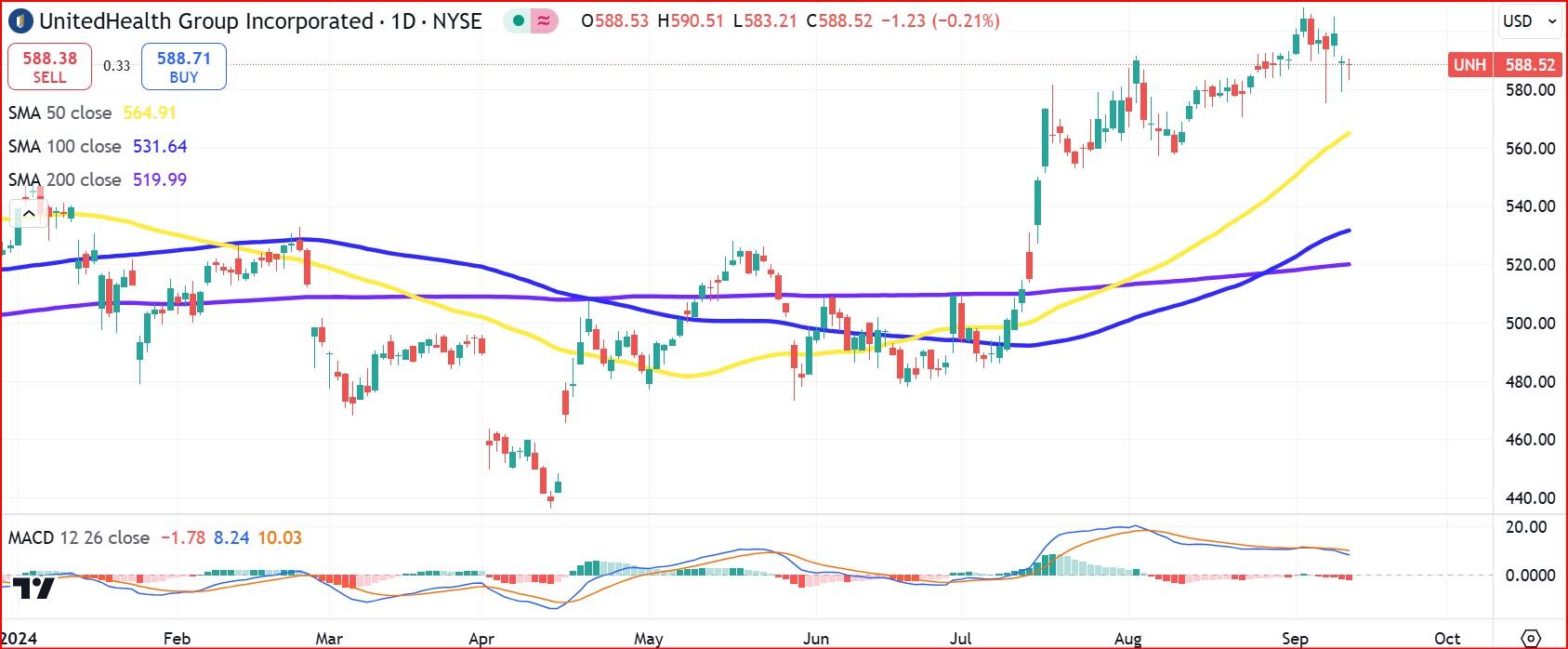
UNH daily stock chart
Author

Clay Webster
FXStreet
Clay Webster grew up in the US outside Buffalo, New York and Lancaster, Pennsylvania. He began investing after college following the 2008 financial crisis.