Pound Sterling tumbles as decline in UK Retail Sales sets stage for BoE rate cuts
- The Pound Sterling underperforms its major peers as weak UK Retail Sales data strengthens the case for a BoE interest rate cut in February.
- UK monthly Retail Sales contracted by 0.3% in December despite being expected to grow strongly by 0.4%.
- The US Dollar strengthens despite a slight acceleration in Fed dovish bets.

The Pound Sterling (GBP) falls sharply against its major peers on Friday as the United Kingdom (UK) Office for National Statistics (ONS) reported that Retail Sales surprisingly contracted in December, another data that adds to the weak economic outlook. The Retail Sales data, a key measure of consumer spending, declined by 0.3% month-on-month. Economists expected the consumer spending measure to have risen at a faster pace of 0.4% than 0.2% growth in November.
According to the ONS’s Retail Sales report, food store sales volumes fell 1.9% in the month, putting index levels at their lowest since April 2013. The monthly fall was strongest in supermarkets, but sales volumes also fell in specialist food stores (such as butchers and bakers) and alcohol and tobacco stores.
Lower individual spending adds to expectations that the Bank of England (BoE) will be forced to cut interest rates by 25 basis points (bps) to 4.5% in the policy meeting in February. Market speculation that the BoE will reduce borrowing rates next month had already escalated due to cooling inflationary pressures and rising government borrowing costs.
The Consumer Price Index (CPI) report for December showed that headline inflation surprisingly decelerated and the core reading grew at a slower-than-projected pace.
Meanwhile, surging yields on UK gilts remain the pivotal factor for the need for policy-easing. The 30-year UK gilt yields soared to 5.48%, the highest level seen in over 26 years. UK gilt yields rallied as investors were cautious over the economic outlook due to stubborn inflation and a likely trade war with the United States (US) under the administration of President-elect Donald Trump on the assumption that he will raise import tariffs significantly, a scenario that will falter the exports sector.
Going forward, the major trigger for the Pound Sterling will be the labor market data for the three months ending November, which will be released on Tuesday. Investors will pay close attention to the employment data to determine the impact of the announcement of an increase in employer contributions to National Insurance (NI) in Chancellor of the Exchequer Rachel Reeves’s first Autumn budget.
Daily digest market movers: Pound Sterling faces pressure against USD ahead of Trump's swearing ceremony
- The Pound Sterling tumbles to near 1.2160 against the US Dollar (USD) in Friday’s session. The GBP/USD pair falls sharply due to multiple headwinds, such as weak UK Retail Sales data and the US Dollar’s strength. The US Dollar Index (DXY), which gauges the Greenback’s value against six major currencies, gains sharply above 109.30. The Greenback remains broadly firm even though investors digest a slight acceleration in Federal Reserve’s dovish bets, which were boosted by a slower-than-projected growth in the core Consumer Price Index (CPI) data for December.
- According to the CME FedWatch tool, traders are pricing in more than one 25-bps interest rate cut this year, seeing the first in the June meeting. Fed Governor Christopher Waller said in an interview with CNBC on Thursday, "If we continue getting soft inflation numbers, as we have seen in December, it is reasonable to think rate cuts could happen in the first half of the year.” Waller also kept expectations of an interest rate cut in March on the table if the Fed continues to progress in inflation and the labor market stays solid.
- Going forward, investors will focus on President-elect Donald Trump's announcement of economic policies after his swearing-in ceremony on Monday. Market participants expect Trump to release a new import tariff plan and cut individuals’ taxes sooner after taking office. Trump’s Treasury pick, Scott Bessent, said on Wednesday that there is an urgent need to lower individual taxes to prevent the economy from facing an economic calamity.
US Dollar PRICE Today
The table below shows the percentage change of US Dollar (USD) against listed major currencies today. US Dollar was the strongest against the New Zealand Dollar.
| USD | EUR | GBP | JPY | CAD | AUD | NZD | CHF | |
|---|---|---|---|---|---|---|---|---|
| USD | 0.21% | 0.45% | 0.44% | 0.30% | 0.47% | 0.55% | 0.32% | |
| EUR | -0.21% | 0.24% | 0.26% | 0.09% | 0.26% | 0.35% | 0.10% | |
| GBP | -0.45% | -0.24% | -0.02% | -0.15% | 0.02% | 0.09% | -0.14% | |
| JPY | -0.44% | -0.26% | 0.02% | -0.12% | 0.04% | 0.12% | -0.12% | |
| CAD | -0.30% | -0.09% | 0.15% | 0.12% | 0.16% | 0.24% | 0.01% | |
| AUD | -0.47% | -0.26% | -0.02% | -0.04% | -0.16% | 0.07% | -0.16% | |
| NZD | -0.55% | -0.35% | -0.09% | -0.12% | -0.24% | -0.07% | -0.23% | |
| CHF | -0.32% | -0.10% | 0.14% | 0.12% | -0.01% | 0.16% | 0.23% |
The heat map shows percentage changes of major currencies against each other. The base currency is picked from the left column, while the quote currency is picked from the top row. For example, if you pick the US Dollar from the left column and move along the horizontal line to the Japanese Yen, the percentage change displayed in the box will represent USD (base)/JPY (quote).
Technical Analysis: Pound Sterling falls back from 10-day EMA
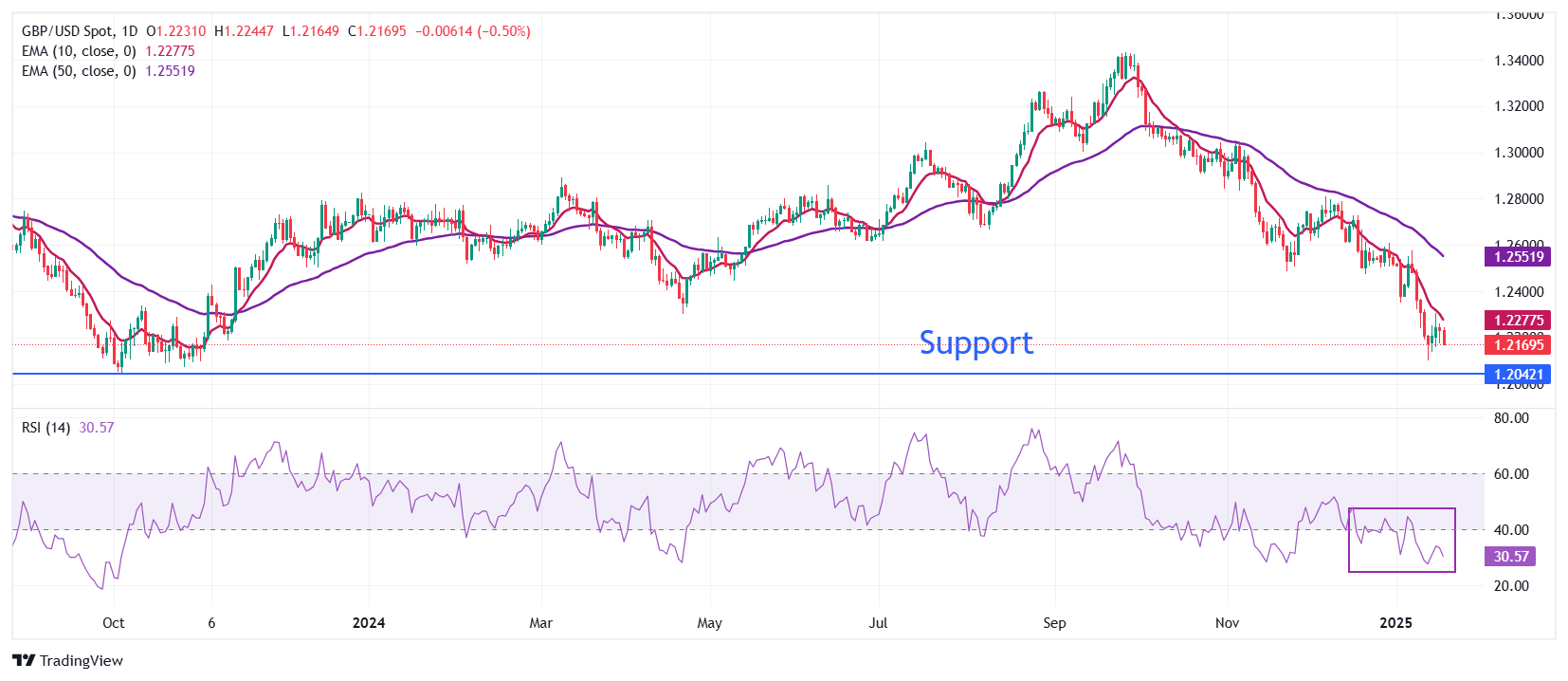
The Pound Sterling resumes its downside journey against the US Dollar after a short-lived pullback move to near the 10-day Exponential Moving Average (EMA) at 1.2313 earlier this week, which currently trades around 1.2278. The outlook of the GBP/USD pair remains bearish as the 50-day EMA slopes downwards around 1.2552.
The 14-day Relative Strength Index (RSI) remains inside the 20.00-40.00 range, suggesting a strong bearish momentum.
Looking down, the pair is expected to find support near the October 2023 low of 1.2050. On the upside, Wednesday's high of 1.2306 will act as key resistance.
Author

Sagar Dua
FXStreet
Sagar Dua is associated with the financial markets from his college days. Along with pursuing post-graduation in Commerce in 2014, he started his markets training with chart analysis.














