GBP/USD slips after soft UK Retail Sales

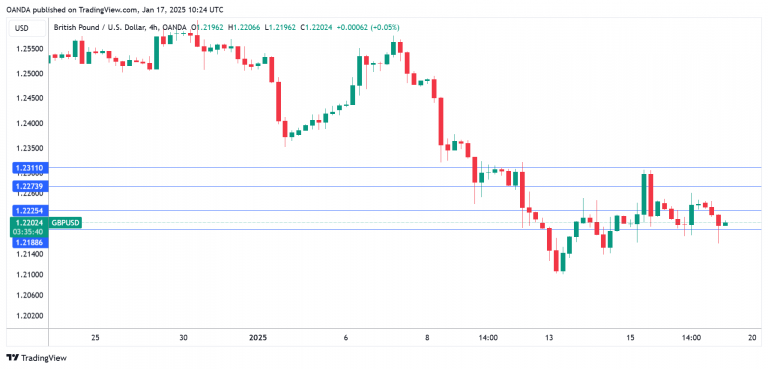
The British pound is lower on Friday. In the European session, GBP/USD is currently trading at 1.2201, down 0.27% on the day. The pound can’t find its footing and is down 2.5% in January and a massive 8.8% since October 1.
UK Retail Sales miss expectations
UK Retail Sales ended the week on a disappointing note. December retail sales declined 0.3% m/m, down from a downwardly revised 0.1% gain in November and shy of the forecast of 0.4%. Quarterly, retail sales fell 0.8% in the fourth quarter.
The weak retail data indicates that the UK consumer held tight on the purse strings during the crucial Christmas season. Consumers remain cautious over inflation worries and expectations that interest rates will stay high. Consumer spending is a key engine of economic growth, and the decrease is retail sales has raised fears of stagflation, a toxic mix of high inflation and low growth which will further hurt businesses and households. The UK economy posted negligible growth of just 0.1% in November, after back-to-back months of no growth.
Finance Minister Rachel Reeves could not have been pleased with the soft GDP and retail sales numbers. Reeves delivered a “tax and spend” budget in October 2024 and has admitted that she needs the economy to show stronger growth in order to increase tax revenue and carry out her spending plans. If the weak economy does not turn around soon, Reeves could find herself on the hot seat.
In the US, retail sales gained 0.4% m/m in December after an upwardly revised gain of 0.8% in November and below the forecast of 0.6%. Annually, retail sales rose 3.9%, below a downwardly revised 4.1% gain in November and above the forecast of 4.0%. The numbers show that consumer spending remains solid and the Federal Reserve isn’t under pressure to lower interest rates anytime soon.
GBP/USD technical
-
GBP/USD is testing support at 1.2225. Below, there is support at 1.2188.
-
1.2274 and 1.2311 are the next resistance lines.
Author

Kenny Fisher
MarketPulse
A highly experienced financial market analyst with a focus on fundamental analysis, Kenneth Fisher’s daily commentary covers a broad range of markets including forex, equities and commodities.














