Pound Sterling jumps above 1.3200 as UK Starmer signals higher taxes
- The Pound Sterling rises above 1.3200 against the US Dollar after UK Starmer's guidance on the financial budget.
- UK Starter is expected to raise the tax burden on individuals from the high-income group.
- Fed’s Mary Daly kept doors open for an aggressive policy easing if the US labor market deteriorates.

The Pound Sterling (GBP) rises further above the round-level figure of 1.3200 to near 1.3240 against the US Dollar (USD) in Tuesday’s New York session. The US Dollar Index (DXY), which tracks the Greenback’s value against six major currencies, exhibits a subdued performance below the immediate resistance of 101.00. The GBP/USD pair is expected to take a breather after last week’s sharp increase, with investors looking for fresh cues about the likely size of the Federal Reserve (Fed) interest rate cut in September.
According to the CME FedWatch tool, 30-day Federal Funds Futures pricing data shows that the probability of a 50-basis-points (bps) interest-rate reduction in September is 28.5%, while the rest favors a smaller cut of 25 bps. The tool unambiguously shows that the Fed’s return to policy normalization is fully priced in by traders, a move that has kept the US Dollar on the back foot for more than a week.
On Monday, San Francisco Fed Bank President Mary Daly emphasized the need to cut interest rates in September. Daly supported a 25 bps interest rate cut but also left doors open for a bigger one if the labor market deteriorates, she said in an interview on Bloomberg.
The confidence of investors that the Fed will begin reducing interest rates from September rose after Fed Chair Jerome Powell said that the time has come for policy to adjust in his speech at the Jackson Hole (JH) Symposium on Friday. Jerome Powell also showed concerns over easing labor market conditions and vowed to support it.
This week, investors will keenly focus on the United States (US) core Personal Consumption Expenditure Price Index (PCE) data for July, which will be published on Friday. Annual core PCE is estimated to have accelerated to 2.7% from the prior release of 2.6%, with monthly figures seen growing steadily by 0.2%. Before that, the US economic calendar will offer on Tuesday the release of the S&P/Case-Shiller Home Price Indices for June and The Conference Board’s gauge of Consumer Confidence for August.
British Pound PRICE Today
The table below shows the percentage change of the British Pound (GBP) against listed major currencies today. British Pound was the strongest against the Japanese Yen.
| GBP | EUR | USD | JPY | CAD | AUD | NZD | CHF | |
|---|---|---|---|---|---|---|---|---|
| GBP | 0.30% | 0.38% | 0.59% | 0.24% | 0.23% | 0.08% | 0.29% | |
| EUR | -0.30% | 0.08% | 0.27% | -0.08% | -0.06% | -0.23% | -0.01% | |
| USD | -0.38% | -0.08% | 0.20% | -0.15% | -0.16% | -0.30% | -0.09% | |
| JPY | -0.59% | -0.27% | -0.20% | -0.34% | -0.35% | -0.50% | -0.29% | |
| CAD | -0.24% | 0.08% | 0.15% | 0.34% | -0.01% | -0.16% | 0.07% | |
| AUD | -0.23% | 0.06% | 0.16% | 0.35% | 0.00% | -0.16% | 0.07% | |
| NZD | -0.08% | 0.23% | 0.30% | 0.50% | 0.16% | 0.16% | 0.20% | |
| CHF | -0.29% | 0.01% | 0.09% | 0.29% | -0.07% | -0.07% | -0.20% |
The heat map shows percentage changes of major currencies against each other. The base currency is picked from the left column, while the quote currency is picked from the top row. For example, if you pick the British Pound from the left column and move along the horizontal line to the US Dollar, the percentage change displayed in the box will represent GBP (base)/USD (quote).
Daily digest market movers: Pound Sterling gains further as UK Starmer hints higher taxes
- The Pound Sterling strengthens against its major peers. The British currency strengthens after United Kingdom (UK) Prime Minister Keir Starmer's commentary on the financial budget's outlook, which will be announced in October. Starmer's commentary indicated that the fiscal budget is expected to be tight. Starmer said, " The budget will be short-term pain for long-term gain," with the intention of increasing the tax burden on households, especially on individuals with higher incomes.
- The outlook of the British currency was already upbeat, given the cheerful market sentiment and an improving UK economic outlook. Economic prospects improved after the flash S&P Global/CIPS PMI showed that activity in both the manufacturing and the service sectors rose at a faster-than-expected pace in August.
- Declining bets favoring another interest-rate cut by the Bank of England (BoE) in September have also improved the Pound Sterling’s appeal. The possibility of this scenario is low as BoE officials expect inflation to rise again even as price pressures in the pipeline seem to be abating.
- British shop prices declined in August for the first time since October 2021, data from the British Retail Consortium (BRC) reported on Tuesday shows. Prices of non-food goods dropped by 1.5% due to slower summer clothes sales, the biggest fall in three years. Food prices rose at a slower pace of 2.0%, the smallest rise since November 2021, down from 2.3% in July.
- A slowdown in the shop price inflation is unlikely to increase expectations of BoE interest rate cuts in September as officials are still concerned about sticky price pressures in the service sector due to wage pressures. However, it could boost speculation for another rate cut before the year ends.
Technical Analysis: Pound Sterling aims to stabilize above 1.3200
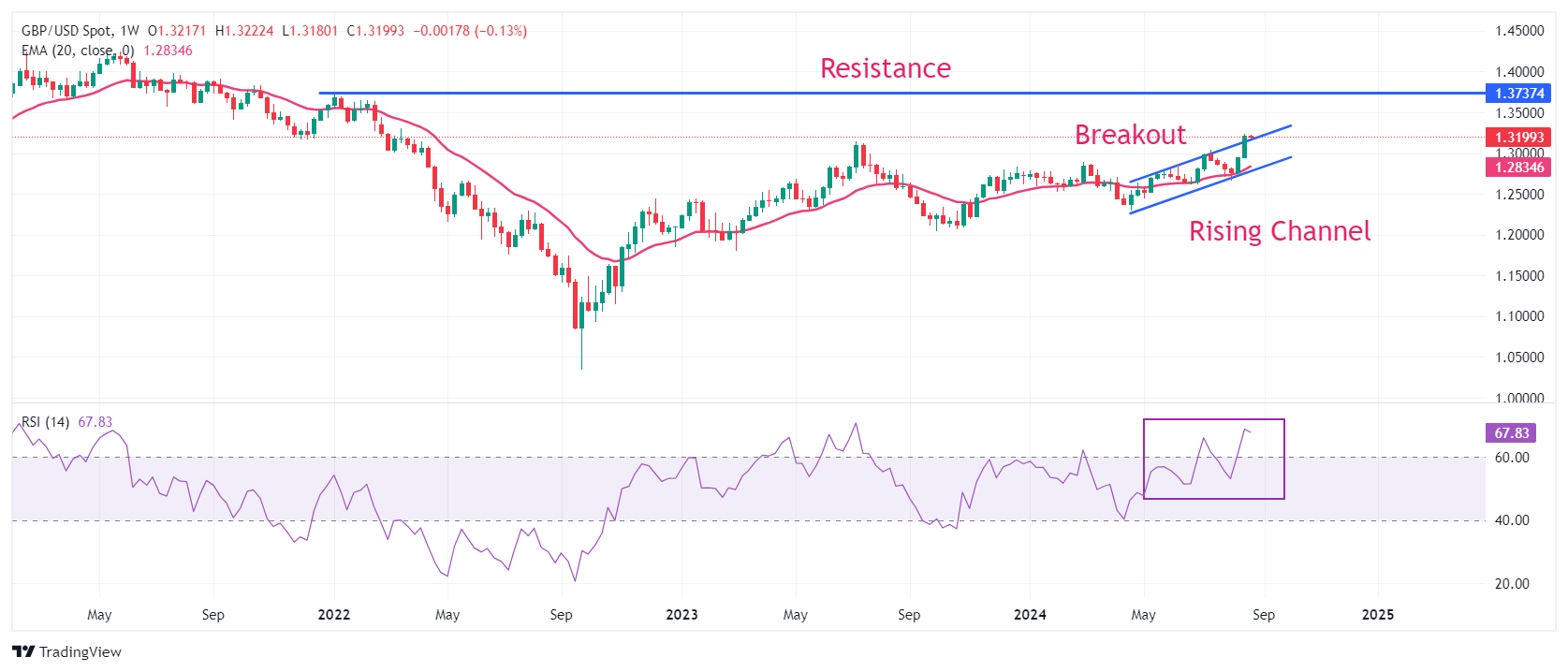
The Pound Sterling posts a fresh two-and-a-half-year high of 1.3240 against the US Dollar. The GBP/USD pair strengthened after delivering a breakout of the Rising Channel chart formation on the weekly time frame. If bullish momentum resumes, the Cable is expected to extend its upside towards the February 4, 2022, high of 1.3640.
The upward-sloping 20-week Exponential Moving Average (EMA) near 1.2766 suggests a strong upside trend.
The 14-period Relative Strength Index (RSI) oscillates in the bullish range of 60.00-80.00, suggesting a strong upside momentum. Still, it has reached overbought levels at around 70.00, increasing the chances of a corrective pullback. On the downside, the psychological level of 1.3000 will be the crucial support for the Pound Sterling bulls.
Economic Indicator
Core Personal Consumption Expenditures - Price Index (YoY)
The Core Personal Consumption Expenditures (PCE), released by the US Bureau of Economic Analysis on a monthly basis, measures the changes in the prices of goods and services purchased by consumers in the United States (US). The PCE Price Index is also the Federal Reserve’s (Fed) preferred gauge of inflation. The YoY reading compares the prices of goods in the reference month to the same month a year earlier. The core reading excludes the so-called more volatile food and energy components to give a more accurate measurement of price pressures." Generally, a high reading is bullish for the US Dollar (USD), while a low reading is bearish.
Read more.Next release: Fri Aug 30, 2024 12:30
Frequency: Monthly
Consensus: 2.7%
Previous: 2.6%
Source: US Bureau of Economic Analysis
After publishing the GDP report, the US Bureau of Economic Analysis releases the Personal Consumption Expenditures (PCE) Price Index data alongside the monthly changes in Personal Spending and Personal Income. FOMC policymakers use the annual Core PCE Price Index, which excludes volatile food and energy prices, as their primary gauge of inflation. A stronger-than-expected reading could help the USD outperform its rivals as it would hint at a possible hawkish shift in the Fed’s forward guidance and vice versa.
Author

Sagar Dua
FXStreet
Sagar Dua is associated with the financial markets from his college days. Along with pursuing post-graduation in Commerce in 2014, he started his markets training with chart analysis.















