Pound Sterling remains weak despite UK Jones assures markets function on orderly way
- The Pound Sterling faces severe selling pressure as a sharp spike in UK gilt yields mirrors a weak economic outlook.
- Fears of persistent UK inflation and Trump’s tariff hike plans have pushed UK bond yields to their highest levels since 1998.
- Renewed US inflation fears have forced Fed officials to turn cautious on interest rate cuts.

The Pound Sterling (GBP) weakens against its major peers on Thursday due to a significant jump in the United Kingdom (UK) government’s borrowing costs. An intense sell-off in UK bonds has pushed 30-year gilt yields to 5.36%, the highest level since 1998. Typically, higher UK gilt yields boost the appeal of the British currency. However, the correlation is not legitimate at this point as a resurgence in inflationary pressures and potentially inflationary United States (US) President-elect Donald Trump policies have weighed on the UK’s economic outlook.
Higher UK gilt yields led to doubts over whether Chancellor of the Exchequer Rachel Reeves will fulfill its fiscal rules, including a non-negotiable commitment to avoid borrowing for day-to-day spending. This also raised concerns about whether the country will remain committed to funding public services and growth-boosting investments through bond selling without further raising taxes.
However, UK Treasury Minister Darren Jones clarified that public spending will be "in line with what was set out in the budget" to the UK House of Commons when they summoned him for an urgent question on the "growing pressure of borrowing costs on the public finances." When asked about the potential reason behind a sudden spike in gilt yields, Jones said that it is normal for the price of gilts to "vary" and assured that financial markets continue to function in an "orderly way".
On the other side, the Bank of England (BoE) doesn’t appear to cut interest rates at a faster pace ahead as high inflation due to stubborn wage growth remains a limiting factor. Traders price in roughly 60 basis points (bps) interest rate reduction by the BoE this year, suggesting that there will be more than two rate cuts. However, analysts at Goldman Sachs said in a note this week that the BoE will cut interest rates in each quarter through the year. This suggests that the BoE policy rate could decline to 3.75% by the year-end.
In Thursday's European session, the BoE survey reported that expectations for inflation a year ahead rose from 2.7% to 2.8% in the three months to December.
Daily digest market movers: Pound Sterling weakens against USD as FOMC minutes signal slowdown in US disinflation trend
- The Pound Sterling declines below 1.2300 against the US Dollar (USD) in Thursday’s London session, the lowest level seen in over a year. The GBP/USD pair weakens as the USD performs strongly on the back of firm US bond yields as President-elect Donald Trump is expected to declare a national economic emergency to provide legal justification for a likely increment in import tariffs on the nation’s allies and adversaries, CNN reported.
- The US Dollar Index (DXY), which tracks the Greenback’s value against six major currencies, edges higher to near 109.25 but remains inside Wednesday’s trading range at the time of writing. The 10-year US Treasury yields trade close to 4.67%, the highest level since April 2024.
- Market participants expect that the US’s higher tariffs will boost demand for domestically produced goods and services, raising growth prospects, employment, and inflationary pressures. This scenario will force Federal Reserve (Fed) policymakers to remain cautious on interest rates for longer, which will be USD-positive.
- Recent Fed minutes from the December meeting also hinted that the disinflation process has stalled temporarily, forcing policymakers to signal fewer interest rate cuts for this year.
- Meanwhile, a sharp rise in the US ISM Services Prices Paid component of the Purchasing Managers Index (PMI) report for December shows that upside risks to inflation have renewed again. The data came in at 64.4, sharply higher from the prior reading of 58.2.
- Going forward, investors will pay close attention to the US Nonfarm Payrolls (NFP) data for December, which will be published on Friday.
Technical Analysis: Pound Sterling tests 1.2250 amid strong bearish momentum
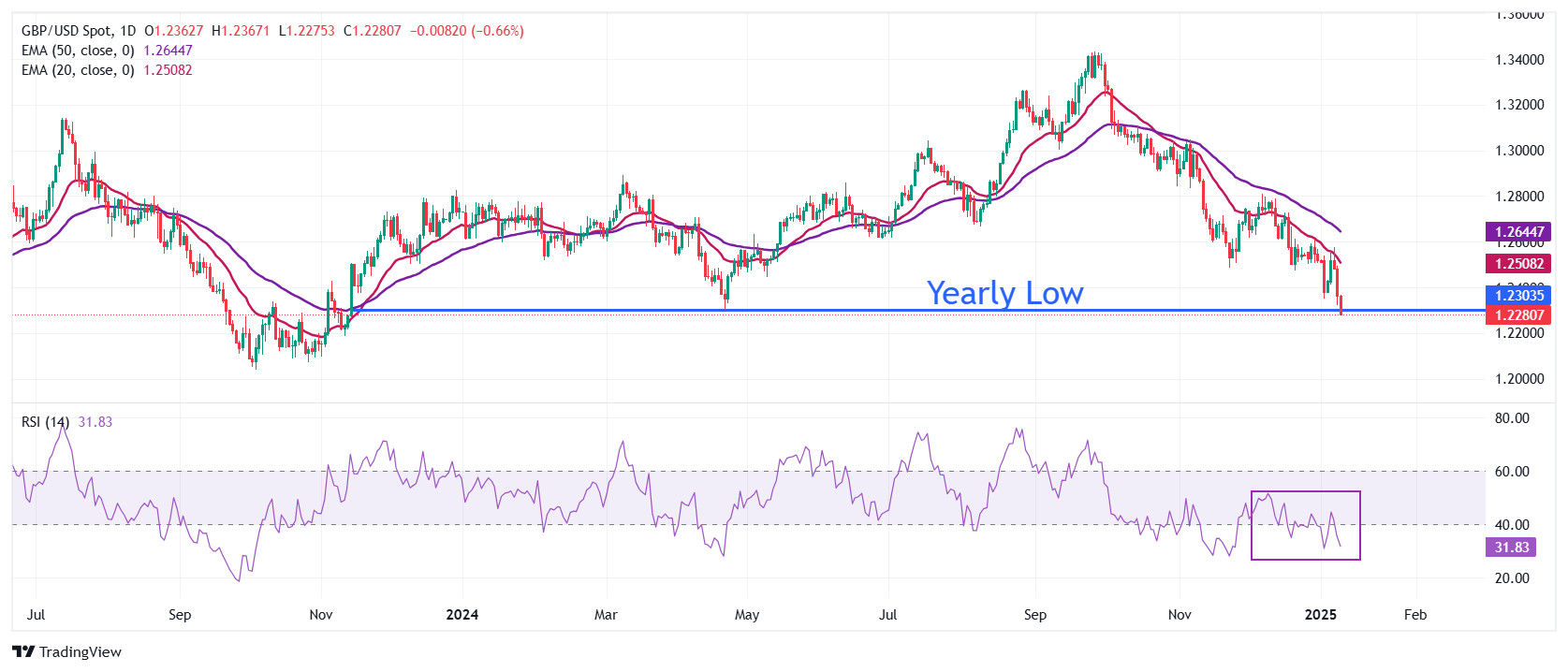
The Pound Sterling slumps to a more-than-a-year-low near 1.2250 against the US Dollar (USD) on Thursday. The GBP/USD pair faces a sharp sell-off after breaking below the January 2 low of 1.2350. The broader outlook of the Cable remains bearish as the 20-day and 50-day Exponential Moving Averages (EMAs) near 1.2510 and 1.2645, respectively, are declining.
The 14-day Relative Strength Index (RSI) drops sharply to near 30.00, suggesting a strong bearish momentum.
Looking down, the pair is expected to find support near the November 10, 2023, low of 1.2185. On the upside, the 20-day EMA will act as key resistance.
Author

Sagar Dua
FXStreet
Sagar Dua is associated with the financial markets from his college days. Along with pursuing post-graduation in Commerce in 2014, he started his markets training with chart analysis.