NZD/USD Price Forecast: Declines to near 0.6300 as US data takes centre stage
- NZD/USD falls sharply to near 0.6300 with a focus on US ISM Manufacturing PMI and the JOLTS Job Openings data.
- The US Dollar refreshes weekly high ahead of a slew of US data.
- China’s massive stimulus announcement has kept strength in the Kiwi dollar intact.

The NZD/USD pair tumbles to near the crucial support of 0.6300 in Tuesday’s New York session after facing selling pressure above the key resistance of 0.6350. The Kiwi asset weakens as the US Dollar (USD) posts a fresh weekly high, with investors turning cautious ahead of a slew of United States (US) economic data.
Investors will pay close attention to the US data as it will influence market expectations for the Federal Reserve (Fed) interest rate outlook. In today’s session, investors will focus on the US ISM Manufacturing PMI for September and the JOLTS Job Openings data for August, which will be published at 14:00 GMT.
The ISM Manufacturing PMI is estimated to have improved slightly to 47.5 from 47.2 in August. Still, the measure would suggest that activity in the factory sector continued to sink. Meanwhile, the Job Openings are expected to have grown at a steady pace, as seen in July, to 7.67 million.
Later this week, the US ADP Employment Change, ISM Services PMI, and the Nonfarm Payrolls (NFP) data for September will be under the spotlight.
In the Asia-Pacific region, the outlook of the New Zealand Dollar (NZD) is still upbeat on China’s massive stimulus for the economic revival. It is worth noting that New Zealand is one of the leading trading partners of China.
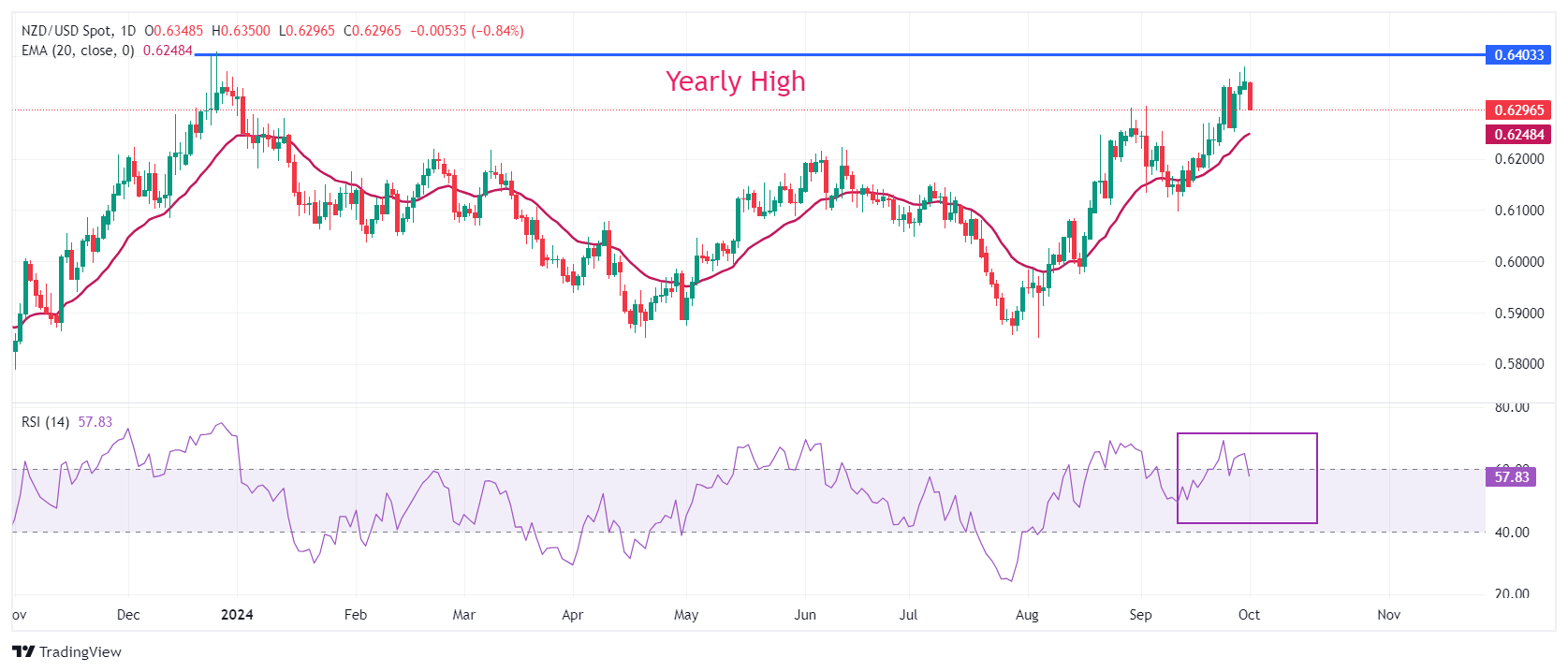
NZD/USD witnesses a sharp decline after failing to sustain above the crucial resistance of 0.6350. However, the near-term outlook of the Kiwi asset is still upbeat as the 20-day Exponential Moving Average (EMA) near 0.6250 is sloping higher.
The 14-day Relative Strength Index (RSI) slips into the 40.00-60.00 range, suggesting a weakening of momentum.
A fresh upside could appear if the asset breaks above the December 2023 high of 0.6400, which will drive the major toward the August 2022 high of 0.6470, followed by the psychological resistance of 0.6500.
In an alternate scenario, the asset could decline to near the 20-day EMA around 0.6250 if sustains below 0.6300. A downside move below the former will expose it to near the round-level support of 0.6200.
NZD/USD daily chart
New Zealand Dollar FAQs
The New Zealand Dollar (NZD), also known as the Kiwi, is a well-known traded currency among investors. Its value is broadly determined by the health of the New Zealand economy and the country’s central bank policy. Still, there are some unique particularities that also can make NZD move. The performance of the Chinese economy tends to move the Kiwi because China is New Zealand’s biggest trading partner. Bad news for the Chinese economy likely means less New Zealand exports to the country, hitting the economy and thus its currency. Another factor moving NZD is dairy prices as the dairy industry is New Zealand’s main export. High dairy prices boost export income, contributing positively to the economy and thus to the NZD.
The Reserve Bank of New Zealand (RBNZ) aims to achieve and maintain an inflation rate between 1% and 3% over the medium term, with a focus to keep it near the 2% mid-point. To this end, the bank sets an appropriate level of interest rates. When inflation is too high, the RBNZ will increase interest rates to cool the economy, but the move will also make bond yields higher, increasing investors’ appeal to invest in the country and thus boosting NZD. On the contrary, lower interest rates tend to weaken NZD. The so-called rate differential, or how rates in New Zealand are or are expected to be compared to the ones set by the US Federal Reserve, can also play a key role in moving the NZD/USD pair.
Macroeconomic data releases in New Zealand are key to assess the state of the economy and can impact the New Zealand Dollar’s (NZD) valuation. A strong economy, based on high economic growth, low unemployment and high confidence is good for NZD. High economic growth attracts foreign investment and may encourage the Reserve Bank of New Zealand to increase interest rates, if this economic strength comes together with elevated inflation. Conversely, if economic data is weak, NZD is likely to depreciate.
The New Zealand Dollar (NZD) tends to strengthen during risk-on periods, or when investors perceive that broader market risks are low and are optimistic about growth. This tends to lead to a more favorable outlook for commodities and so-called ‘commodity currencies’ such as the Kiwi. Conversely, NZD tends to weaken at times of market turbulence or economic uncertainty as investors tend to sell higher-risk assets and flee to the more-stable safe havens.
Author

Sagar Dua
FXStreet
Sagar Dua is associated with the financial markets from his college days. Along with pursuing post-graduation in Commerce in 2014, he started his markets training with chart analysis.