Mexican Peso rises after hotter-than-expected inflation data

Most recent article: Mexican Peso prolongs rally as Banxico adopts cautious stance
- The Mexican Peso is rising after the release of broadly inflationary data suggests interest rates might remain elevated.
- Relatively high interest rates in Mexico, at 11.00%, are drawing foreign capital inflows, supporting MXN.
- USD/MXN has broken below the key June 24 low at 17.87.
The Mexican Peso (MXN) continues appreciating in its key pairs on Wednesday after the release of Mexican macroeconomic data on Tuesday showed continued signs of inflationary pressures in the economy.
An overall beneficial backdrop due to carry flows is further supporting the Peso because of the attractiveness to foreign investors of the relatively high interest rates on offer in Mexico (11.00%).
The carry trade is an operation in which investors borrow in a currency where interest rates are low (like the Yen) and bank the money in a currency where interest rates are high (like MXN). The difference between the interest payments on the loan and the interest paid on the deposit (or bond) renders the profit, all other things being equal.
At the time of writing, one US Dollar (USD) buys 17.81 Mexican Pesos, EUR/MXN trades at 19.27, and GBP/MXN at 22.81.
Mexican Peso recovers on inflationary data
The Mexican Peso is recovering as investors mull recent macroeconomic data that showed Mexican inflation broadly rising in June.
The Headline Inflation rate in Mexico came out at 0.38% on a month-on-month basis, beating the 0.24% expected by economists and higher than the negative 0.19% of May, according to data from INEGI.
Core Inflation for June, which excludes volatile food and energy components, came out at 0.22%, falling below the 0.24% estimated by economists but above the 0.17% in May.
The 12-month Inflation rate in June, meanwhile, came out at 4.98%, which was higher than the 4.84% expected by economists and the 4.69% previously.
The slower increase in core inflation could be critical in terms of the outlook for interest rates in Mexico, according to investor advisor service of Capital Economics.
“Core inflation edged down last month. While there’s still a lot of uncertainty around the next rate decision in August, we think that the easing of core price pressures, alongside the weak run of activity data and the rebound in the Peso leave an August rate cut in play,” says Kimberley Sperrfechter, Emerging Markets Economist at Capital Economics.
Assuming the Banxico does go ahead and cut interest rates in August, this could have a negative impact on the Peso.
Technical Analysis: USD/MXN breaches key June 24 low
USD/MXN breaks below the key June 24 line-in-the-sand low at 17.87.
USD/MXN Daily Chart
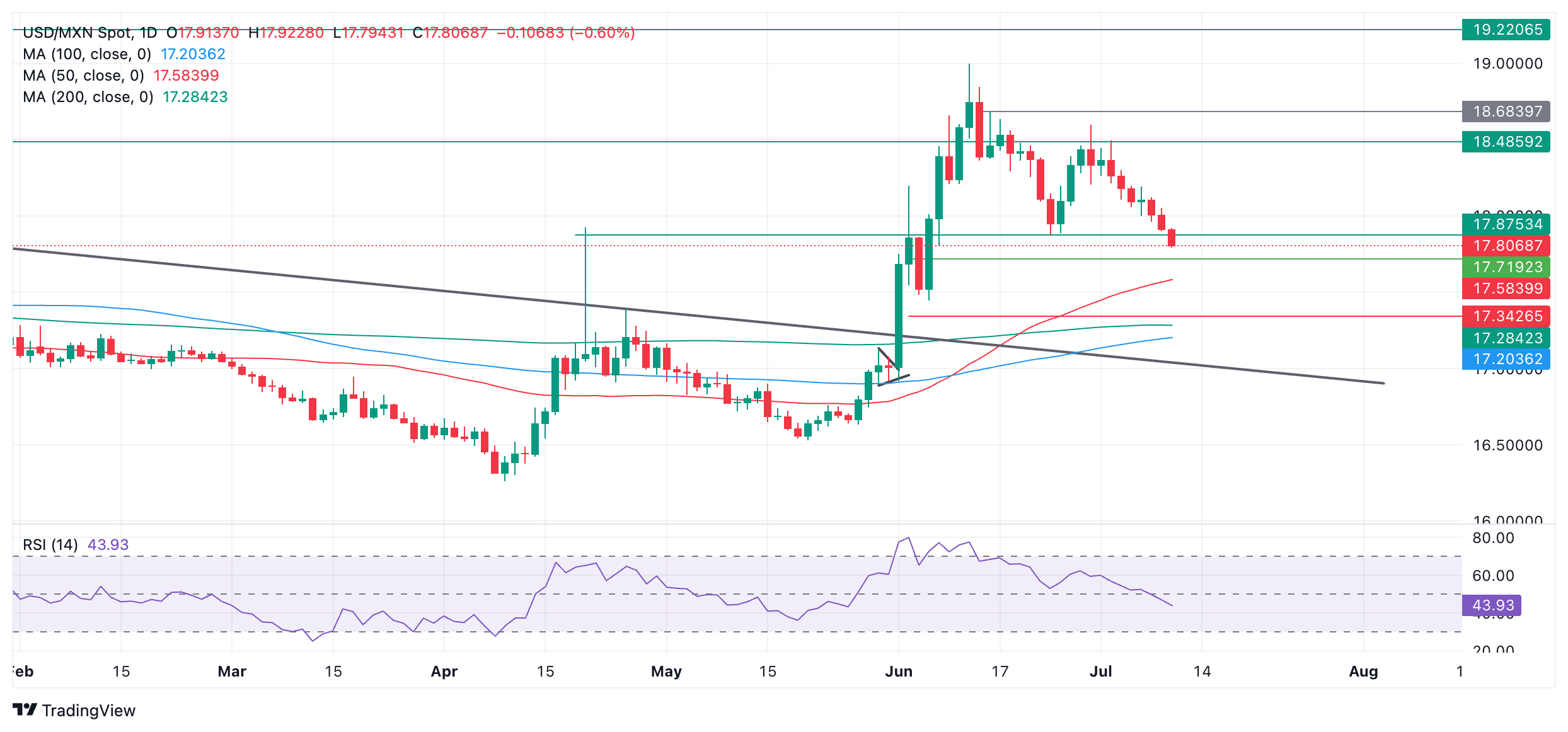
The break is so far on an intraday basis. A decisive break below 17.87, would reconfirm the down-trending bias, with the next target lying at 17.50 (50-day Simple Moving Average).
A decisive break would be one accompanied by a long red candle that closed near its low or three red candles in a row that broke below the level.
As things stand, the short-term trend is bearish, and the “the trend is your friend” adage suggests the odds favor an extension lower.
The direction of the medium and long-term trends, meanwhile, remain in doubt.
Economic Indicator
Core Inflation
The core inflation index released by the Bank of Mexico is a measure of price movements by the comparison between the retail prices of a representative shopping basket of goods and services, excluding taxes and energy. The purchase power of Mexican Peso is dragged down by inflation. The inflation index is a key indicator since it is used by the central bank to set interest rates. Generally speaking, a high reading is seen as positive (or bullish) for the Mexican Peso, while a low reading is seen as negative (or Bearish).
Read more.Last release: Tue Jul 09, 2024 12:00
Frequency: Monthly
Actual: 0.22%
Consensus: 0.24%
Previous: 0.17%
Source: National Institute of Statistics and Geography of Mexico
Author

Joaquin Monfort
FXStreet
Joaquin Monfort is a financial writer and analyst with over 10 years experience writing about financial markets and alt data. He holds a degree in Anthropology from London University and a Diploma in Technical analysis.