Gold recovers after mixed US data
- Gold bounces after the release of mixed US inflation and jobs' data.
- Neutral or dovish Fedspeak from a string of Fed officials also supports the precious metal.
- Technically, XAU/USD enters a short-term downtrend, biasing price action to further losses.

Gold (XAU/USD) trades half a percent higher in the $2,620s on Thursday after a volatile reaction following the release of US inflation and jobs data.
Although the inflation data revealed upside price pressures, the labor market data was weaker than expected, and – given the Federal Reserve's avowed prioritisation of employment security over fighting inflation – suggests a greater chance the bank will maintain a pro-easing stance.
This, in turn, suggests it will go ahead and cut interest rates at its next policy meeting and lower interest rates are bullish for Gold as they reduce the opportunity cost of holding the non-interest paying asset.
Gold bounces after mixed US data
Gold springs back into the "green" after intially selling of on Thursday following the release of US data.
The precious metal initially dipped after the US Consumer Price Index (CPI) showed a rise 2.4% annually in September, which was lower than the 2.5% in August but higher than expectations of 2.3%, data from the Bureau of Labor Statistics showed.
CPI ex Food & Energy rose 3.3% annually in September, which was higher than the 3.2% in August and beat expectations of 3.2%, also showing sticky inflationary conditions.
On the Jobs front, however, it was a different story, and Gold rallied back into positive territory after US Initial Jobless Claims in the week ending October 8 rose by 258K, which was above the 225K of the previous week and beat expectations of 230K.
Continuing Claims for week ending September 27 stood at 1.861 million, which was higher than the revised down 1.819M and the 1.83M expected. Overall the data showed some weakness creeping into the jobs market which is likely to keep the Fed on track to cut interest rates (to stimulate borrowing) at its November policy meeting.
Federal Reserve Bank of San Francisco President Mary Daly (voting member) said on Wednesday that one or two more rate cuts were needed before the end of the year, adding, "I was more worried about the labor market," than "accelerating inflation."
The market-based probability of the Fed lowering by 50 bps (0.50%) remained at zero following the release, according to the CME Fedwatch tool. The chances of a smaller 25 bps cut meanwhile stood at 89%, slightly higher than before the data. Further – from a cut of some magnitude being inevitable – the probability of the Fed doing nothing in November fell to 11%.
Gold had been recovering following a string of speeches by Fed policymakers on Wednesday. These were all rated as either falling in the neutral or dovish territory by the FXStreet FedTracker, an AI-powered tool that gauges the tone of Fed officials’ speeches on a dovish-to-hawkish scale from 0 to 10.
Gold underpinned by safe-haven demand
Gold might be underpinned, however, as it continues to attract safe-haven flows amid elevated geopolitical tensions. Israel keeps up its attacks on targets in Lebanon, and markets remain on tenterhooks anticipating a retaliatory attack by Israel on Iran after its ballistic rocket raid last week.
In terms of the latest developments, the White House confirmed Israeli Prime Minister Benjamin Netanyahu spoke with US President Joe Biden on Wednesday, but nothing was mentioned about Israel’s potential retaliation against Iran. The Biden administration is pressing Israel to limit its retaliation to military targets, according to Bloomberg News and Axios News reported that Netanyahu will convene Israel’s security cabinet today.
Technical Analysis: Gold in short-term downtrend
Gold rebounds from support at just above the psychological $2,600 mark and although it is rallying probably remains, on balance, in a short-term downtrend, however the bias is not strong either way.
XAU/USD 4-hour Chart
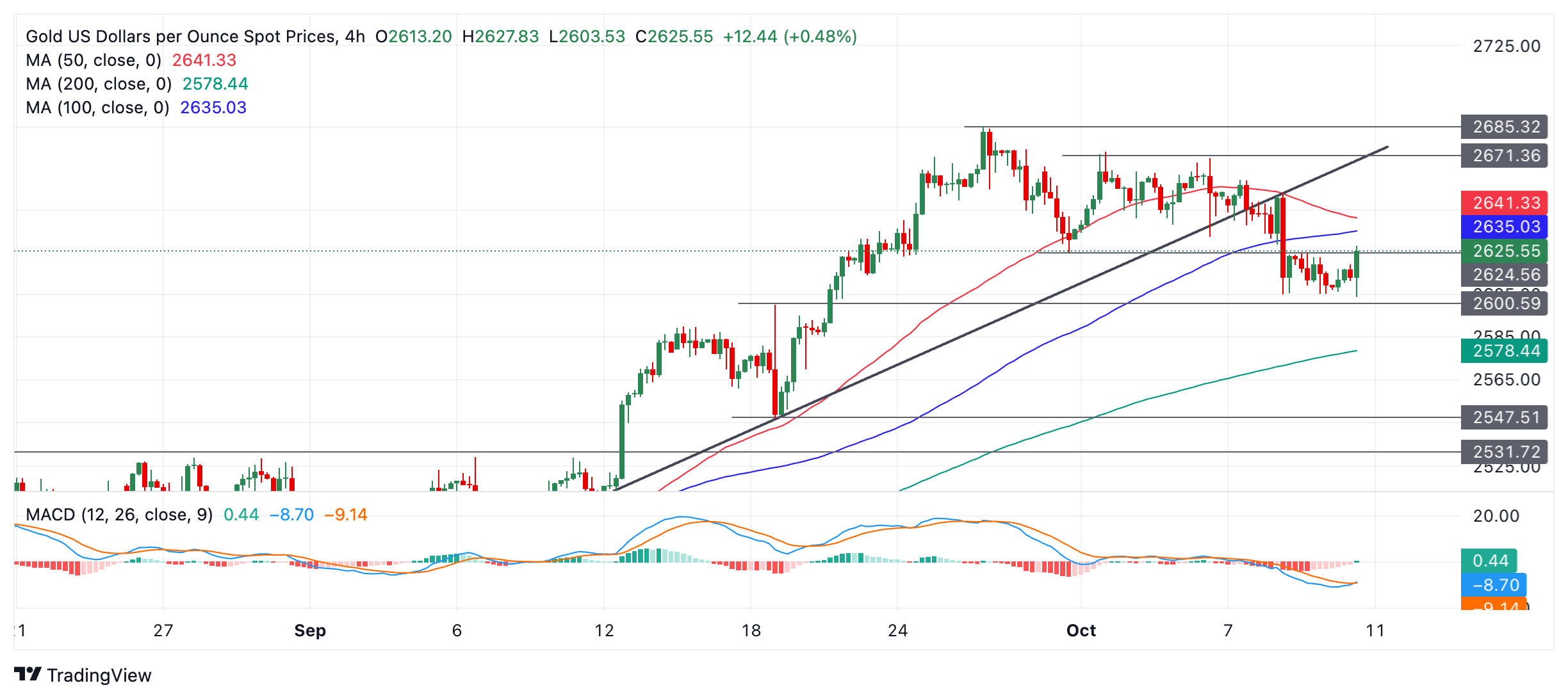
A break below support at $2,600 (August 18 high, round number) would probably indicate further weakness toward the next downside target at $2,578, where the green 200-period Simple Moving Average (SMA) on the 4-hour chart above is likely to provide a safety net.
Bears should proceed with caution, however, as the medium and long-term trends remain bullish. If, at any moment, one of these longer up cycles resumes, Gold could stall, reverse, and begin a new up leg higher.
Gold FAQs
Gold has played a key role in human’s history as it has been widely used as a store of value and medium of exchange. Currently, apart from its shine and usage for jewelry, the precious metal is widely seen as a safe-haven asset, meaning that it is considered a good investment during turbulent times. Gold is also widely seen as a hedge against inflation and against depreciating currencies as it doesn’t rely on any specific issuer or government.
Central banks are the biggest Gold holders. In their aim to support their currencies in turbulent times, central banks tend to diversify their reserves and buy Gold to improve the perceived strength of the economy and the currency. High Gold reserves can be a source of trust for a country’s solvency. Central banks added 1,136 tonnes of Gold worth around $70 billion to their reserves in 2022, according to data from the World Gold Council. This is the highest yearly purchase since records began. Central banks from emerging economies such as China, India and Turkey are quickly increasing their Gold reserves.
Gold has an inverse correlation with the US Dollar and US Treasuries, which are both major reserve and safe-haven assets. When the Dollar depreciates, Gold tends to rise, enabling investors and central banks to diversify their assets in turbulent times. Gold is also inversely correlated with risk assets. A rally in the stock market tends to weaken Gold price, while sell-offs in riskier markets tend to favor the precious metal.
The price can move due to a wide range of factors. Geopolitical instability or fears of a deep recession can quickly make Gold price escalate due to its safe-haven status. As a yield-less asset, Gold tends to rise with lower interest rates, while higher cost of money usually weighs down on the yellow metal. Still, most moves depend on how the US Dollar (USD) behaves as the asset is priced in dollars (XAU/USD). A strong Dollar tends to keep the price of Gold controlled, whereas a weaker Dollar is likely to push Gold prices up.
Author

Joaquin Monfort
FXStreet
Joaquin Monfort is a financial writer and analyst with over 10 years experience writing about financial markets and alt data. He holds a degree in Anthropology from London University and a Diploma in Technical analysis.