EUR/USD slides as traders brace for volatility ahead of French no-confidence vote
- EUR/USD edges lower with investors focusing on political jitters in France as the no-confidence vote against the prime minister looms.
- ECB Holzmann supports a 25 bps interest rate cut in a policy meeting on December 12.
- Investors will also focus on US private employment and Services PMI data for November.

EUR/USD falls below the key support of 1.0500 in North American trading hours on Wednesday. The major currency pair drops as investors expect the oust Prime Minister Michel Barnier in a no-confidence motion by French far-right and left-wing parties. The vote has bolstered political uncertainty in the Eurozone’s second-largest nation due to the increasing chances that the French government will collapse, hurting the Euro (EUR).
The French no-confidence debate is set to start at 15:00 GMT, and voting should happen sooner. Since Marine Le Pen announced on Monday that her party would vote to bring down the government, it would now require someone in the left-wing parties to shift position in order for Prime Minister Barnier to win the vote and avoid the fallout of the government.
Growing concerns over the Eurozone's economic outlook have also weighed on the Euro (EUR). While testifying before the European Parliament's Committee on Economic and Monetary Affairs on Wednesday, European Central Bank (ECB) President Christine Lagarde said that the economic growth in the Eurozone will be weaker in the near term. ECB Lagarde avoided pre-committing to a particular rate path, but other European Central Bank (ECB) officials supported more interest rate cuts in the monetary policy meeting on December 12.
ECB policymaker and Governor of Austrian Central Bank Robert Holzmann said in an interview with Oberoesterreichische Nachrichten newspaper on Tuesday: “As the data currently stands, I think a reduction of 0.25 percentage points is conceivable, not more.”
When asked about his views on the Eurozone’s inflation outlook, Holzmann said he sees risks to inflation skewed on the upside due to Trump’s tariffs policies. However, the extent of the effect will be based on how he will implement polcies.
On the contrary, ECB board member Piero Cipollone said on Tuesday that US tariffs would weaken the economy, which translates into lower consumption and thus reduced pressure on prices. Looking at the economic calendar, investors will also focus on the
EUR/USD remains edgy while US Dollar faces slight pressure after private employment data
- The US Dollar Index (DXY), which tracks the Greenback’s value against six major currencies, struggles to hold intraday gains around 106.60 as the United States (US) ADP Employment Change data for November has come in weaker-than-expected. The agency showed that the US private sector added fresh 146K jobs in November, marginally lower than estimates of 150K and significantly lower than 184K in October, downwardly revised from 233K.
- The impact of the ADP Employment data is expected to be limited as investors await key US Nonfarm Payrolls (NFP) data for November, which will be released on Friday, to get a clear picture of the current labor market status.
- In Wednesday's session, investors will also focus on the ISM Services Purchasing Managers’ Index (PMI) data for November, the Federal Reserve’s (Fed) Beige Book, and Chair Jerome Powell’s speech for fresh interest rate guidance. Economists expect the Services PMI – which gauges activity in the services sector – to have declined to 55.5 from the prior release of 56.0, suggesting a slowdown in growth.
- Investors will pay close attention to Jerome Powell's speech to get cues about the likely interest rate action in its monetary policy meeting on December 18. There is a 74% chance that the Fed will reduce its key borrowing rates by 25 basis points (bps) to 4.25%-4.50% and a 26% probability of rates being unchanged at the current levels, according to the CME FedWatch tool.
- Meanwhile, a string of Fed officials have recently said that they see more interest rate cuts as appropriate as inflation continues to cool down. “I expect it will be appropriate to continue to move to a more neutral policy setting over time,” New York Fed President John Williams said on Monday. However, Williams didn’t provide any target for the Federal Funds Rate and said that the path would be data-dependent.
- The outlook of the US Dollar remains broadly positive as US President-elect Donald Trump threatened to impose 100% tariffs on BRICS. “The idea that the BRICS countries are trying to move away from the dollar while we stand by and watch is OVER,” Trump wrote in a social media post over the weekend.
Technical Analysis: EUR/USD slips below 1.0500
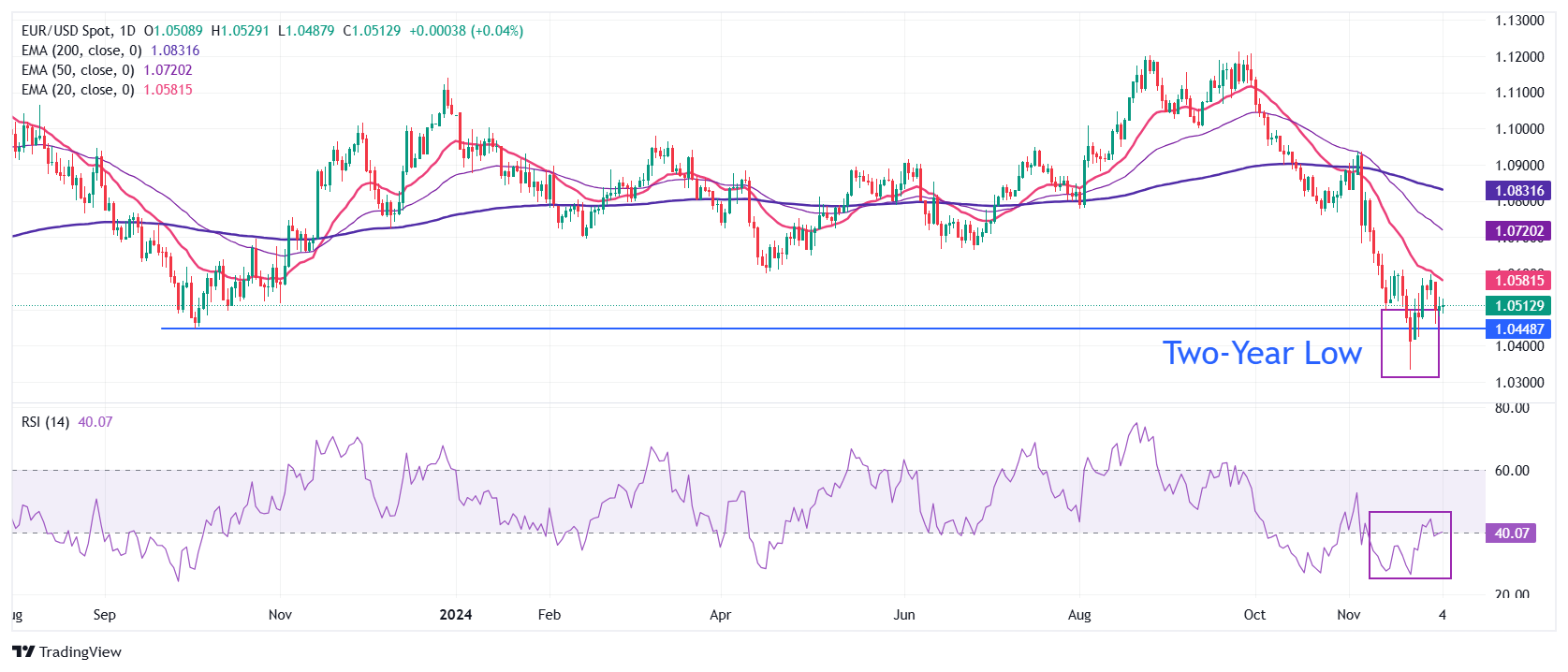
EUR/USD drops below 1.0500 in Wednesday’s North American session. The outlook of the major currency pair remains bearish as all short-to-long-term day EMAs are declining, pointing to a downside trend.
The 14-day Relative Strength Index (RSI) remains close to 40.00, suggesting that the bearish momentum has faded. However, the bearish trend has not been extinguished.
Looking down, the November 22 low of 1.0330 will be a key support for Euro bulls. On the flip side, the 50-day EMA near 1.0750 will be the key barrier for the Euro bulls.
Economic Indicator
Fed's Chair Powell's speech
Jerome H. Powell took office as a member of the Board of Governors of the Federal Reserve System on May 25, 2012, to fill an unexpired term. On November 2, 2017, President Donald Trump nominated Powell to serve as the next Chairman of the Federal Reserve. Powell assumed office as Chair on February 5, 2018.
Read more.Next release: Wed Dec 04, 2024 18:45
Frequency: Irregular
Consensus: -
Previous: -
Source: Federal Reserve
Author

Sagar Dua
FXStreet
Sagar Dua is associated with the financial markets from his college days. Along with pursuing post-graduation in Commerce in 2014, he started his markets training with chart analysis.

















