EUR/USD rises further as US Bessent looks to bring fiscal discipline
- EUR/USD recovers further above 1.0500 as the US Dollar tumbles after Trump’s pick of Scott Bessent as Treasury Secretary
- The US Dollar weakens, tracing plunging bond yields.
- ECB Lane warned that US tariffs could lead to a big disruption in the Eurozone.

EUR/USD extends recovery above the psychological resistance of 1.0500 in Monday’s North American session as the US Dollar (USD) plummets. The US Dollar Index (DXY), which gauges the Greenback’s value against six major currencies, plunges at around 106.60 after the selection of fund manager Scott Bessent for the role of Treasury Secretary by President-elect Donald Trump.
The Greenback fell sharply early in the Asian session, as did 10-year US Treasury yields, in a warm welcome by bond markets given Bessent’s old relation with Wall Street. However, this initial reaction appears to be short-lived as Bessent is expected to enact Trump's policies.
In an interview with the Wall Street Journal (WSJ) after his nomination for Treasury Secretary over the weekend, Bessent said that he will focus on enacting tariffs, eliminating tax cuts on social security benefits and overtime wages, and maintaining the US Dollar’s status as the world's reserve currency.
Meanwhile, the improved economic outlook in the United States (US) is expected to support the resumption of the US Dollar’s uptrend. According to PMI data released on Friday, overall business activity in the US expanded in November at the fastest pace in 31 months. The data signaled robust growth in the service sector activity and a minor contraction in the manufacturing sector’s output.
This week, investors will focus on the Personal Consumption Expenditure Price Index (PCE) data for October, which will be published on Wednesday. The inflation data will influence market speculation for the Federal Reserve’s (Fed) likely interest rate action in the December meeting. According to the CME FedWatch tool, there is a 56% chance that the Fed will cut interest rates by 25 basis points (bps) to 4.25%-4.50%, while the rest favors leaving rates unchanged.
US Dollar PRICE Today
The table below shows the percentage change of US Dollar (USD) against listed major currencies today. US Dollar was the weakest against the Euro.
| USD | EUR | GBP | JPY | CAD | AUD | NZD | CHF | |
|---|---|---|---|---|---|---|---|---|
| USD | -1.03% | -0.52% | -0.28% | 0.09% | -0.29% | -0.13% | -0.64% | |
| EUR | 1.03% | 0.34% | 0.15% | 0.53% | 0.67% | 0.32% | -0.19% | |
| GBP | 0.52% | -0.34% | -0.19% | 0.19% | 0.34% | -0.02% | -0.53% | |
| JPY | 0.28% | -0.15% | 0.19% | 0.39% | 0.43% | 0.22% | -0.17% | |
| CAD | -0.09% | -0.53% | -0.19% | -0.39% | -0.23% | -0.21% | -0.75% | |
| AUD | 0.29% | -0.67% | -0.34% | -0.43% | 0.23% | -0.36% | -0.86% | |
| NZD | 0.13% | -0.32% | 0.02% | -0.22% | 0.21% | 0.36% | -0.51% | |
| CHF | 0.64% | 0.19% | 0.53% | 0.17% | 0.75% | 0.86% | 0.51% |
The heat map shows percentage changes of major currencies against each other. The base currency is picked from the left column, while the quote currency is picked from the top row. For example, if you pick the US Dollar from the left column and move along the horizontal line to the Japanese Yen, the percentage change displayed in the box will represent USD (base)/JPY (quote).
Daily digest market movers: EUR/USD recovers even though downside risks to Eurozone growth swell
- EUR/USD is expected to remain on the back foot as investors expect Scott Bessent’s selection for the role of Treasury Secretary has set the stage for tariff hikes, a move that would prompt a global trade war. Higher import tariffs by the US will adversely impact the already vulnerable Eurozone economy by dampening its export sector.
- Speaking to Les Echos on Monday, European Central Bank (ECB) Chief Economist Philip Lane said that the risk of a big disruption to the Eurozone is very high if the US government enacts a rapid and universal tariff regime, according to Mace News. Last week, Lane warned that a global trade war due to the likely implementation of President-elect Donald Trump’s higher tariffs would result in a “sizeable” loss in global economic output. "Trade fragmentation entails sizeable output losses,” Lane added.
- When asked about his outlook on interest rates, Lane said: “A lot of the final leg of bringing inflation to target could be covered next year; after that restrictive policy will not be needed.”
- The German IFO Business Sentiment index data came in mixed in November. The data showed that German businesses’ morale deteriorated slightly over the month, although the index gauging expectations came in slightly better than what economists had expected.
- Friday’s Flash HCOB Composite PMI data for November showed that the European Union (EU) is going through a rough phase. The Composite PMI unexpectedly declined as the service sector output came in below the 50.0 threshold, a figure that separates expansion from contraction. The manufacturing sector activity contracted further. The report showed that New Orders decreased for the sixth straight month running. a, “The environment in November is stagflationary,” analysts at S&P Global said.
Technical Analysis: EUR/USD bounces back strongly from 1.0330
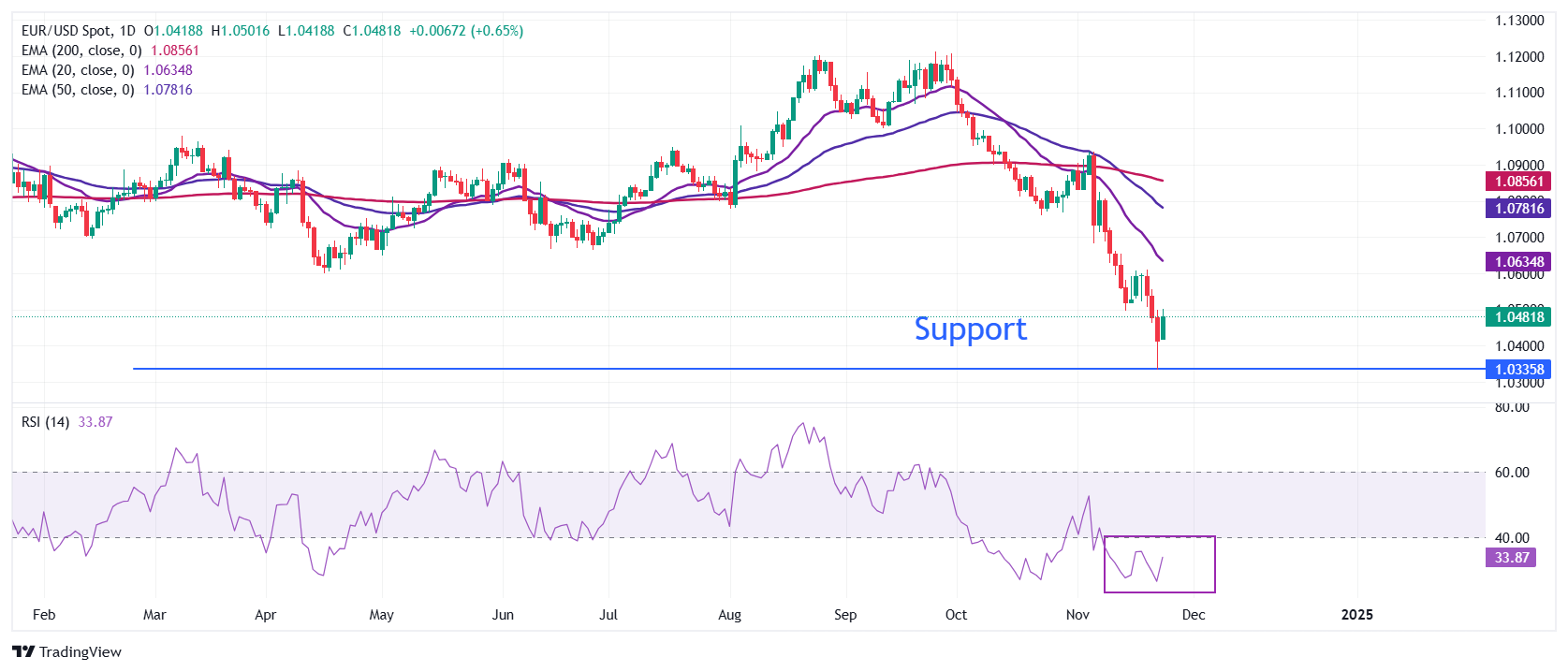
EUR/USD climbs above 1.0500, extending the recovery seen on Monday’s opening. The major currency pair appears to have made a near-term low near 1.0330. While, the broader outlook for the pair remains bearish as all short-to-long-term day Exponential Moving Averages (EMAs) are declining, pointing to a downside trend.
The 14-day Relative Strength Index (RSI) rebounded after reaching oversold territory. However, the momentum oscillator has cooled down, which could allow bears to take the charge again.
Looking down, the November 22 low of 1.0330 will be a key support for Euro bulls. On the flip side, the November 20 high round 1.0600 emerges as the first resistance.
(This story was corrected on November 25 at 14:58 GMT to say in the first paragraph of the Technical Analysis that the EUR/USD near-term low is 1.0330, not 1.330)
Author

Sagar Dua
FXStreet
Sagar Dua is associated with the financial markets from his college days. Along with pursuing post-graduation in Commerce in 2014, he started his markets training with chart analysis.

















