EUR/USD finds cushion near 1.1050 as US Manufacturing PMI contracts steadily
- EUR/USD finds interim support near 1.1050 as the US Manufacturing PMI came in lower-than-expected, while Job Openings spurt.
- Fed Powell doesn't see the need to cut interest rates quickly.
- The ECB is highly expected to cut interest rates again in October.

EUR/USD discovers temporary support near 1.1050 in Tuesday's North American session. The major currency finds buying interest after the release of the United States (US) ISM Manufacturing Purchasing Managers Index (PMI) for September and the JOLTS Job Openings data for August.
The Manufacturing PMI contracted at a steady pace to 47.2, while investors were anticipating a slight improvement to 47.5. The data indicates that weakness continues to persist in the manufacturing sector, which could prompt market expectations for another Federal Reserve (Fed) 50 basis points (bps) interest rate cut in November. Meanwhile, Fresh job openings came in at 8.04 million, higher than estimates of 7.65 million and the former release of 7.71 million.
A sharp recovery in the US Dollar (USD) appears to have stalled after the release of the above-mentioned data. Earlier, the US Dollar bounced back after traders pare Fed large rate cut bets for November. The US Dollar Index (DXY), which tracks the Greenback’s value against six major currencies, struggles to extend its upside above 101.30. According to the CME FedWatch tool, 30-day Federal Fund futures pricing data shows that the likelihood of the Fed reducing interest rates by 50 bps in November waned to 40% from 58% a week ago.
Market speculation for Fed outsize interest rate cuts eased after Fed Chair Jerome Powell's comments at the National Association for Business Economics conference on Monday, which indicated that the central bank will reduce key rates by quarter-to-a-percentage in both meetings remaining this year. Powell said, "If the economy evolves as expected, that would be two more cuts by year's end, for a total reduction of half a percentage point more", Reuters reported.
On the contrary, Atlanta Fed Bank President Raphael Bostic backed a second straight interest rate cut by 50 bps if the labor market data weakens unexpectedly. For fresh insights about the current labor market health, investors will focus on the United States (US) ADP Employment Change and the Nonfarm Payrolls (NFP) data for September, which will be published on Wednesday and Friday, respectively.
Daily digest market movers: EUR/USD remains under pressure as soft Eurozone HICP spurts ECB rate cut bets
- EUR/USD slides below the round-level support of 1.1100 in Tuesday’s New York session. The major currency pair weakens due to further deceleration in the preliminary annual Eurozone headline Harmonized Index of Consumer Prices (HICP) below the European Central Bank’s (ECB) target of 2%, which has boosted market speculation for the ECB cutting interest rates again in October.
- The report showed that the annual headline HICP inflation decelerated at a faster-than-expected pace to 1.8% from the estimates of 1.9% and August's reading of 2.2%. The core HICP – which excludes volatile items such as food, energy, alcohol, and tobacco – rose by 2.7%, slower than expectations and the August reading of 2.8%. Monthly headline HICP deflated by 0.1% in September, while the core HICP grew at a similar pace.
- The ECB delivered the second interest rate cut of its current policy-easing cycle in September and is expected to cut again in October. The return of the annual HICP below 2% is not the sole reason for an increase in the ECB rate cut bets. The Old Continent is underperforming on various parameters, such as the labor market and overall economic activity. Therefore, more rate cuts are needed for the economic revival.
- On Monday, ECB President Christine Lagarde acknowledged, “Some survey indicators suggest that the recovery is facing headwinds,” at the European Union parliamentary hearing in Brussels. "The latest developments strengthen our confidence that inflation will return to target in a timely manner," and "we will take that into account in our next monetary policy meeting in October," she added.
Technical Analysis: EUR/USD drops below 20-day EMA
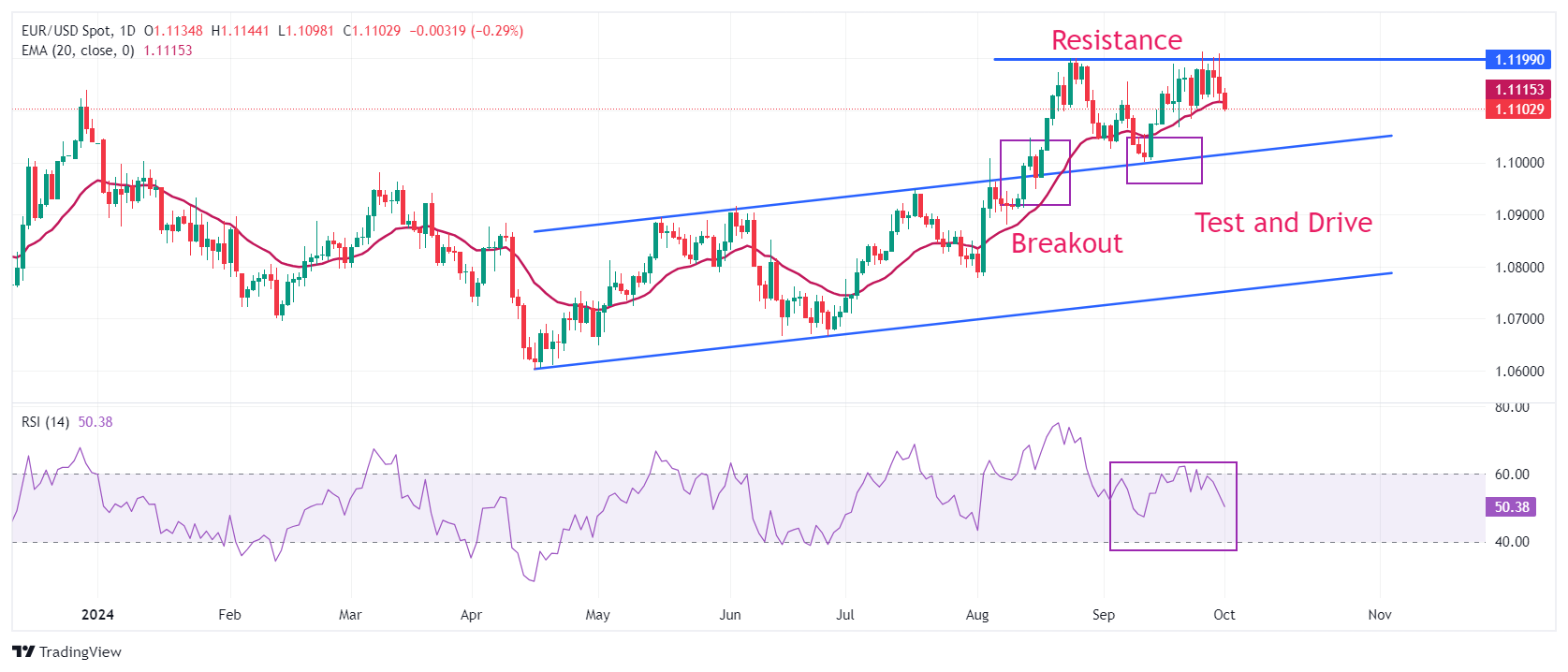
EUR/USD drops sharply to near 1.1100 after failing to recapture the key resistance of 1.1200 on Monday. The major currency pair drops slightly below the upward-sloping 20-day Exponential Moving Average (EMA) near 1.1110, suggesting that the near-term outlook has become uncertain.
The long-term outlook of the shared currency pair remains firm till it holds the breakout of the Rising Channel chart pattern formed on a daily time frame near the psychological support of 1.1000.
The 14-day Relative Strength Index (RSI) edges lower below 60.00, suggesting momentum is weakening.
Looking up, a decisive break above the round-level resistance of 1.1200 will result in further appreciation toward the July 2023 high of 1.1276. On the downside, the psychological level of 1.1000 and the July 17 high near 1.0950 will be major support zones.
Author

Sagar Dua
FXStreet
Sagar Dua is associated with the financial markets from his college days. Along with pursuing post-graduation in Commerce in 2014, he started his markets training with chart analysis.