EUR/USD ticks down as German Retail Sales decline, Eurozone HICP deflates
- EUR/USD gives up entire intraday gains as German Retail Sales decline and Eurozone HICP deflates on month.
- Investors await the preliminary Eurozone HICP data for November, which will influence the ECB’s likely interest rate cut size prospects.
- ECB’s Villeroy keeps hopes of an outsize interest rate cut in December on the table.

EUR/USD surrenders its entire gains after posting a fresh weekly high near 1.0580 in the North American session on Friday. The major currency pair falls as the flash Eurozone Harmonized Index of Consumer Prices (HICP) data for November, showed that price pressures deflated on a month-on-month basis and the US Dollar (USD) rebounded.
The monthly headline and core HICP – which excludes volatile food and energy prices –deflated by 0.3% and 0.6%, respectively, a scenario that would prompt expectations of European Central Bank’s (ECB) larger-than-usual interest rate cut of 50 basis points (bps) in the December meeting. The ECB has already reduced its Deposit Facility Rate by 75 basis points (bps) to 3.25% this year.
Weak German Retail Sales data for October also adds to ECB outside rate cut prospects. Month-on-month Retail Sales contracted by 1.5% after rising 1.2% in September. Economists expected the Retail Sales data, a key measure of consumer spending, to decline at a slower pace of 0.3%. On year, the consumer spending measure rose by 1%, slower than estimates of 3.2% and the prior release of 3.8%.
On year-on-year, headline and core HICP accelerated to 2.3% and 2.8%, respectively, as expected.
Meanwhile, ECB Governing Council member and Governor of the Bank of France François Villeroy de Galhau kept the option of an outsize interest rate cut on the table in his speech on Thursday. “Seen from today, there is every reason to cut on December 12. Optionality should remain open on the size of the cut, depending on incoming data, economic projections, and our risk assessment,” Villeroy said.
Currently, traders expect the ECB to cut its key borrowing rates at least by 25 bps in the December meeting. For 2025, traders see the ECB cutting interest rates in every meeting through June, pushing the Rate on Deposit Facility lower to 1.75% by the year-end, according to Reuters.
Daily digest market movers: EUR/USD gives up intraday gains as US Dollar bounces back
- EUR/USD faces selling pressure after refreshing a weekly high below 1.0600 as the US Dollar (USD) rebounds in a holiday-truncated week. The US Dollar Index (DXY), which tracks the Greenback’s value against six major currencies, recovers some intraday losses and rebounds above 106.00 after posting a fresh two-week low around 105.60 on Friday. The USD Index started correcting on Monday after United States (US) President-elect Donald Trump nominated Scott Bessent, a veteran hedge-fund manager, for the role of Treasury Secretary.
- Financial markets anticipated that Bessent would enact Trump’s economic agenda without disrupting external relations and fiscal discipline. “The objective of enacting tariffs will be “layered in gradually and the budget deficit will be reduced to 3% of Gross Domestic Product (GDP) by slashing spending, a move that won’t result in higher inflation than feared,” Bessent said in an interview with the Financial Times (FT) last weekend.
- On the monetary policy front, market experts expect the Federal Reserve (Fed) to be cautious about interest rate cuts as the core Personal Consumption Expenditures Price Index (PCE) data, the Fed’s preferred inflation gauge, accelerated in October. The probability that the Fed will cut interest rates by 25 bps to the 4.25%-4.50% range in the December meeting is 66%, while the rest supports leaving them unchanged, according to the CME FedWatch tool.
- Going forward, the price action in the US Dollar could be sideways as US markets will open for limited hours on account of Thanksgiving holidays. For the next week, investors should brace for high volatility as a slew of employment and economic data will be published.
Technical Analysis: EUR/USD falls after failing to test 1.0600
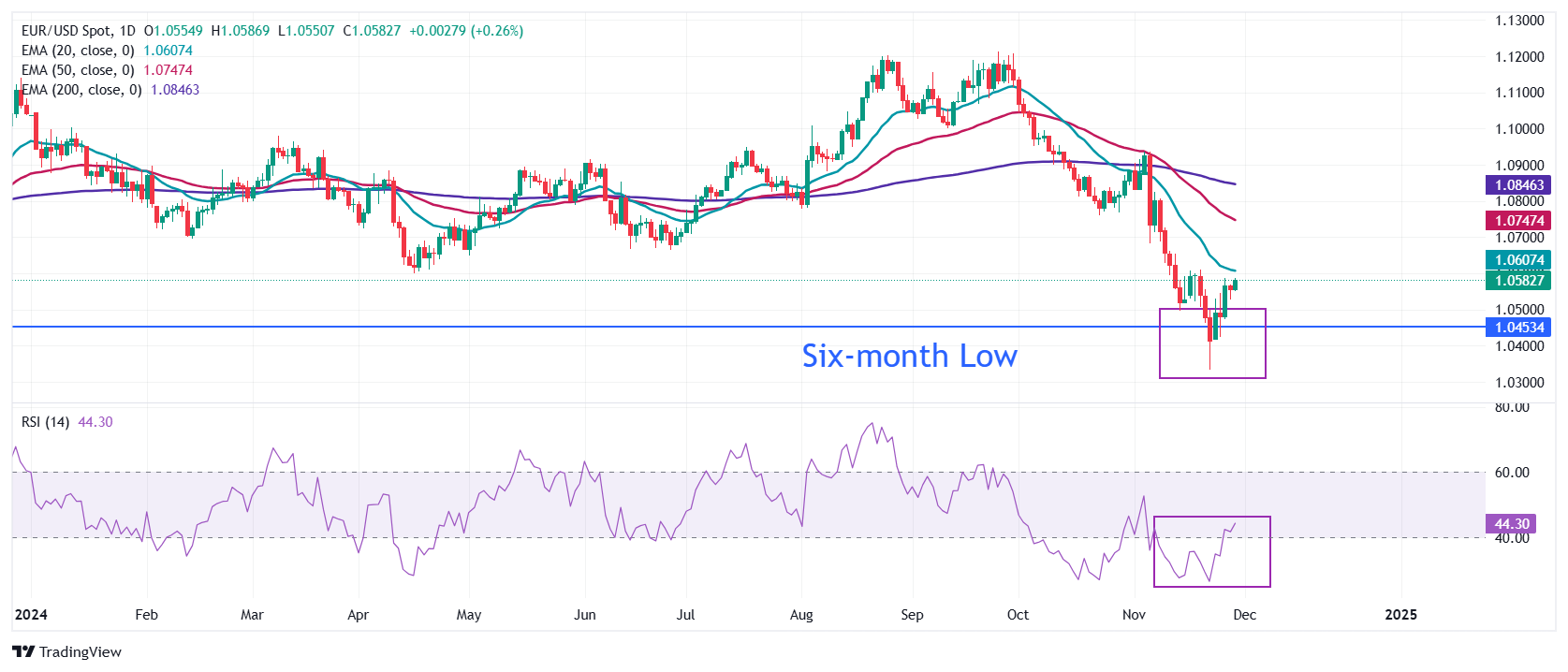
EUR/USD surrenders gains and edges lower 1.0580 on Friday. The recovery move in the major currency pair appears to have stalled as its broader outlook remains bearish, given that all short-to-long-term day EMAs are declining, pointing to a downside trend.
The 14-day Relative Strength Index (RSI) rebounded after conditions turned oversold and climbed above 40.00, suggesting that the bearish momentum has faded. However, the bearish trend has not been extinguished.
Looking down, the November 22 low of 1.0330 will be a key support for Euro bulls. On the flip side, the 50-day EMA near 1.0747 will be the key barrier.
Economic Indicator
Core Harmonized Index of Consumer Prices (MoM)
The Core Harmonized Index of Consumer Prices (HICP) measures changes in the prices of a representative basket of goods and services in the European Monetary Union. The HICP, released by Eurostat on a monthly basis, is harmonized because the same methodology is used across all member states and their contribution is weighted. The MoM figure compares the prices of goods in the reference month to the previous month. Core HICP excludes volatile components like food, energy, alcohol, and tobacco. The Core HICP is a key indicator to measure inflation and changes in purchasing trends. Generally, a high reading is seen as bullish for the Euro (EUR), while a low reading is seen as bearish.
Read more.Last release: Fri Nov 29, 2024 10:00 (Prel)
Frequency: Monthly
Actual: -0.6%
Consensus: -
Previous: 0.2%
Source: Eurostat
Author

Sagar Dua
FXStreet
Sagar Dua is associated with the financial markets from his college days. Along with pursuing post-graduation in Commerce in 2014, he started his markets training with chart analysis.