EUR/USD gives up some gains on robust US Q2 GDP growth
- EUR/USD falls slightly as the US Dollar rebounds on robust US Q2 flash GDP.
- The Euro’s appeal remains uncertain due to the Eurozone’s dismal economic outlook.
- German government announces tax relief for households and corporations.

EUR/USD gives up some gains after rising to near 1.0860 in Thursday’s American session after robust United States (US) Q2 flash Gross Domestic Product (GDP) data. Preliminary Q2 GDP report showed that the economy grew at a faster-than-expected pace of 2.8% from the estimates of 2.0% and the former release of 1.4% on an annualized basis. The US Dollar Index (DXY), which tracks the Greenback’s value against six major currencies, bounces back to a weekly high of 104.50. Stronger-than-expected US Q2 GDP data has strengthened its economic outlook.
While the growth rate turned out robust, fears of price pressures remaining stubborn eased as the GDP Price Index, a key measure to gauge changes in the prices of goods and services produced, decelerated sharply to 2.3% from expectations of 2.6% and the prior reading of 3.1%. This would boost expectations of rate cuts by the Federal Reserve (Fed).
According to the CME FedWatch tool, 30-day Federal Fund futures pricing data shows that a rate cut in September appears certain. The data also indicate that the Fed will cut interest rates twice this year.
Separately, the Durable Goods Orders for June have declined significantly. New Orders for Durable Goods surprisingly contracted by 6.6%. Economits expected the economic data to have grown at a faster pace of 0.3% from May’s reading of 0.1%.
The next trigger for the US Dollar will be the Personal Consumption Expenditures Price Index (PCE) data for June, which will be published on Friday. The core PCE inflation, the Fed's preferred inflation gauge, will indicate whether market expectations for rate cuts in September are appropriate.
The underlying inflation is estimated to have decelerated to 2.5% from May’s figure of 2.6%, with the monthly figure growing steadily by 0.1%. The scenario in which inflationary pressures decelerate in line with expectations or at a faster pace will be unfavorable for the US Dollar as it will boost rate cut expectations. On the contrary, steady or higher-than-expected inflation growth will force traders to pare Fed rate-cut bets for September.
Daily digest market movers: EUR/USD holds nominal gains despite Euro's outlook remains uncertain
- EUR/USD surrenders its intraday gains after jumping to near 1.0850 in Thursday’s European session. The major currency pair gives up some gains as the Euro's near-term outlook is uncertain due to firm expectations of more rate cuts by the European Central Bank (ECB) and deepening concerns over German economic prospects.
- The ECB is expected to cut interest rates two more times this year as price pressures are expected to remain at their current levels for the entire year and will return to the bank’s target in 2025. Some ECB officials also see current market expectations for rate cuts as appropriate.
- Meanwhile, a sharp decline in Eurozone business activity, especially in the bloc’s largest nation, Germany, has boosted expectations of more interest rate cuts this year to prompt economic growth. German flash Composite Purchasing Managers Index (PMI) unexpectedly contracted in July. Hamburg Commercial Bank (HCOB) reported on Wednesday that preliminary German Composite PMI surprisingly declined to 48.7 in July, the lowest reading in four months. The economy skirted a recession last year but contracted by 0.3%.
- Poor German activity has also dampened its business sentiment index. German IFO Business Climate, an early indicator of current conditions and business expectations, surprisingly declined to 87 in July. Investors forecasted the sentiment data to have risen to 88.9 from June’s reading of 88.6. In the same period, the Expectations index unexpectedly dropped to 86.9 from the estimates of 89.0 and the former release of 88.8, downwardly revised from 89.0.
- The German government promises to provide tax relief to corporations and households in a move to boost overall consumption. The tax relief move announced by German Finance Minister Christian Lindner on Wednesday will pave the way for a 30-billion-euro reduction in the tax burden in 2025 and 2026, an effort to leave the economy with more funds for spending and investment.
Technical Analysis: EUR/USD holds key support of 1.0800
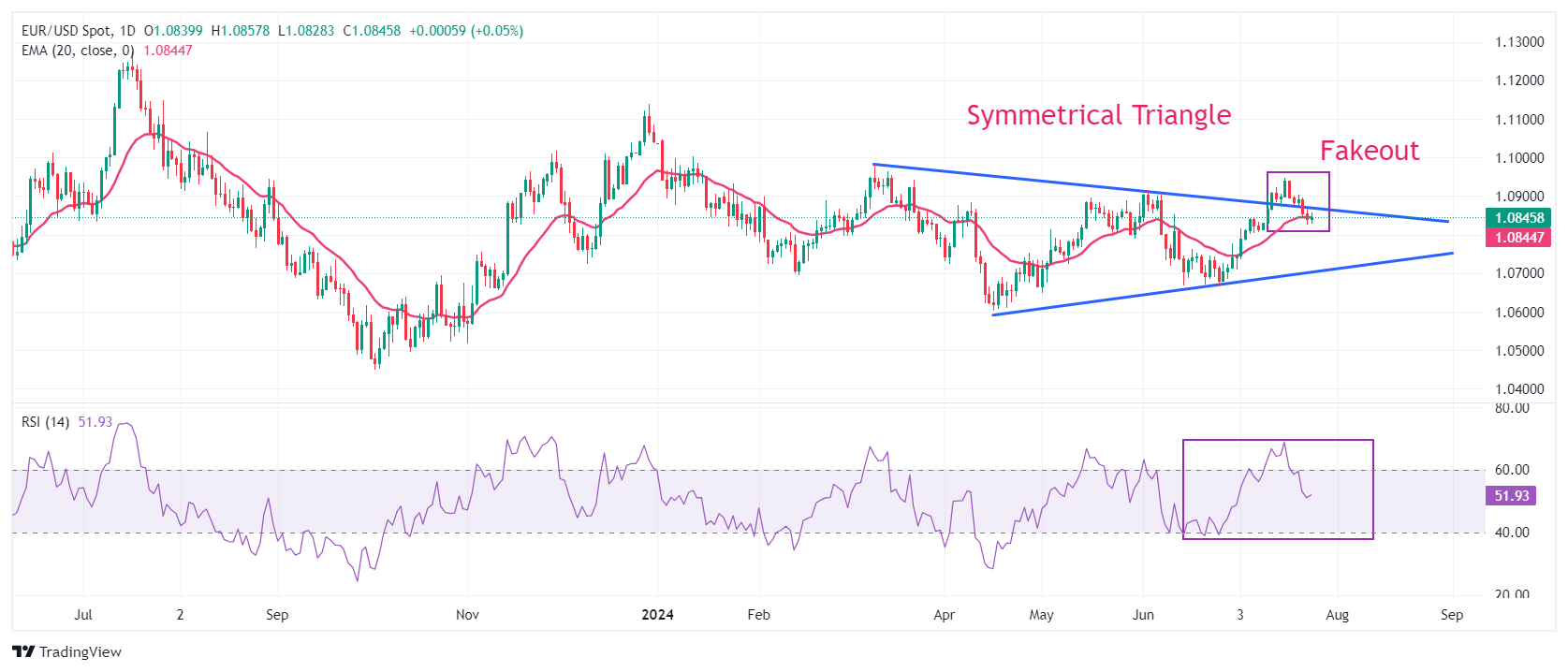
EUR/USD returns inside the Symmetrical Triangle formation on a daily timeframe after failing to hold the breakout. The major currency pair extends its downside below the 20-day Exponential Moving Average (EMA), which trades around 1.0840. The shared currency pair could slide further towards round-level supports near 1.0800 and 1.0700.
The 14-day Relative Strength Index (RSI) returns within the 40.00-60.00 range, suggesting the bullish momentum has faded.
On the upside, the round-level resistance at 1.0900 will be a key barrier for the Euro bulls.
Economic Indicator
Gross Domestic Product Annualized
The real Gross Domestic Product (GDP) Annualized, released quarterly by the US Bureau of Economic Analysis, measures the value of the final goods and services produced in the United States in a given period of time. Changes in GDP are the most popular indicator of the nation’s overall economic health. The data is expressed at an annualized rate, which means that the rate has been adjusted to reflect the amount GDP would have changed over a year’s time, had it continued to grow at that specific rate. Generally speaking, a high reading is seen as bullish for the US Dollar (USD), while a low reading is seen as bearish.
Read more.Last release: Thu Jul 25, 2024 12:30 (Prel)
Frequency: Quarterly
Actual: 2.8%
Consensus: 2%
Previous: 1.4%
Source: US Bureau of Economic Analysis
The US Bureau of Economic Analysis (BEA) releases the Gross Domestic Product (GDP) growth on an annualized basis for each quarter. After publishing the first estimate, the BEA revises the data two more times, with the third release representing the final reading. Usually, the first estimate is the main market mover and a positive surprise is seen as a USD-positive development while a disappointing print is likely to weigh on the greenback. Market participants usually dismiss the second and third releases as they are generally not significant enough to meaningfully alter the growth picture.
Author

Sagar Dua
FXStreet
Sagar Dua is associated with the financial markets from his college days. Along with pursuing post-graduation in Commerce in 2014, he started his markets training with chart analysis.